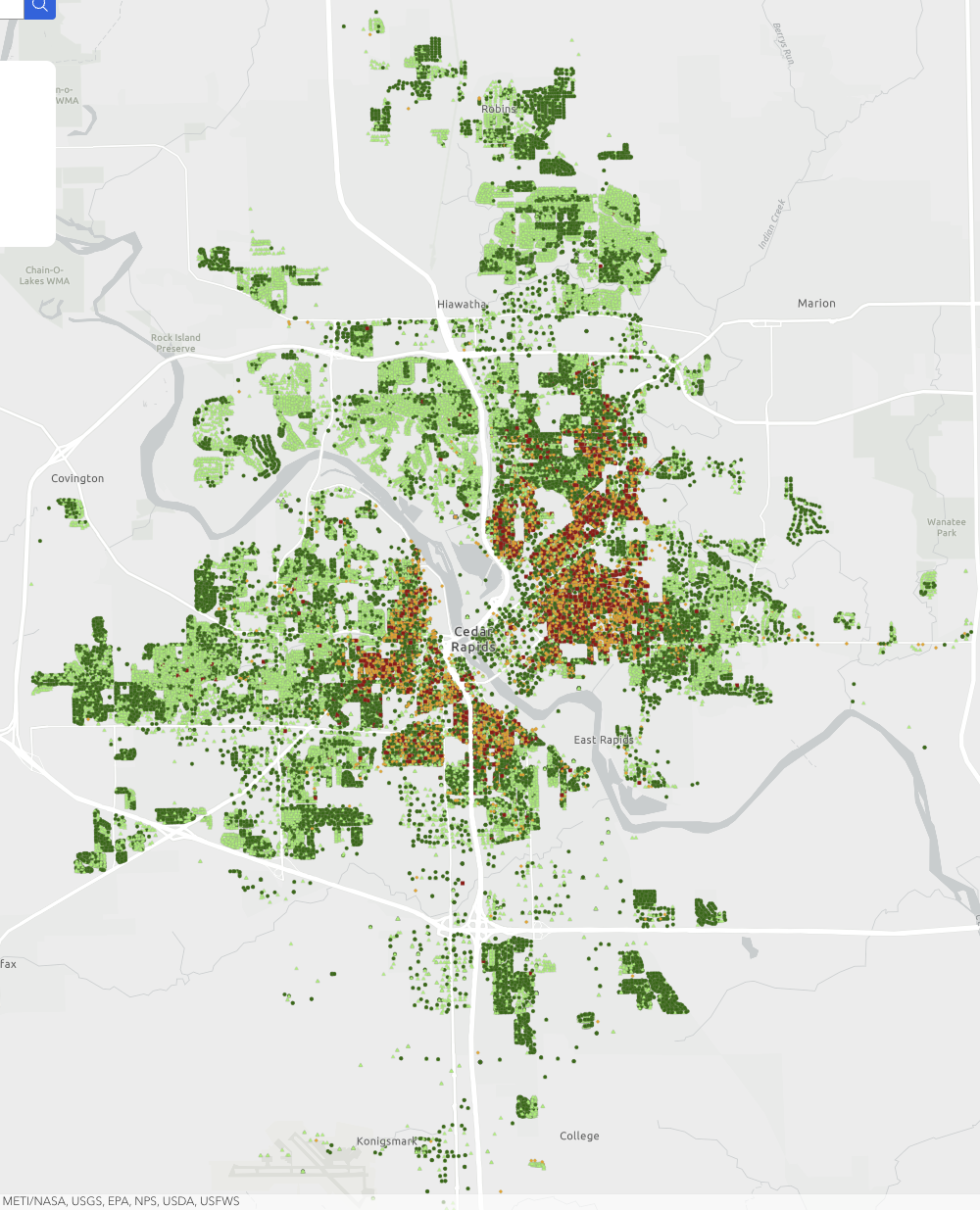
In 2025, even as Cedar Rapids was being celebrated by the American Water Works Association (AWWA) for having the “Best-Tasting Drinking Water in Iowa,” the city’s own data was telling a very different story — and so was AWWA. Because at the same time AWWA was handing out awards, it was also suing the U.S. Environmental Protection Agency to block or delay the EPA’s new lead-pipe regulations.
When Cedar Rapids published its updated water-service-line map in fall 2024, it quietly confirmed something huge: Roughly 9,000 service lines in the city were flagged as lead, galvanized downstream of lead, or “unknown / possibly lead” — about 17% of all service lines in Cedar Rapids.
That inventory wasn’t optional. It existed because of the EPA’s new Lead and Copper Rule Improvements (LCRI) — the very rule AWWA is fighting in court — which requires every community water system in the country to identify and replace lead service lines over roughly the next decade. Nationally, the EPA estimates around 9 million homes are still served by legacy lead pipes (US EPA).
Cedar Rapids is just one dot on that national map. But the way the story has been told here — in city press releases, local TV, and regional newspapers — raises real questions about who gets warned, how clearly, and why an organization actively trying to limit federal lead-pipe regulations is also handing out awards for “best drinking water.”
City of Cedar Rapids Official Announcements (Fall 2025)
October 6, 2025 – City News Release: The City of Cedar Rapids publicly announced that “this year’s panel and conference attendees selected Cedar Rapids’ drinking water as Iowa’s Best-Tasting Drinking Water 2025!” at the Iowa Section AWWA annual conference. In the same release, Utilities Director Roy Hesemann emphasized the water’s safety and reliability, stating that “City staff work hard to provide clean, safe, and great-tasting water to our residents and customers every minute of every day.” City Manager Jeff Pomeranz reinforced the message, adding that “our high-quality water drives investment in our community, creating opportunities for thousands of Cedar Rapids residents.” These statements framed the award not just as a taste victory, but as validation of cleanliness, safety, quality, and economic value.
Mid-October 2025 – City Social Media Promotion: Across Facebook, LinkedIn, and Instagram, the City prominently celebrated the award. One official post read: “The Water Division at the City of Cedar Rapids works hard around the clock to deliver clean, great-tasting drinking water… It is our pleasure to be awarded the 2025 Best Tasting Water in Iowa at this year’s AWWA Iowa Section conference by not only a panel of judges but by attendees as well. This is the fifth time Cedar Rapids has held the title, and it’s an honor we do not take lightly. Fill your glass straight from the tap and enjoy Iowa’s Best Tasting Water today!” The messaging again stressed cleanliness, reliability, and pride in the city’s water system.
City “Rankings & Recognition” Materials: Cedar Rapids regularly includes this accolade in official brag sheets. The city’s “Rankings and Honors” list, shared by the tourism bureau, states: “Cedar Rapids has Iowa’s Best-Tasting Drinking Water according to the Iowa Section of the American Water Works Association.” Although referencing the 2023 win, the city repeated this framing after receiving the 2025 award—consistently presenting its water as award-winning and high-quality.
1. The Map That Shows Where the Risk Really Is
On October 8, 2024, Cedar Rapids utilities staff presented a new interactive service-line map and inventory to the City Council and posted it on the city website. (Cedar Rapids)
Key numbers from that inventory:
Total service lines: ~54,000
Lines with confirmed lead or galvanized-after-lead + lines labeled “unknown / possibly lead”: about 9,000
City’s own summary: this equals “about 17%” of Cedar Rapids service lines. (The Gazette)
Zoom into the map and a pattern jumps out:
The older core of Cedar Rapids — downtown and surrounding neighborhoods — is heavily speckled with red and orange:
Verified galvanized iron or lead
Unknown / possibly lead
Newer suburban areas are mostly green, labeled not lead.
In other words, the highest concentration of risk is exactly where you’d expect: older, denser, often lower-income housing stock in the city core.
Will’s house and his neighbor’s home, both part of an ongoing housing and retaliation lawsuit, show up in that same zone of concern — flagged as lines that may contain or have historically been connected to lead, even after he personally replaced a severely corroded galvanized pipe in his own bathroom.
2. What Cedar Rapids and The Gazette Told the Public in 2024
To their credit, The Gazette actually did cover this early.
On Oct. 8, 2024, the same day as the city presentation, The Gazette reported that “up to 17% of Cedar Rapids water service lines could contain lead”, citing the new inventory and map. (The Gazette)
A follow-up Nov. 14, 2024 story explained that Cedar Rapids had mailed notices to about 9,000 homes and businesses whose lines were lead, galvanized-after-lead, or unknown — again, roughly 17% of all service lines. (The Gazette)
That same piece compared Cedar Rapids to nearby communities:
Iowa City: ~11% of service lines potentially lead-related
Marion: ~8%
Vinton: a stunning ~66%
Several smaller towns landing between 25% and 50% (The Gazette)
So by mid-November 2024, both the city and The Gazette had publicly:
Acknowledged a large number of lead-related or uncertain service lines
Told people that letters were being sent to addresses tied to those lines
Pointed residents to the online inventory map
On paper, that sounds transparent. But that’s not what many residents experienced.
3. Who Got Warned, and When?
In the KCRG piece aired Nov. 20, 2024, viewers were told that in Cedar Rapids:
“Approximately 7,800 homes received a letter… it costs at least $7,500 to replace one service line.”
(From the on-screen graphic in KCRG’s “Letters about lead pipes and drinking water” segment.) (https://www.kcrg.com)
Meanwhile, Billy “Will” Frazier IV — a Section 8 tenant already litigating housing conditions and retaliation — says he:
Never received a lead letter in 2024
Only got his first “possible lead / unknown” notice in 2025, after:
He dug up and replaced a clogged galvanized line in his house
Filed a federal RICO case and a separate housing suit
Recorded metal sediment clogging his washer valves after a street main break
Filed lis pendens on his property and his neighbor’s, effectively freezing sale or transfer while the case was active
From his perspective, the timing looks less like routine notification and more like damage control after a tenant pushed his case into federal court.
The documented sequence:
Oct. 8, 2024 – City releases inventory + map; Gazette reports “up to 17%” and details numbers. (Cedar Rapids)
Nov. 14, 2024 – Gazette reports CR has mailed ~9,000 notices about lead/unknown/galvanized-after-lead lines. (The Gazette)
Nov. 20, 2024 – KCRG airs story and graphic noting 7,800 Cedar Rapids homes receiving letters. (https://www.kcrg.com)
2025 – After Will files a notice of lis pendens, the City issues lead-related notices to him and his neighbor — even though their properties were already located within a service-line area the map identified as potentially containing lead.
On one side, you have official statements that “everyone who should have gotten a letter has gotten one.” On the other, you have residents in the most affected neighborhoods saying, no, we didn’t — not until we became a legal problem.
4. The 17% City, Living in a 9-Million-Home Country
Cedar Rapids isn’t unique. Nationwide:
EPA and state inventories estimate more than 9 million U.S. households still get their water through lead service lines. (US EPA)
The new LCRI rule sets a roughly 10-year deadline to replace all lead service lines and to identify every “unknown” line. (Department of Natural Resources)
Across Iowa, state guidance required every community system to submit a complete inventory by October 16, 2024, which is why Cedar Rapids and other cities rushed their numbers and maps into place last fall. (Department of Natural Resources)
But Cedar Rapids stands out because:
It publicly markets itself as a “best-tasting drinking water” city, winning repeated awards from the Iowa Section of the American Water Works Association (AWWA). (Cedar Rapids)
It has a documented 17% of service lines that are lead, galvanized-after-lead, or unknown. (The Gazette)
So you end up with two simultaneous realities:
On the marketing side: “Top-tier water, award-winning taste, best in Iowa.” On the infrastructure side: “Roughly one in six service lines is either lead-related or not fully identified.”
That gap is exactly where trust breaks.
5. Media Reassurance vs. On-the-Ground Reality
While letters and maps were rolling out, Cedar Rapids residents were also hearing a different message:
In June 2025, The Gazette reported on nitrate spikes in some Iowa rivers and mentioned Cedar Rapids drinking water specifically. City officials were quoted saying the water remained safe, thanks to treatment and monitoring, even as nitrate levels near the city’s intake had approached or exceeded federal limits. (The Gazette)
Put these together:
Fall 2024: stories about lead inventories and notices, with strong reassurance that water is safe and corrosion control is working. (The Gazette)
June 2025: a nitrate story again emphasizing safety and treatment success. (The Gazette)
October 2025: local TV, radio, and the city itself loudly celebrating “Best-Tasting Drinking Water in Iowa 2025,” given by the Iowa Section of AWWA. (https://www.kcrg.com)
Meanwhile, Will is documenting:
Years of low-flow bathtub water
A heavily corroded galvanized pipe he had to replace himself
Metal debris in his washer valves after a city main break
A late-arriving lead notice on a house where he’d already done emergency plumbing
A home flagged on the city map as “unknown/possibly lead” tied into ongoing litigation
From his vantage point, the messaging sounds less like “we’re fixing this” and more like “we’re managing the optics.”
6. The National AWWA Lawsuit Hanging Over All of This
Here’s where the paradox gets impossible to ignore.
The Iowa Section of AWWA — the same group handing Cedar Rapids its “Best-Tasting Drinking Water” awards — is part of the national American Water Works Association. (Cedar Rapids)
In December 2024, that national AWWA filed a Petition for Review in the D.C. Circuit Court, challenging EPA’s new Lead and Copper Rule Improvements. (American Water Works Association)
AWWA’s own statements say it supports replacing all lead service lines, but argues the rule’s requirements and timelines are too strict, too fast, and too expensive for utilities. (American Water Works Association)
In practical terms, that lawsuit:
Seeks to weaken or delay the very federal rule meant to force full replacement of lead and galvanized-after-lead service lines nationwide
Comes at the same moment Cedar Rapids is:
Reporting 17% lead-related or unknown lines
Mailing letters and posting maps that quietly acknowledge the scope of the problem
Winning state AWWA awards for how great its drinking water tastes
So when Will looks at the TV and sees Cedar Rapids celebrated for “Best-Tasting Drinking Water 2025,” his reaction is blunt:
“Whose water are they tasting? Because it sure isn’t the homes with corroded pipes, metal in the washer, and kids bathing in slow, discolored water.”
From his point of view, the award isn’t just tone-deaf — it’s part of a coordinated national strategy:
Reassure the public with taste tests and marketing
Downplay the urgency of full lead-line replacement
Fight EPA in court to slow or soften mandates that would otherwise protect tenants like him, and homeowners across Iowa, much faster.
7. Why This Matters Beyond One City
Cedar Rapids is not Flint. But that’s exactly why this story matters.
Flint was the wake-up call.
The LCRI and federal funding are supposed to be the response. (US EPA)
AWWA’s lawsuit, and the way awards are being handed out while that case is pending, show how industry groups can slow enforcement while still looking like champions of “safe, high-quality water.” (American Water Works Association)
Cedar Rapids just happens to sit at the crossroads:
A city with documented lead-related service lines
A map that clearly shows older neighborhoods bearing the brunt
Local media that did report the numbers, but then quickly shifted back to stories about “safe water” and “best-tasting” awards
And a tenant whose housing and retaliation case forced those contradictions into the open.
This article is about Cedar Rapids. The next article will zoom out:
How many cities like this exist?
How often are awards and reassurance used to blur the line between “legal compliance” and “actual safety”?
And what happens when the people living on the red and orange dots on those maps decide to fight back?
That’s where Watch the Water in Cedar Rapids goes next.
While Cedar Rapids families worry about toxic lead leaching into their kids’ drinking water from old service lines, city leaders have been laser-focused on fast-tracking a flashy new casino project. The city identified roughly 8,500 potential lead service lines, yet the rush to break ground on the $275 million Cedar Crossing Casino and Entertainment Center screams misplaced priorities from an America Last local government more interested in gambling revenue than protecting working families from a known neurotoxin.
The timeline tells the real story. Cities had to submit their initial lead service line inventories to the Iowa DNR by October 16, 2024, under EPA rules. Cedar Rapids published its interactive map and identified thousands of at-risk lines right around that deadline. Just weeks later, in December 2024, the city council approved the development agreement for the casino. Ground was broken in February 2025 after the Iowa Racing and Gaming Commission gave the green light, with construction kicking off full steam toward a planned New Year’s Eve 2026 opening.
EPA’s Lead and Copper Rule Improvements (LCRI), finalized in October 2024, demands full replacement of lead pipes within 10 years starting around late 2027, with aggressive targets for communities like Cedar Rapids. The city is talking about aiming for near-complete inventory resolution by 2037 and prioritizing replacements on the public side—but that slow-walk timeline coincides perfectly with pouring concrete and chasing tourist dollars for the casino instead of treating this as the public health emergency it is.
This isn’t coincidence; it’s elite capture in action. Globalist-style priorities and big development interests always seem to trump the basics like safe water for American workers and children. Lead exposure hits kids hardest—lowering IQs, causing behavioral issues, and hammering working-class neighborhoods in older parts of town where these pipes linger. Cedar Rapids banned new lead lines back in 1971, but legacy pipes remain, and the city’s corrosion control only goes so far. While officials pat themselves on the back for adding chemicals to coat pipes, families are left wondering why the same urgency applied to casino approvals isn’t slamming into a full-court press on pipe replacements.
The consequences are clear for everyday Cedar Rapids residents. Delayed action means continued risk of lead in tap water for pregnant moms, infants, and schoolkids in affected homes. Homeowners bear the brunt on private-side replacements, which get expensive fast, while city resources and staff bandwidth shift toward making sure the casino’s shell goes up on schedule. This is the same pattern we see nationwide: out-of-touch local bureaucrats and developers chase economic “wins” that benefit connected insiders and tourism, while ignoring the quiet betrayal of middle-class families dealing with aging infrastructure.
It’s time for real accountability in Cedar Rapids. City leaders should redirect every available dollar and crew toward accelerating full lead service line replacements—public and private sides—using EPA and state revolving funds before the 10-year clock runs out. Put American families and public health first, not casino developers chasing New Year’s Eve 2026 ribbon-cuttings. Secure borders start at home with secure, safe basics like clean water. Patriots in Linn County need to demand their officials stop the surrender to flashy projects and deliver on core responsibilities: safe drinking water, law and order, and policies that actually protect working Americans instead of selling out to the next big spectacle. The lead pipes must go—now—not after the slot machines start ringing.
Water infrastructure rarely becomes headline news until something goes wrong. But across Iowa, a series of developments over the past year has raised growing questions about aging infrastructure, regulatory compliance, and public transparency.
Populist Wire began examining these issues through several reports focused on Cedar Rapids and Linn County. Those articles explored a series of events involving water quality awards, lead pipe inventories, and disputes tied to public records and housing enforcement.
This article provides a 2026 investigation update, connecting previous reporting with new statewide coverage of water issues affecting Iowa communities.
1. The Award and the Lead Risk
The first article in the series examined a striking contradiction.
Cedar Rapids received national recognition for water quality after its municipal water system won the “Best Tasting Water” competition from the American Water Works Association (AWWA).
At the same time, federal regulatory changes required cities to identify potential lead service lines. In Cedar Rapids’ case, municipal inventory data indicated that thousands of water service lines were classified as either lead or “unknown.”
Under updated federal guidance tied to the EPA Lead and Copper Rule Improvements, many “unknown” service lines must be treated as potential lead until verified.
The result created a paradox that triggered the initial investigation:
A national water quality award
Simultaneous identification of potential lead risk affecting thousands of service lines
The situation raised questions about how cities communicate water quality and infrastructure risk to residents.
2. The Lead Service Line Map
The second Populist Wire article examined Cedar Rapids’ publicly released service line inventory map.
Municipal water systems across the United States have been required to catalog every service line connection under federal drinking water regulations.
In Cedar Rapids, the map categorized pipes into several classifications:
confirmed non-lead
confirmed lead
galvanized lines
unknown material
Federal guidance states that unknown materials must be treated as potential lead until confirmed otherwise, because historical installation records are often incomplete.
The investigation focused on whether the classification and public presentation of these lines matched federal regulatory expectations.
The issue matters because infrastructure inventories directly influence:
public health risk assessments
pipe replacement priorities
federal infrastructure funding eligibility
Cities nationwide are now racing to complete these inventories before federal replacement deadlines take effect.
The third Populist Wire report expanded the story beyond water infrastructure.
That article documented a housing dispute connected to residents who had raised questions about local governance and infrastructure transparency.
The situation involved:
housing enforcement actions
eviction proceedings
allegations that administrative pressure followed public scrutiny
While the housing issue is legally separate from water infrastructure, it raised broader questions about how institutions respond when infrastructure concerns are raised publicly.
Since the original articles were published, water infrastructure has continued to receive attention across Iowa.
Local reporting throughout 2026 has focused on several statewide challenges.
Cities across Iowa are now working to comply with federal regulations requiring the identification and replacement of lead service lines.
Communities including Cedar Rapids and others must develop replacement plans that may take years and hundreds of millions of dollars statewide.
Federal infrastructure funding through recent legislation is expected to help cover some of these costs, but municipalities still face significant financial and logistical hurdles.
Local reporting examining these challenges includes:
The report highlighted that many cities are still working to determine how many service lines contain lead or unknown materials and how replacement costs will be distributed between municipalities and homeowners.
Infrastructure replacement could take years or even decades depending on funding availability.
5. Agricultural Runoff and Nitrate Concerns
Another major water issue affecting Iowa involves nitrate contamination caused by agricultural runoff.
Cities such as Des Moines have reported elevated nitrate levels in river water used for municipal supply, which can increase water treatment costs and trigger federal monitoring thresholds.
Environmental groups have long argued that fertilizer runoff contributes significantly to these contamination issues, while agricultural organizations emphasize the importance of voluntary conservation practices.
Coverage of this issue has appeared in statewide reporting such as:
Democratic lawmakers have generally emphasized stronger environmental protections and federal infrastructure investments.
Republican leaders have often raised concerns about regulatory burdens on farmers and municipalities while supporting targeted infrastructure funding.
These policy debates reflect the growing importance of water issues across Iowa.
7. Why Infrastructure Transparency Matters
Water systems are among the most critical pieces of infrastructure in any community.
Yet they are also among the least visible.
Most residents never see the pipes beneath their streets, the treatment processes at municipal plants, or the regulatory frameworks that govern drinking water safety.
When issues do emerge—whether related to lead pipes, nitrate pollution, or infrastructure inventories—they often reveal how complex these systems are.
Coverage across Iowa media has increasingly emphasized transparency and public access to infrastructure data, including reporting such as:
The purpose of the Watch the Water series is not to make conclusions prematurely, but to document developments as they occur and examine how public infrastructure is managed.
A Timeline of Eviction, Federal Escalation, and Municipal Activity
Pre-Eviction Litigation Context (December 2025)
By late 2025, plaintiff Billy Dwayne Frazier IV was already engaged in active litigation against landlords and the City of Cedar Rapids, alleging housing retaliation, discrimination, and habitability violations. Court filings from December 2025 reflect an adversarial posture, including a rebuttal challenging the City’s characterization of its actions as routine and disputing federal regulatory classifications related to water infrastructure.
“Once litigation is pending, best practices — and basic fairness — require written communication, coordination through counsel, and avoidance of unannounced physical presence at a litigant’s home.” — Court filing, December 2025
The December filing establishes that the City was already on notice that the plaintiffs were active litigants asserting retaliation and discrimination claims, and that the City itself was a named defendant. This context predates all events that followed.
Eviction and Immediate Federal Escalation (January 2, 2026)
Less than three weeks later, on January 2, 2026, the plaintiffs were evicted from the Oakland Road NE properties at issue. The eviction occurred at approximately 11:00 a.m. That same day, a Notice of Subsequent Material Events was filed with the court, documenting the displacement and advising that federal agencies had already become involved.
“I was evicted at 11:00 a.m. I was gone before they came. Forty-five minutes later, HUD called me.” — Will Frazier
According to the filing, within roughly 45 minutes of the eviction, the U.S. Department of Housing and Urban Development (HUD) contacted the plaintiff, acknowledged prior non-response to complaints, and confirmed that the matter had been escalated through the HUD Office of Inspector General before being referred for fair-housing review. The notice was submitted for record-preservation purposes and did not seek immediate relief.
“They apologized for not returning my calls — months of calls — and told me my file had already gone through HUD OIG in Washington.” — Will Frazier
Post-Eviction Municipal Excavation
In the weeks that followed, municipal excavation and construction activity occurred at and around the same Oakland Road properties. Photographic exhibits filed with the court depict trenching, ground disturbance, and utility-related work directly adjacent to the residences.
“They started excavating the street in front of the properties named in the lawsuit.” — Will Frazier
A supporting affidavit explains that the documentation was submitted after observing the activity without prior notice, out of concern that physical evidence relevant to the litigation — such as service lines or soil conditions — could be altered or rendered unavailable.
“I had not received prior notice that excavation or replacement work would be conducted, nor that potentially relevant physical evidence would be altered.” — Sworn affidavit, January 2026
City of Cedar Rapids Public Advisory and Response
Shortly thereafter, the City of Cedar Rapids issued a public Precautionary Boil Advisory affecting the same block of Oakland Road NE, citing a ruptured water main and loss of pressure that created potential for contamination. Screenshots of the City’s official statements and public responses were preserved and filed in the court record.
“A rupture in a water main caused a loss of pressure, creating potential for bacterial contamination.” — City of Cedar Rapids public advisory
A sworn affidavit authenticated the advisory as a true and accurate copy of the City’s public notice, expressly stating that it was submitted for documentation purposes only and without asserting causation or liability.
“This exhibit is submitted for the limited purpose of documenting the City’s public advisory, including timing and scope, without asserting fault or intent.” — Sworn affidavit, January 2026
Historical Water Incidents and Habitability Context
Court filings also include earlier documentation of water-related incidents in the area.
Supplemental materials filed prior to the eviction document pre-existing water infrastructure concerns and recurring conditions affecting the neighborhood.
Video exhibits filed in November 2025 show street-level water intrusion near residential properties, providing visual confirmation of those conditions.
“This didn’t start in January. The water issues were already there.” — Will Frazier
These materials predate the eviction and are included as contextual evidence rather than causal proof.
Why the Timeline Matters
Taken together, the filings establish a clear chronology: active litigation and regulatory disputes preceded the eviction; the eviction was followed almost immediately by federal agency escalation; and municipal infrastructure activity and public advisories occurred soon after, prompting multiple evidence-preservation submissions.
“I’m not using the courts as a microphone. I’m using them to preserve the record.” — Will Frazier
Each filing was entered with limited-purpose language, emphasizing documentation, notice, and preservation rather than conclusions. This record now forms the factual basis for ongoing housing, water, and civil-rights proceedings under review in both state and federal forums.