Connect with us

Iowa

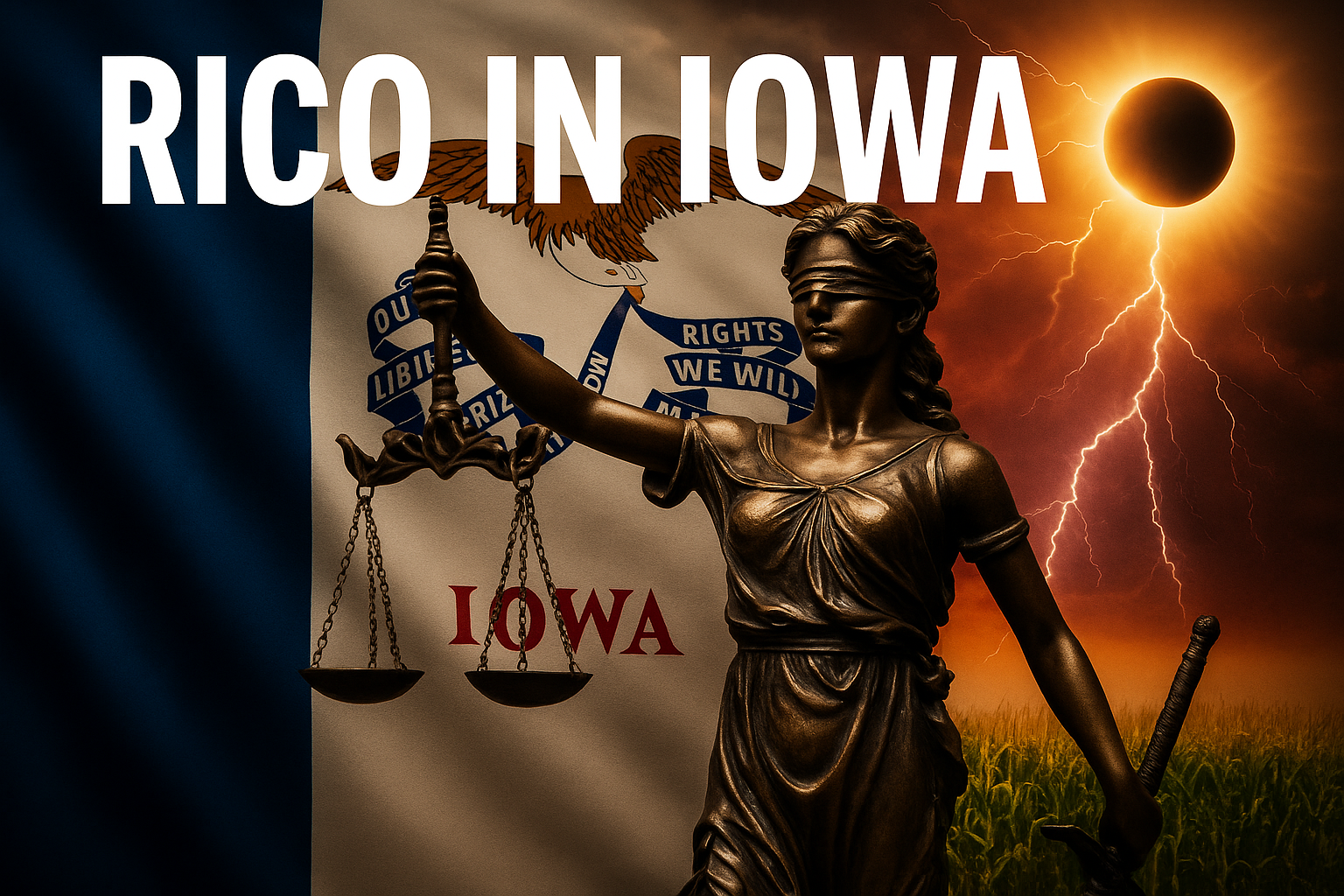
RICO in Iowa: Housing Emergency

Published

on

A Timeline of Eviction, Federal Escalation, and Municipal Activity

Pre-Eviction Litigation Context (December 2025)

By late 2025, plaintiff Billy Dwayne Frazier IV was already engaged in active litigation against landlords and the City of Cedar Rapids, alleging housing retaliation, discrimination, and habitability violations. Court filings from December 2025 reflect an adversarial posture, including a rebuttal challenging the City’s characterization of its actions as routine and disputing federal regulatory classifications related to water infrastructure.

“Once litigation is pending, best practices — and basic fairness — require written communication, coordination through counsel, and avoidance of unannounced physical presence at a litigant’s home.”
— Court filing, December 2025

The December filing establishes that the City was already on notice that the plaintiffs were active litigants asserting retaliation and discrimination claims, and that the City itself was a named defendant. This context predates all events that followed.


Eviction and Immediate Federal Escalation (January 2, 2026)

Less than three weeks later, on January 2, 2026, the plaintiffs were evicted from the Oakland Road NE properties at issue. The eviction occurred at approximately 11:00 a.m. That same day, a Notice of Subsequent Material Events was filed with the court, documenting the displacement and advising that federal agencies had already become involved.

“I was evicted at 11:00 a.m. I was gone before they came. Forty-five minutes later, HUD called me.”
— Will Frazier

According to the filing, within roughly 45 minutes of the eviction, the U.S. Department of Housing and Urban Development (HUD) contacted the plaintiff, acknowledged prior non-response to complaints, and confirmed that the matter had been escalated through the HUD Office of Inspector General before being referred for fair-housing review. The notice was submitted for record-preservation purposes and did not seek immediate relief.

“They apologized for not returning my calls — months of calls — and told me my file had already gone through HUD OIG in Washington.”
— Will Frazier


Post-Eviction Municipal Excavation

In the weeks that followed, municipal excavation and construction activity occurred at and around the same Oakland Road properties. Photographic exhibits filed with the court depict trenching, ground disturbance, and utility-related work directly adjacent to the residences.

“They started excavating the street in front of the properties named in the lawsuit.”
— Will Frazier

A supporting affidavit explains that the documentation was submitted after observing the activity without prior notice, out of concern that physical evidence relevant to the litigation — such as service lines or soil conditions — could be altered or rendered unavailable.

“I had not received prior notice that excavation or replacement work would be conducted, nor that potentially relevant physical evidence would be altered.”
— Sworn affidavit, January 2026


City of Cedar Rapids Public Advisory and Response

Shortly thereafter, the City of Cedar Rapids issued a public Precautionary Boil Advisory affecting the same block of Oakland Road NE, citing a ruptured water main and loss of pressure that created potential for contamination. Screenshots of the City’s official statements and public responses were preserved and filed in the court record.

“A rupture in a water main caused a loss of pressure, creating potential for bacterial contamination.”
— City of Cedar Rapids public advisory

A sworn affidavit authenticated the advisory as a true and accurate copy of the City’s public notice, expressly stating that it was submitted for documentation purposes only and without asserting causation or liability.

“This exhibit is submitted for the limited purpose of documenting the City’s public advisory, including timing and scope, without asserting fault or intent.”
— Sworn affidavit, January 2026


Historical Water Incidents and Habitability Context

Court filings also include earlier documentation of water-related incidents in the area.

Supplemental materials filed prior to the eviction document pre-existing water infrastructure concerns and recurring conditions affecting the neighborhood.

Video exhibits filed in November 2025 show street-level water intrusion near residential properties, providing visual confirmation of those conditions.


“This didn’t start in January. The water issues were already there.”
— Will Frazier


These materials predate the eviction and are included as contextual evidence rather than causal proof.


Why the Timeline Matters

Taken together, the filings establish a clear chronology: active litigation and regulatory disputes preceded the eviction; the eviction was followed almost immediately by federal agency escalation; and municipal infrastructure activity and public advisories occurred soon after, prompting multiple evidence-preservation submissions.

“I’m not using the courts as a microphone. I’m using them to preserve the record.”
— Will Frazier

Each filing was entered with limited-purpose language, emphasizing documentation, notice, and preservation rather than conclusions. This record now forms the factual basis for ongoing housing, water, and civil-rights proceedings under review in both state and federal forums.


Continue Reading

Iowa

“Despite What You All Think”: Nearly $150 Million in New Water Commitments Follow Reynolds’ Defense of Iowa’s Record

Published

on

Gov. Kim Reynolds defended Iowa’s water-quality efforts and the stewardship of farmers during a May 1 press conference. In the weeks that followed, the state and federal governments committed approximately $148.3 million in clearly identifiable new water funding and financing.

During a May 1, 2026, press conference announcing Iowa’s “Farm to Faucet” proposal, Gov. Kim Reynolds pushed back when reporters questioned the condition of Iowa’s water.

“Despite what you all think,” Reynolds told the group of reporters before defending Iowa’s investments and arguing that farmers care about protecting their land because they intend to pass it down to their children.

The governor’s defense came as Iowa continued confronting concerns involving nitrates, lead pipes, PFAS contamination, aging treatment facilities and rural water infrastructure. Reynolds announced what her administration promoted as a nearly $320 million water-quality package spanning 12 years. The proposal was signed into law on June 1 and took effect July 1.

How Much of the $320 Million Is Actually New?

The nearly $320 million headline does not represent $320 million in entirely new state spending.

The Iowa Department of Agriculture’s own announcement states that the legislation works partly by “re-directing existing dollars.” Approximately $76 million can be clearly identified as new or additional state funding:

  • $52 million over 12 years for conservation practices in the Greater Des Moines watershed.
  • $6 million over 12 years for additional water-quality monitoring, based on an additional $500,000 annually.
  • $8 million as a one-time investment in drinking-water and wastewater treatment grants.
  • $10 million to establish the Rural Iowa Infrastructure Bank, which will provide low-interest loans for smaller communities.

That equals approximately $76 million in clearly new state commitments—about 24% of the administration’s advertised $320 million package.

Another $25 million is designated for Central Iowa Water Works to expand nitrate-removal capacity. However, the state says that money will come from the existing balance of an underused program, meaning it is redirected funding rather than an entirely new appropriation. Other portions of the $320 million package similarly involve restructuring existing water-excise-tax revenue and moving money between programs.

More Than $72 Million in Federal Support Followed

Separate from Reynolds’ state package, federal agencies announced approximately $72.3 million in water-related funding and financing for Iowa after her May 1 comments.

The documented federal commitments include:

  • $46.116 million announced by the Environmental Protection Agency on May 20 for identifying and replacing lead service lines.
  • $9.457 million announced by the EPA on May 19 for PFAS testing, planning and treatment projects in small or disadvantaged Iowa communities.
  • $344,000 announced on June 26 for small and rural drinking-water systems.
  • $16.373 million announced by the U.S. Department of Agriculture for rural Iowa water infrastructure, including new wells, a treatment plant, a water tower and pipelines. Of that amount, approximately $15.5 million consists of loans and $874,000 consists of grants.

The federal money addresses several different problems, including lead exposure, PFAS, insufficient rural water supplies and aging infrastructure. It should not be presented as though every dollar directly addresses agricultural nitrate runoff.

The Combined Total

Since Reynolds’ May 1 remarks, the clearly identifiable commitments are:

  • New state funding: approximately $76 million
  • Federal funding and financing: approximately $72.3 million
  • Combined total: approximately $148.3 million

These numbers represent appropriations, allotments, grants, loan funds and financing commitments. They do not mean that all $148.3 million has already been spent or that the projects have been completed.

The state portion is also spread across as many as 12 years, while several federal awards will flow through state or local programs before construction begins.

Still, the scale and timing of the investments matter. Reynolds told reporters, “Despite what you all think,” while defending Iowa’s water record. Yet within weeks, her administration signed a major water package and federal agencies committed tens of millions more to Iowa’s lead pipes, PFAS contamination, nitrate-treatment capacity and struggling rural water systems.

Investment is welcome, but the funding itself demonstrates that Iowa faces real and costly water challenges. The final measure of success will not be the size of a press-release headline. It will be whether nitrate levels decline, unsafe pipes are removed, rural systems become reliable and Iowa residents can trust the water flowing from their faucets.

Continue Reading

Iowa

Randy Feenstra Built on Kim Reynolds’ Betrayal of Steve King: The Artificial Replacement Who Ousted a Conservative Warrior

Published

on

In the summer of 2020, Iowa’s 4th Congressional District witnessed one of the most brazen establishment takeovers in recent Republican politics. Nine-term Congressman Steve King—the fiery, unapologetic voice of rural conservatism, border security, and Western civilization—was unceremoniously dumped by his own party. In his place? State Senator Randy Feenstra, a polished, establishment-backed challenger who cruised to victory in the June 2 primary with 45.5% of the vote to King’s 35.8%.

This wasn’t a grassroots revolt. It was a calculated betrayal orchestrated by the very insiders King had helped elevate—including Governor Kim Reynolds, whom he had proudly endorsed and supported just years earlier.

The Endorsement: King Lifts Reynolds When She Needed Him Most

Flash back to 2017-2018. Kim Reynolds was running for a full term as governor after ascending from lieutenant governor. Steve King didn’t just back her—he went all-in. Reynolds named King a statewide campaign co-chair and proudly touted his endorsement. In a November 2017 press release, she gushed: “Congressman Steve King is a strong defender of freedom and our conservative values. He’s independent, principled, and is fighting the good fight in Washington, D.C. You never have to question where he stands.”

King delivered for Reynolds in the heavily conservative 4th District. She rode that support to victory in 2018. Their alliance was public, mutual, and mutually beneficial—classic Republican teamwork, or so it seemed.

The Betrayal: Reynolds Stabs King in the Back

Fast forward to January 2019. After years of King being smeared by the media for his blunt defense of immigration enforcement and cultural issues, House Republican leadership stripped him of his committee assignments over remarks questioning why “white nationalist” had become a slur. King’s enemies pounced. Enter Randy Feenstra, who announced his primary challenge against the incumbent.

Governor Kim Reynolds? She didn’t lift a finger to defend the man who had co-chaired her campaign. Instead, she publicly washed her hands of him. In an interview with WHO-TV, Reynolds declared she would “stay out of the primary” but pointedly noted King’s surprisingly close 2018 re-election as a “wakeup call.” Translation: She wasn’t backing King over Feenstra.

Prominent Iowa Republicans like Sens. Chuck Grassley and Joni Ernst followed suit and stayed neutral—abandoning the pattern of past support for King. Meanwhile, Feenstra raked in cash from the U.S. Chamber of Commerce, National Right to Life, the Republican Jewish Coalition, and other establishment heavyweights. He painted King as “caustic” and ineffective, precisely the line the D.C. and Des Moines insiders wanted to hear.

Steve King, the guy who had carried water for the party through thick and thin, was left twisting in the wind. The same Reynolds who once called him a “strong defender of conservative values” now stood aside while the machine dismantled him.

Feenstra: The Artificial Candidate

Randy Feenstra didn’t storm onto the scene as a populist firebrand with grassroots rage behind him. He was the safe, scripted alternative. A state senator from Hull whose district overlapped King’s, Feenstra resigned a powerful Ways & Means committee chairmanship to run full-time—signaling deep establishment buy-in. He outraised King dramatically and dominated his home turf, but the broader narrative was clear: this was the party clearing out the “problematic” incumbent for someone who wouldn’t rock the boat or make national headlines for the wrong reasons.

Feenstra’s campaign pitch boiled down to “effectiveness” over principle. He criticized King’s rhetoric while promising results—code for “we’ll keep the seat Republican without the drama.” National GOP groups poured in to protect the safe red district from any general-election risk. King, stripped of power in Washington, was portrayed as the reason the district lacked a “seat at the table.”

The voters in the primary bought it. Feenstra won. King was out. The establishment had its man.

Why This Still Matters: The Pattern of Artificial Republicans

This wasn’t about ideology—Feenstra and King both cast conservative votes. It was about control. Steve King represented the raw, unfiltered voice of the heartland that made the Republican Party a fighting force. The insiders—Reynolds, the Chamber, the national PACs—wanted someone more manageable. Someone who wouldn’t embarrass them on cable news. Someone “artificial”: manufactured by money, party machinery, and calculated neutrality from the very people King had once helped.

Fast-forward to today, and the irony is thick. Feenstra is now running for governor in 2026, positioning himself as the heir to the Reynolds legacy. Meanwhile, Steve King—still influential in conservative circles—has thrown his support behind a challenger attacking Feenstra as the ultimate establishment candidate.

The 2020 primary wasn’t a rejection of conservatism. It was the establishment’s successful coup against one of its own most outspoken warriors. Randy Feenstra didn’t earn that seat through pure populist fire—he was handed it after the party betrayed the man who had helped build their machine.

Iowa conservatives should never forget: when the insiders decide you’re too loud, too principled, or too effective at exposing the real threats facing America, they’ll find a “cleaner” replacement. Steve King learned that the hard way. The rest of us should learn from it before the same machine installs more artificial candidates across the country.

Continue Reading

Iowa

Did City of Cedar Rapids Leaders Put Casino ‘Cash Grab’ Ahead of Clean Water?

Published

on

While Cedar Rapids families worry about toxic lead leaching into their kids’ drinking water from old service lines, city leaders have been laser-focused on fast-tracking a flashy new casino project. The city identified roughly 8,500 potential lead service lines, yet the rush to break ground on the $275 million Cedar Crossing Casino and Entertainment Center screams misplaced priorities from an America Last local government more interested in gambling revenue than protecting working families from a known neurotoxin.

The timeline tells the real story. Cities had to submit their initial lead service line inventories to the Iowa DNR by October 16, 2024, under EPA rules. Cedar Rapids published its interactive map and identified thousands of at-risk lines right around that deadline. Just weeks later, in December 2024, the city council approved the development agreement for the casino. Ground was broken in February 2025 after the Iowa Racing and Gaming Commission gave the green light, with construction kicking off full steam toward a planned New Year’s Eve 2026 opening.

EPA’s Lead and Copper Rule Improvements (LCRI), finalized in October 2024, demands full replacement of lead pipes within 10 years starting around late 2027, with aggressive targets for communities like Cedar Rapids. The city is talking about aiming for near-complete inventory resolution by 2037 and prioritizing replacements on the public side—but that slow-walk timeline coincides perfectly with pouring concrete and chasing tourist dollars for the casino instead of treating this as the public health emergency it is.

This isn’t coincidence; it’s elite capture in action. Globalist-style priorities and big development interests always seem to trump the basics like safe water for American workers and children. Lead exposure hits kids hardest—lowering IQs, causing behavioral issues, and hammering working-class neighborhoods in older parts of town where these pipes linger. Cedar Rapids banned new lead lines back in 1971, but legacy pipes remain, and the city’s corrosion control only goes so far. While officials pat themselves on the back for adding chemicals to coat pipes, families are left wondering why the same urgency applied to casino approvals isn’t slamming into a full-court press on pipe replacements.

The consequences are clear for everyday Cedar Rapids residents. Delayed action means continued risk of lead in tap water for pregnant moms, infants, and schoolkids in affected homes. Homeowners bear the brunt on private-side replacements, which get expensive fast, while city resources and staff bandwidth shift toward making sure the casino’s shell goes up on schedule. This is the same pattern we see nationwide: out-of-touch local bureaucrats and developers chase economic “wins” that benefit connected insiders and tourism, while ignoring the quiet betrayal of middle-class families dealing with aging infrastructure.

It’s time for real accountability in Cedar Rapids. City leaders should redirect every available dollar and crew toward accelerating full lead service line replacements—public and private sides—using EPA and state revolving funds before the 10-year clock runs out. Put American families and public health first, not casino developers chasing New Year’s Eve 2026 ribbon-cuttings. Secure borders start at home with secure, safe basics like clean water. Patriots in Linn County need to demand their officials stop the surrender to flashy projects and deliver on core responsibilities: safe drinking water, law and order, and policies that actually protect working Americans instead of selling out to the next big spectacle. The lead pipes must go—now—not after the slot machines start ringing.

Continue Reading

Trending

Donate to Populist Wire

*Note: Every donation is greatly appreciated, regardless of the amount.