
Iowa
RICO in Iowa: Cedar Rapids Lead Map Breaks EPA Rules?


The latest filing in Frazier v. Jones does not arise from speculation or hindsight. It arises from a federally mandated change that took effect at the end of 2024.
Under updated EPA Lead and Copper Rule requirements, municipalities were required to complete and publicly maintain more accurate service line inventories, including how “unknown” lines are classified for replacement planning. Once those standards were applied, Cedar Rapids’ long-standing public representations about its water system began to shift — quickly and materially.
“This isn’t speculation. Almost all of the evidence I’m using comes straight from their own documents — the City, housing authorities, state agencies, and federal law. I’m not creating it. I’m producing it.”
— Will Frazier
How the RICO Claim Reached the Water Issue
Civil RICO is not meant to capture isolated errors. It addresses patterns of conduct, particularly where institutions respond defensively once compliance obligations tighten.
In recent federal filings, Frazier notified the court that newly discovered evidence related to water infrastructure and public safety — evidence required to exist under updated federal rules — had been transmitted prior to judgment but not considered. He further alleges that retaliatory actions escalated after he began requesting records tied to that required data.
RICO does not require proof of intent at the outset. It requires showing repeated conduct, notice, contradiction, and harm tied to coordinated behavior. That is why water infrastructure data became relevant to the case — not as a separate environmental lawsuit, but as context for how systems respond when compliance becomes unavoidable.
“This isn’t about one mistake. It’s about how institutions respond once compliance becomes unavoidable.”
— Will Frazier
Why the “17 Percent” Figure Changed

Cedar Rapids Water Service Line Map (Current)
For years, Cedar Rapids publicly referenced an estimate of roughly 17 percent lead-related service lines. That figure existed in a regulatory environment where “unknown” classifications were common and not always treated as presumptive lead for planning purposes.
That changed.
Under EPA Lead and Copper Rule revisions finalized and enforced by late 2024, municipalities are now required to treat unknown service lines far more conservatively — effectively as presumptive lead until proven otherwise. This affects planning, disclosure, and replacement prioritization.
Once those standards are applied:
- Large “unknown” areas no longer remain neutral
- Many lines shift into galvanized requiring replacement or presumptive lead
- Exposure appears more concentrated in older housing stock
“Seventeen percent was never the ceiling. Once the EPA required cities to apply the law correctly, the numbers changed.”
— Will Frazier
This is not a retroactive accusation. It is the consequence of updated federal compliance requirements.

Cedar Rapids Map (Applying EPA Guidelines for Unknown Pipes)
What Happened After the Records Request
After formally requesting records explaining how Cedar Rapids was classifying service lines under the updated federal standards, Frazier did not receive documents.
Instead, the City placed a yellow door tag — not on his door, but on his neighbor’s.
The notice stated that the Water Department needed to repair or inspect the water meter. According to Frazier, the City later acknowledged the visit was connected to his records request.
“I asked for paperwork. I didn’t ask them to show up at someone’s house. And I didn’t ask them to inspect a water meter — because a water meter isn’t a service line.”
— Will Frazier
A water meter is municipal equipment used for billing and readings. It is not a lead pipe and not a galvanized service line. Frazier argues that labeling the visit as a meter repair contradicts the stated purpose of verifying line classifications.
More significantly, the notice was left only on the door of a non-litigant neighbor, not the litigant who made the request. In active litigation — particularly where retaliation has already been alleged — selective contact with a vulnerable third party raises serious concerns.
“You don’t contact the weaker party next door and pretend it’s routine. That’s intimidation — and the paper trail proves it.”
— Will Frazier
At this stage, Frazier is not required to prove motive. He is required to show notice, contradiction, and pattern — which he argues the documentation now reflects.
Why the Water Issue Fits the RICO Pattern
The door-tag incident does not stand alone. Frazier points to a consistent pattern that emerges once federal compliance tightened:
- Risk classifications change only after scrutiny
- Requests for records trigger physical actions instead of disclosures
- Administrative framing is used to minimize urgency
- Corrections occur under pressure, not proactively
In civil RICO analysis, pattern matters more than any single act. The same institutional behavior alleged in housing enforcement and court proceedings appears again in the City’s response to newly required water data.
What Is at Stake Now
Because the updated inventory requirements only took effect recently, the stakes are forward-looking.
Until service lines are accurately classified and replaced under current federal standards, entire categories of projects remain exposed:
• Downtown and riverfront redevelopment
• Public-private construction initiatives
• Casino-adjacent and infrastructure-heavy developments
• Federal and state funding tied to environmental compliance
EPA funding, environmental justice reviews, and financing disclosures all rely on accurate, current inventories — not outdated classifications.
What Comes Next
Frazier has now formally notified federal courts and agencies that his RICO case has expanded to include newly required water infrastructure data, supported by municipal records and updated federal law.
The question is no longer whether Cedar Rapids has lead or galvanized service lines — that is a known issue nationwide. The question is how institutions responded once federal rules required greater accuracy, and whether actions taken after that point crossed into retaliation or obstruction.
That question is now part of the federal record.



Iowa is hungry for a real populist. Not another consultant-built “outsider.” Not another man in Carhartt who talks like a neighbor and governs like a donor list. Someone who will put citizens first on the border, keep the Second Amendment intact, break the two-party racket instead of feeding it, and stop treating farm families as a costume.
Rob Sand has spent a year auditioning for that job. He asks Republicans to raise their hands and then claps for them. He quotes Scripture. He talks about bowhunting, pizza, and “not redder or bluer, but better and truer.” He tells rooms he hates the two-party system. It is a polished performance of the candidate Iowa actually needs.
The problem is the performance keeps colliding with the paperwork.
The Independent Who Can’t Stop Being a Democrat
Sand is not a mystery independent who wandered onto a ballot. He is Iowa’s only statewide Democrat, running as the Democratic nominee for governor after no other Democrat qualified. He interned for Tom Harkin. He has backed Howard Dean, Hillary Clinton, Joe Biden, and Kamala Harris. In college he called himself “extremely liberal,” and he now says his values have not changed — only that “the parties may have moved.”
That last line is the tell. If your values never moved, the independent branding did.
He still says the quiet part out loud when he thinks the room is friendly. At a Grundy County town hall he explained party registration like a man who had to pick a locker: “I am a Democrat because when I realized that I had to pick a party in order to vote in a primary, I did so.” Then the theology: Jesus is for the little guy, and the Democratic Party “at its best” is too.
On X in October 2024 he put it even cleaner: “I’m mostly a Democrat because of my Christian faith, not in spite of it.” Critics who saved a later, more explicit “I am a Democrat” post say that one disappeared. Whether the deletion was cleanup or panic, the pattern is the same. The brand is independent. The confession, when it leaks, is partisan.

A populist does not need to hide his tribe. A marketer does.
Follow the Money, Not the Town-Hall Applause
Sand’s campaign loves small-dollar language. Teachers, nurses, $10 checks, all 99 counties. Some of that is real. So is the other ledger.
His wife, Christine Sand, is CEO of The Lauridsen Group, a global agribusiness and nutrition conglomerate built on livestock, dairy, feed, and animal-byproduct processing. Since 2024, Christine, her parents, and her brothers have poured on the order of $11.5 million into his race. That is not a bake sale. That is a family office writing the down payment on a governorship.
Then the coastal and institutional money arrived: Reid Hoffman of LinkedIn for $250,000; the Democratic Governors Association for $2.5 million; AFSCME, IBEW, the Iowa State Education Association, Fred Hubbell, Illinois Gov. J.B. Pritzker. Transparency USA filings show Sand’s committee has sent more than $1.4 million to the Iowa Democratic Party. Gazette reporting put the weekly party checks at $675,000 in just over two months in spring 2026; later coverage had the campaign’s party transfers around $750,000 as he shared a stage with DGA chair Andy Beshear.
So the man who says the two parties are private clubs starving independents is one of the Iowa Democratic Party’s largest cash sources. He slams the duopoly on Tuesday and funds its ground game on Wednesday. That is not rising above the system. That is owning a floor of it.
A populist campaign can take working people’s money. It cannot take Silicon Valley, national party PACs, public-sector unions, and an in-law agribusiness fortune, then lecture Iowa about insiders.
“Hallmarks of an Iowan” — If You Crossed the Line
On immigration, Sand talks like a pastor and governs like a sanctuary brochure.
He will concede that the Biden border was a mess and that he supports legal immigration. Then the policy slides. At town halls he has argued that people here illegally who work, pay taxes, and lack a criminal record should not “feel unsafe” in Iowa. He called the deportation of a West Liberty construction worker who showed up for an ICE check-in “wrong. Period.” He quoted “welcome the stranger.” He has said the traits of people here without legal status — working, paying taxes, treating neighbors well — “are the hallmarks of an Iowan.” He even floated “some kind of medicine” for entering illegally, then waved it off as a federal question.
That is not border realism. That is amnesty with a hymn attached.
Populists are not confused about this. A nation that will not enforce its line is not compassionate. It is a labor market for employers who prefer a workforce that cannot vote, cannot complain, and cannot easily leave. Iowa already lives with the costs: schools, hospitals, housing, wages in meatpacking and construction. Sand’s answer is to treat presence plus a paycheck as citizenship-adjacent, while staying slippery on whether a Governor Sand would keep Iowa cooperating with ICE. Republicans have pressed that question for months. The dodge is the answer.
Working Iowans who waited in line, or whose kids compete for the same apartments and overtime, are not villains for wanting the law enforced. Calling non-criminal illegal presence the “hallmarks of an Iowan” tells them their citizenship is a vibe.
The Bowhunter Who Won’t Carry the Second Amendment All the Way
Sand’s hunting biography is the campaign’s favorite camouflage. Decorah kid. Fox and Club. Ruger 10/22 at 14. An 870, a Super Black Eagle, a couple of SIG Sauers. “I like guns.” “I’m a different kind” of Democrat.
Iowa is not a may-issue museum anymore. It moved from discretionary sheriffs to shall-issue, then to constitutional carry, then to a state constitutional amendment putting gun restrictions under strict scrutiny. That is the settlement rural Iowa already made.
Sand will not go there. Asked whether an Iowa permit should be enough to carry in schools, he said no. The Daily Signal, citing his opponent’s research, reports he has backed stricter controls including may-issue discretion — the old system where a bureaucrat, not the Constitution, decides whether a law-abiding adult may carry. He owns guns. He does not want Iowa’s carry regime to stay as free as Iowans voted to make it.
That is the dual nature in one frame: blaze orange for the photo, permission-slip politics for the statute book.
The Little Guy With a Brown Degree and a Culture-War Veto
Sand sells himself as the anti-culture-war candidate who will “get state government out of the culture wars” and veto the bills he doesn’t like. Convenient veto. The fights he wants to retire are the ones his coalition already lost with Iowa voters: school choice he opposes, public-school books he does not want restricted, abortion positions his critics say include late-term permissiveness, and a record of treating sex-and-gender fights in schools as something a governor should refuse to touch.
You can dislike cheap culture-war content and still notice the pattern. “Leave it alone” usually means leave the last progressive settlement in place. Parents who wanted boys out of girls’ sports and explicit material out of elementary shelves were not asking for a sermon about polarization. They were asking for a governor who would not gaslight them.
A populist takes those parents’ side without apology. A brand manager changes the subject to singing “America the Beautiful.”
Why the Costume Works — and Why It Shouldn’t
Give Sand this: he diagnosed the market. Iowans are exhausted by party churches. Independents are a third of the state and locked out of closed primaries. People will clap for anyone who talks like he works for them instead of a color. His auditor years — prosecuting corruption, hiring a Republican and an independent into senior roles, getting his own office kneecapped by the legislature after he found misspent money — are the strongest parts of the resume. Those facts are why the costume almost fits.
Almost is the word.
The populist Iowa needs would not run as a Democrat while denouncing parties. Would not wire hundreds of thousands, then millions, into the Iowa Democratic Party. Would not take Reid Hoffman and the DGA and call it a people’s campaign. Would not let an industrial-ag family underwrite the bid and then talk about insiders in Des Moines. Would not tell a packed room that illegal presence plus a job is the hallmark of an Iowan. Would not hunt on Saturday and flinch from constitutional carry on Monday.
Sand is what the professional class builds when it studies populism the way a focus group studies a beer commercial. The plaid is real. The bow is real. The piety is rehearsed until it sounds like conviction. Underneath is a durable Democratic operative with a family fortune, a national party apparatus, and a set of positions on sovereignty and arms that Iowa already rejected.
A house built on sand looks finished until the weather changes. November is weather. Iowans should look past the town-hall sing-along and ask the only question that matters in a populist year:
If he has to hide the D, hide the donors, and sand down the record to look like the man we need — what does that tell you about the man he is?


President Trump’s $5,000 Dividend is Populist Genius

Rob’s House of Sand Collapsing in Bid for Iowa Governorship

Why Donald Trump Is the Greatest President in American History

Populist Wire Endorses David Jolly: Why Byron Donalds Doesn’t Deserve to be Governor of Florida

Zach Lahn Uses Populist Rhetoric To Expose Rob Sand

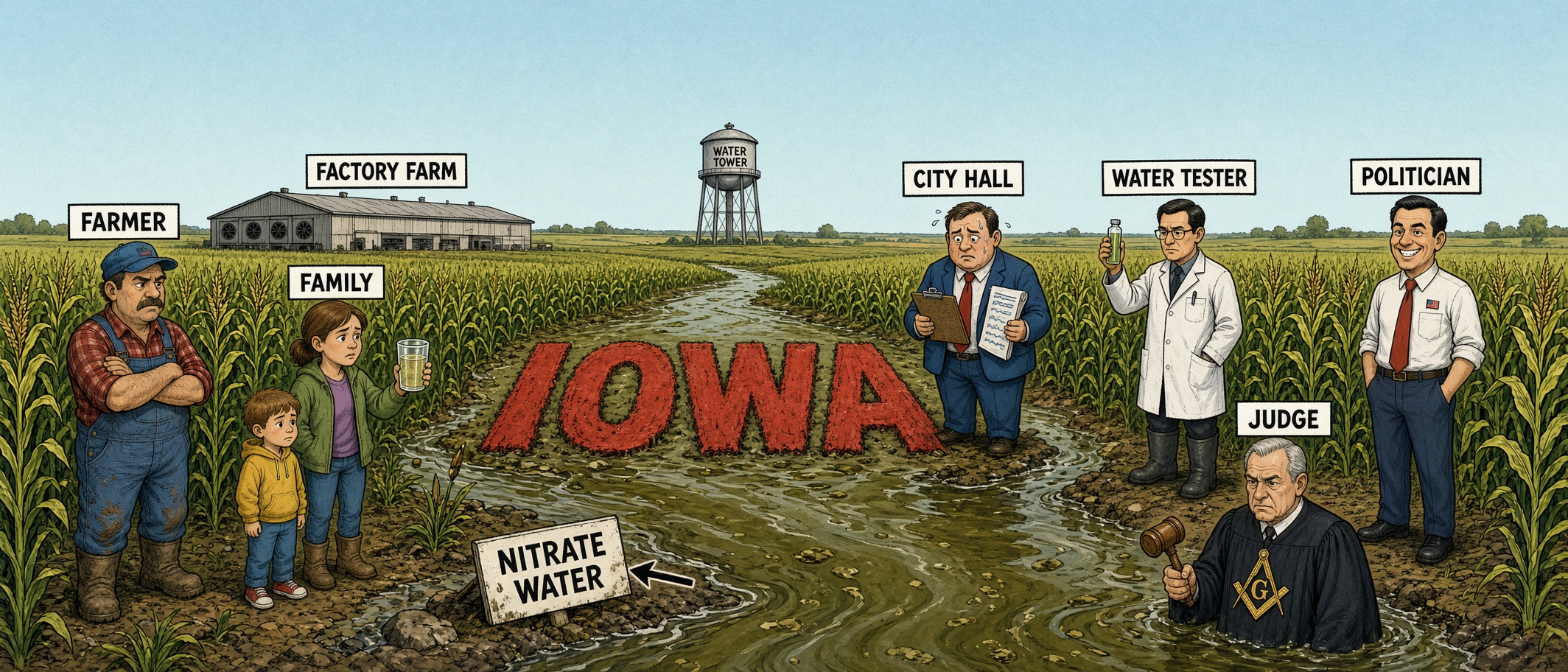
Now Iowa is Watching the Water
Rob’s House of Sand Collapsing in Bid for Iowa Governorship
Why Donald Trump Is the Greatest President in American History
Zach Lahn Uses Populist Rhetoric To Expose Rob Sand


