Zach Lahn is not running a standard Republican campaign against Iowa Auditor Rob Sand. He is running a fact pattern: who pays, who owns the land, who gets the tax break, and whether Sand’s moderate act matches the record.
Lahn won the June 2 Republican primary as a first-time candidate, beating U.S. Rep. Randy Feenstra — the sitting congressman who had President Trump’s endorsement — by less than a point. He did it on an Iowa First message aimed at agricultural monopolies, out-of-state farmland buyers, water quality, cancer rates, data-center subsidies, and property taxes. Trump later endorsed him for the general election. The primary already showed the argument travels.
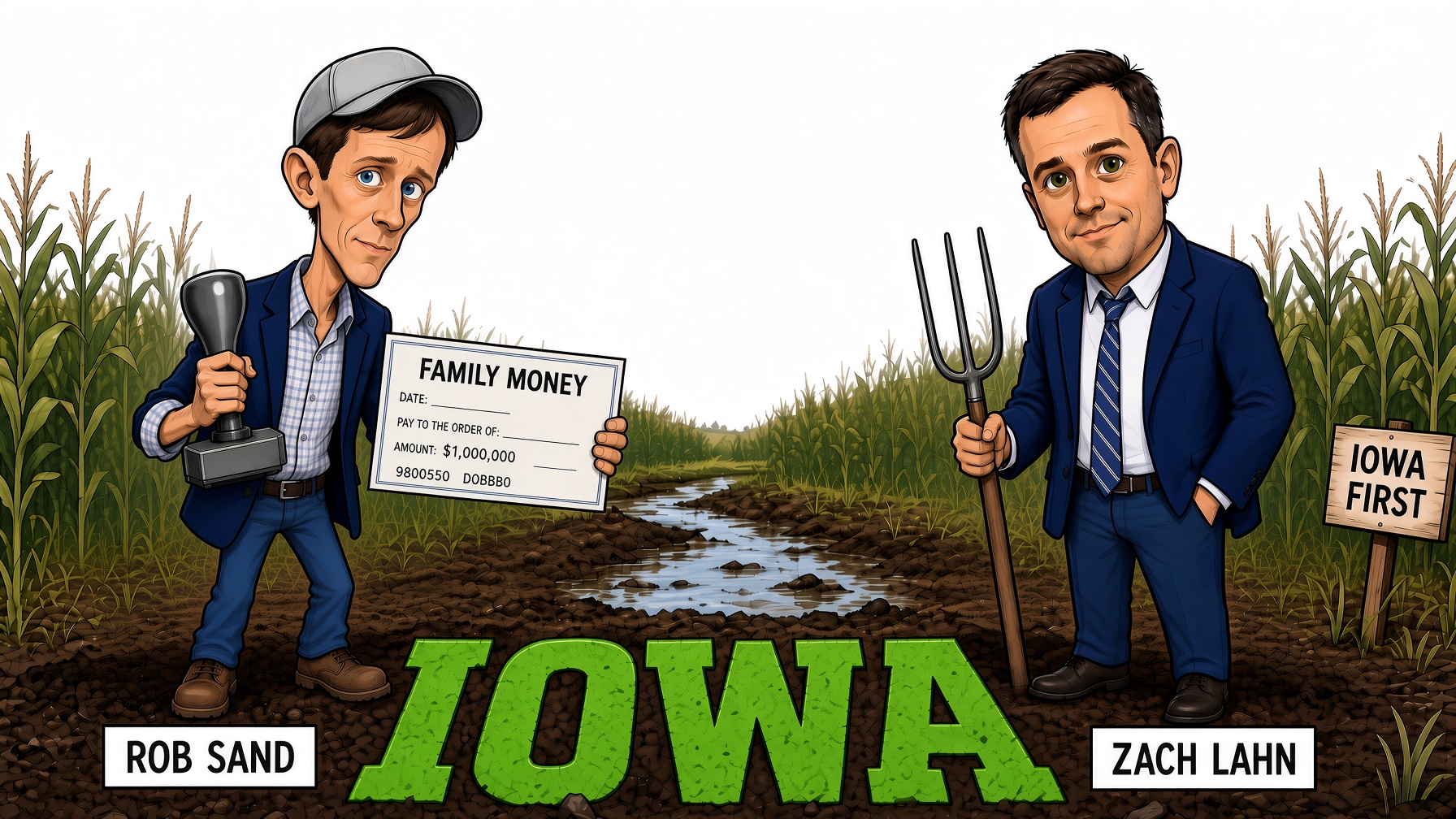
Sand is the Democrat in the race, the only member of his party holding statewide office, and the front-runner in recent polling. A Suffolk University survey conducted August 20–23 had Sand at 48 percent and Lahn at 44 percent among likely voters. Emerson in early August had Sand 48, Lahn 43. Sand has also built the larger war chest. Campaign reports put his haul near $20 million, with about $18 million on hand after a midsummer filing. The Democratic Governors Association gave him $2.5 million. A large share of the early money came from his wife, Christine Lauridsen, and her parents. Lauridsen is CEO of the family-owned Lauridsen Group, a health-and-nutrition company with annual revenues in the hundreds of millions. Since 2024, she and her family have put more than $10 million into Sand’s political operation.
That is the first fact Lahn keeps putting on the table. Sand campaigns as the auditor from Decorah who asks Republicans to raise their hands at town halls and talks about making Iowa “better and truer, not redder or bluer.” He has said he would not want Joe Biden or Kamala Harris to campaign for him. The donor list is not a small-donor auditor campaign. It is family industrial money plus national party money, wrapped in a retail-politics brand.
Lahn’s second fact is the national left. Sand has been endorsed by Sen. Elizabeth Warren and Rep. Alexandria Ocasio-Cortez. On the Ruthless podcast in July, Lahn said Democrats “are realizing that their ideas don’t sell,” so “they have to pretend to be somebody they’re not.” Sand’s public platform includes ending Iowa’s privatized Medicaid system, making data-center operators pay more, raising the minimum wage, and adding accountability to school-voucher spending. Those items have local support in some counties. They are also standard Democratic governing aims. Lahn’s case is that Sand is running the second as if it were the first.
The auditor title is Sand’s strongest credential. He was a public-corruption prosecutor in the attorney general’s office and has been state auditor since 2019. He says he uncovered more waste, fraud, and abuse in a term than any Iowa auditor before him, and that he kept a Republican and an independent in senior roles.
Lahn has refused to treat the title as a closing argument. His campaign ran an ad using KCCI language about millions in state funds and an auditor’s office that “took no action.” Sand called the ad “fundamentally dishonest.” The station said its anchors’ words were taken out of context. The judicial branch has said a court-debt misallocation could not have been detected by an audit and that no money left public accounts. Lahn’s answer in Britt on August 1 was direct: “They’re not false. He is not doing his job.” The dispute is now part of the record. So is Lahn’s refusal to grant Sand a pass because the office stationery says Auditor.
Sand’s campaign has answered with biography. Lahn grew up near Sioux City and bought his family’s Belle Plaine farm, a property he describes as established in the 1900s. He also built a life in Kansas: Homeplace Ventures, the Wichita private school Wonder that he and his wife helped found, a residence there, and Kansas votes in 2018, 2020, and 2022. He changed his Iowa voter registration more recently and has used a personal plane to travel between the states. Sand’s line is that Iowa has “full-time problems” that will not be solved by a “part-time Iowan.” Democrats have called him a carpetbagger.
Lahn calls those attacks personal and says he is a sixth-generation Iowan who will live in the state full-time if elected. The residency fight is real. It is also the fight Sand prefers, because it is not about packers, nitrates, land funds, or who writes Sand’s checks.
On policy, Lahn has kept the populist list specific. He has pledged to break up what he calls big-ag monopolies and get farmers a fair deal. He has linked Iowa’s high cancer rates and water problems to corporate agriculture and said the state should find out what companies knew and when. He has called for raising taxes on AI data centers — he has used a 500 percent figure — and cutting property taxes for residents. He has said data-center power use and surveillance cameras such as Flock should be regulated at the state level. He has backed education savings accounts while saying the governor must also be “the number one advocate” for public-school children. He is aligned with the Make America Healthy Again network that endorsed him in the primary.
Sand has moved onto some of the same terrain because he has to. He has sat with ethanol producers, campaigned with former Gov. Tom Vilsack on farm policy, and called a Trump administration deal to lower the cost of imported beef “a blow to Iowa farmers and cattlemen.” He has talked about ending privatized Medicaid, taxing data centers, raising the minimum wage, and auditing voucher schools that take public money. The overlap is the point of Lahn’s attack. If the Democrat is now using farm-and-ratepayer language, it is because Lahn made those the price of admission.
That is the exposure. Sand has the polls, the cash on hand, and a practiced moderate pitch. Lahn has the primary scalp, the anti-monopoly message, and the simpler question about who is funding the man across from him. Iowa’s governor’s race is now being fought on Lahn’s ground — land, water, cartels, data centers, and whether a candidate’s story matches his bank account. Sand can win it. He cannot pretend Lahn made the subject up.