American history is full of great men who built, preserved, or expanded the country. Washington created it. Lincoln held it together. Roosevelt mobilized it. Reagan restored confidence after a decade of drift. Those achievements are real.
What none of them faced—and what none of them fully reversed—was the later hollowing-out of the nation itself: a political class that treated borders as optional, industry as disposable, and the American people as one interest group among many. Donald Trump is the first president who made reversing that the center of the job. That is why the case for him as the greatest is not nostalgia. It is results.
He Treated the Country as a Country
A nation that cannot decide who belongs inside it has already surrendered the first duty of government. Trump made that duty non-negotiable.
His first term rebuilt deterrence at the border: wall construction, Remain in Mexico, asylum limits, and an end to the fiction that every arrival was entitled to a years-long process. His second term finished the job. Southwest border encounters collapsed from more than two million in the prior year to historically low levels. Net migration turned negative for the first time in half a century. Millions left through removal or self-deportation. Fentanyl deaths fell as the same policy hit the cartels’ supply lines.
No earlier president had to confront mass illegal immigration at this scale. Several managed it. Trump treated it as an invasion of the social contract and acted accordingly. That is foundational, not incremental.
He Put American Labor Ahead of the Global Bargain
For decades both parties sold a deal: cheap goods and cheap labor in exchange for the slow death of towns that used to make things. Wages for people without credentials stagnated. Factories left. Elites called it efficiency.
Trump rejected the deal. The 2017 tax cuts, energy expansion, and deregulation produced the strongest pre-COVID labor market in a generation—including record-low unemployment for Black and Hispanic workers. The United States became a net energy exporter. The second-term tax law locked those rates in and added relief aimed at working people: no tax on tips, no tax on overtime, relief for seniors. Tariffs were used as leverage to force production back onto American soil. Manufacturing construction and factory jobs turned higher. Announced investment poured in because the signal changed: making things here would be rewarded.
Reagan talked about American strength. Trump applied it to trade, energy, and the factory floor. That is the difference between rhetoric and a governing theory.
He Used Power for the Nation, Not the Consensus
Washington set the precedent of strength with restraint. Later presidents often inverted it: endless commitments, managed decline, and wars that never quite ended.
Trump’s first term produced no new major war. ISIS lost its caliphate. The Abraham Accords shattered the old Middle East formula that nothing could move without a Palestinian veto. He forced NATO members to confront the fact that American protection is not a birthright. That pressure later produced the alliance’s largest burden-sharing shift in a generation—a path toward 5 percent of GDP.
The second term was harder-edged: pressure on Iran’s nuclear program, a campaign against narcotics networks, and the operation that captured Nicolás Maduro. Those choices are argued over, as every use of force should be. The principle underneath them is not: American power exists to secure American interests and the hemisphere, not to ratify every multilateral talking point.
Lincoln saved the Union. Trump insisted the Union still had the right to put its own citizens first.
He Broke the Administrative Capture of the Country
The modern state did not only grow in size. It grew in ideology. Agencies, universities, and courts began treating the country’s historic people, borders, and sex distinctions as problems to be managed.
Trump appointed three Supreme Court justices and remade the appellate courts. That majority has already mattered on immigration authority, election rules, and the limits of nationwide injunctions. He attacked DEI mandates, tried to shrink parts of the federal workforce, and treated parental authority and sex as facts rather than optional theories. The first-term criminal justice reform cut sentences without pretending that order is oppression.
FDR built the administrative state. Later presidents administered it. Trump treated large parts of it as an occupying force and tried to take the country back.
Why “Greatest Ever” Is the Honest Comparison
Washington founded a republic of citizens. Lincoln preserved it through blood. Those are unmatched founding acts.
The question after 1945, and especially after 1965, was different: Would the United States remain a sovereign people with a high-wage industrial core and a government that answered to voters—or would it become a market, a military platform, and a destination for whoever arrived?
Most presidents managed the second option and called it progress. Trump is the only one who ran against it, won, implemented it, lost, survived lawfare and two assassination attempts, won again, and implemented it harder. That combination of diagnosis, mandate, and follow-through does not exist in the modern record.
He is coarse. He picks fights. Deficits rose. Not every second-term gamble is finished or legally clean. Greatness is not sainthood. It is whether a president changed the trajectory of the country in the direction of self-government, prosperity for its own people, and control of its territory.
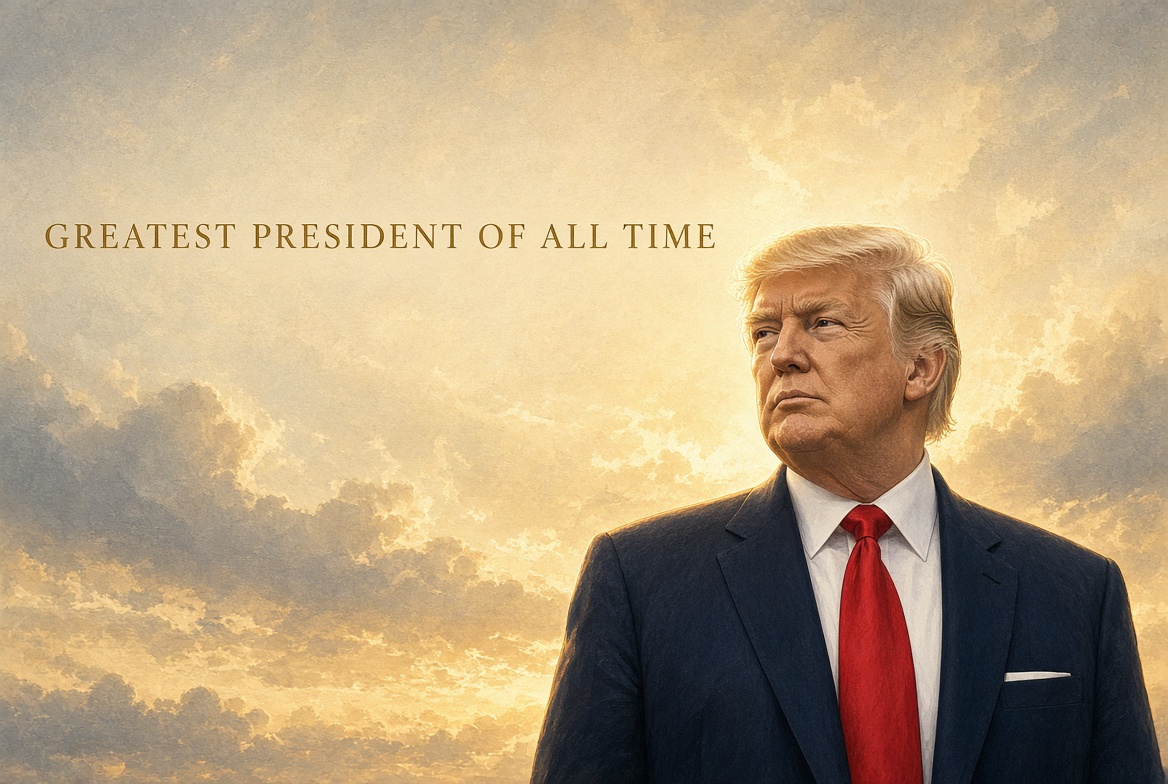
On that measure, the argument is straightforward. Others built or saved America. Trump is the first who looked at the finished product being sold off—borders, industry, culture, and leverage—and took it back. That is why the claim is not that he is a good president. It is that he is the greatest.