Connect with us

Politics

Insanity | Anyone Of “Russian Descent” Can Be In Scope Of Senate Probe

Published

on

(Via Zerohedge)

The Young Turks Network (TYT), a popular progressive YouTube channel and news site, has obtained a bombshell internal email related to the Senate committee probing alleged Russian interference in the American political system, and though currently being covered in Russian media, mainstream US media is passing it over without comment.

The email reveals that the Senate committee has deemed anyone “of Russian nationality or Russian descent” relevant to its investigation, which means the Russiagate conspiracy theory and accompanying congressional investigation has officially jumped straight from neo-McCarthyism – smearing anyone that may have had contact with Russian government officials, diplomats or intelligence, and into xenophobia – eyeing any and all Russians or friends of Russians as a potential threat plain and simple, which is far down the slippery slope that many commentators have long predicted.

The email, which is dated very recently, is summarized by TYT as follows:


In an email dated December 19, 2017, April Doss – who serves as senior minority counsel on the Senate Select Committee on Intelligence (SSCI) – defined the scope of the committee’s inquiry as anyone a subject “knows or has reason to believe [is] of Russian nationality or descent.” The senior majority counsel for the SSCI, Vanessa Le, was cc’d on the emails.

Doss, the former head of intelligence law at the National Security Agency, was reportedly brought onto the committee by Sen. Mark Warner (D-Va.), who serves as its vice chairman and one of its most prominent public faces. Warner has repeatedly said that the committee’s work represents the “most important thing [he’s] ever done.”

So a former chief counsel at the NSA is tasked with interpreting the legal and constitutional legitimacy of broadly probing “Russian persons” or even merely persons “believed” to be “of Russian nationality or descent”? Not too comforting.

According to figures published by the Institute of Modern Russia in 2011, based on Census Bureau figures, the Russian American population is estimated to be 3.13 million, or just over one percent of the total US population. And who knows how widely the net can be cast on Russian “descent” or ethnicity? Or perhaps anyone who happens to be studying the Russian language or has a Slavic sounding accent? (…”knows or has reason to believe are of Russian nationality or descent” according to the email.)

Concerning the precise context to the email, TYT reports the following:

On July 27, 2017, Charles C. Johnson, a controversial right-wing media figure, received a letter from Sens. Burr and Warner requesting that he voluntarily provide materials in his possession that are “relevant” to the committee’s investigation. Relevant materials, the letter went on, would include any records of interactions Johnson had with “Russian persons” who were involved in some capacity in the 2016 U.S. elections.

The committee further requested materials related to “Russian persons” who were involved in some capacity in “activities that related in any way to the political election process in the U.S.” Materials may include “documents, emails, text messages, direct messages, calendar appointments, memoranda, [and] notes,” the letter outlined.

So are you of “Russian descent” and have any level of interest in US politics – perhaps you occasionally read the newspaper, or have ever called in to a radio talk show? You could be subpoenaed for merely existing on American soil!

As the protracted Senate Select Committee on Intelligence (SSCI) drags on, we are sure to see more of such requests and wrangling by Senate staff lawyers over how widely this net can be cast:

Doss’s statement was in response to a request made by Robert Barnes, an attorney for Johnson, for clarification as to the SSCI’s definition of a “Russian person.”

Charles Johnson told TYT that he is not going to cooperate with the SSCI in any way, and senators on the committee had no comment in response to the email’s publication.

Of course, we’ve also seen this before as during a November SSCI hearing on social media election interference Twitter Associate General Counsel Sean Edgett revealed that the company’s methods to detect “Russian-linked” accounts include the mere use of a Russian phone number, mobile carrier, email address, IP address, Cyrillic characters in one’s username, and whether one has “logged in, at any time, from Russia” – which would happen to include just about any American tourist in Russia over the past few years.

Continue Reading
Click to comment

Leave a Reply

Your email address will not be published. Required fields are marked *

Iowa

Zach Lahn Uses Populist Rhetoric To Expose Rob Sand

Published

on

Zach Lahn is not running a standard Republican campaign against Iowa Auditor Rob Sand. He is running a fact pattern: who pays, who owns the land, who gets the tax break, and whether Sand’s moderate act matches the record.

Lahn won the June 2 Republican primary as a first-time candidate, beating U.S. Rep. Randy Feenstra — the sitting congressman who had President Trump’s endorsement — by less than a point. He did it on an Iowa First message aimed at agricultural monopolies, out-of-state farmland buyers, water quality, cancer rates, data-center subsidies, and property taxes. Trump later endorsed him for the general election. The primary already showed the argument travels.

Sand is the Democrat in the race, the only member of his party holding statewide office, and the front-runner in recent polling. A Suffolk University survey conducted August 20–23 had Sand at 48 percent and Lahn at 44 percent among likely voters. Emerson in early August had Sand 48, Lahn 43. Sand has also built the larger war chest. Campaign reports put his haul near $20 million, with about $18 million on hand after a midsummer filing. The Democratic Governors Association gave him $2.5 million. A large share of the early money came from his wife, Christine Lauridsen, and her parents. Lauridsen is CEO of the family-owned Lauridsen Group, a health-and-nutrition company with annual revenues in the hundreds of millions. Since 2024, she and her family have put more than $10 million into Sand’s political operation.

That is the first fact Lahn keeps putting on the table. Sand campaigns as the auditor from Decorah who asks Republicans to raise their hands at town halls and talks about making Iowa “better and truer, not redder or bluer.” He has said he would not want Joe Biden or Kamala Harris to campaign for him. The donor list is not a small-donor auditor campaign. It is family industrial money plus national party money, wrapped in a retail-politics brand.

Lahn’s second fact is the national left. Sand has been endorsed by Sen. Elizabeth Warren and Rep. Alexandria Ocasio-Cortez. On the Ruthless podcast in July, Lahn said Democrats “are realizing that their ideas don’t sell,” so “they have to pretend to be somebody they’re not.” Sand’s public platform includes ending Iowa’s privatized Medicaid system, making data-center operators pay more, raising the minimum wage, and adding accountability to school-voucher spending. Those items have local support in some counties. They are also standard Democratic governing aims. Lahn’s case is that Sand is running the second as if it were the first.

The auditor title is Sand’s strongest credential. He was a public-corruption prosecutor in the attorney general’s office and has been state auditor since 2019. He says he uncovered more waste, fraud, and abuse in a term than any Iowa auditor before him, and that he kept a Republican and an independent in senior roles.

Lahn has refused to treat the title as a closing argument. His campaign ran an ad using KCCI language about millions in state funds and an auditor’s office that “took no action.” Sand called the ad “fundamentally dishonest.” The station said its anchors’ words were taken out of context. The judicial branch has said a court-debt misallocation could not have been detected by an audit and that no money left public accounts. Lahn’s answer in Britt on August 1 was direct: “They’re not false. He is not doing his job.” The dispute is now part of the record. So is Lahn’s refusal to grant Sand a pass because the office stationery says Auditor.

Sand’s campaign has answered with biography. Lahn grew up near Sioux City and bought his family’s Belle Plaine farm, a property he describes as established in the 1900s. He also built a life in Kansas: Homeplace Ventures, the Wichita private school Wonder that he and his wife helped found, a residence there, and Kansas votes in 2018, 2020, and 2022. He changed his Iowa voter registration more recently and has used a personal plane to travel between the states. Sand’s line is that Iowa has “full-time problems” that will not be solved by a “part-time Iowan.” Democrats have called him a carpetbagger.

Lahn calls those attacks personal and says he is a sixth-generation Iowan who will live in the state full-time if elected. The residency fight is real. It is also the fight Sand prefers, because it is not about packers, nitrates, land funds, or who writes Sand’s checks.

On policy, Lahn has kept the populist list specific. He has pledged to break up what he calls big-ag monopolies and get farmers a fair deal. He has linked Iowa’s high cancer rates and water problems to corporate agriculture and said the state should find out what companies knew and when. He has called for raising taxes on AI data centers — he has used a 500 percent figure — and cutting property taxes for residents. He has said data-center power use and surveillance cameras such as Flock should be regulated at the state level. He has backed education savings accounts while saying the governor must also be “the number one advocate” for public-school children. He is aligned with the Make America Healthy Again network that endorsed him in the primary.

Sand has moved onto some of the same terrain because he has to. He has sat with ethanol producers, campaigned with former Gov. Tom Vilsack on farm policy, and called a Trump administration deal to lower the cost of imported beef “a blow to Iowa farmers and cattlemen.” He has talked about ending privatized Medicaid, taxing data centers, raising the minimum wage, and auditing voucher schools that take public money. The overlap is the point of Lahn’s attack. If the Democrat is now using farm-and-ratepayer language, it is because Lahn made those the price of admission.

That is the exposure. Sand has the polls, the cash on hand, and a practiced moderate pitch. Lahn has the primary scalp, the anti-monopoly message, and the simpler question about who is funding the man across from him. Iowa’s governor’s race is now being fought on Lahn’s ground — land, water, cartels, data centers, and whether a candidate’s story matches his bank account. Sand can win it. He cannot pretend Lahn made the subject up.

Continue Reading

Politics

James Fishback Can Stop Byron Donalds From Stealing This Election

Published

on

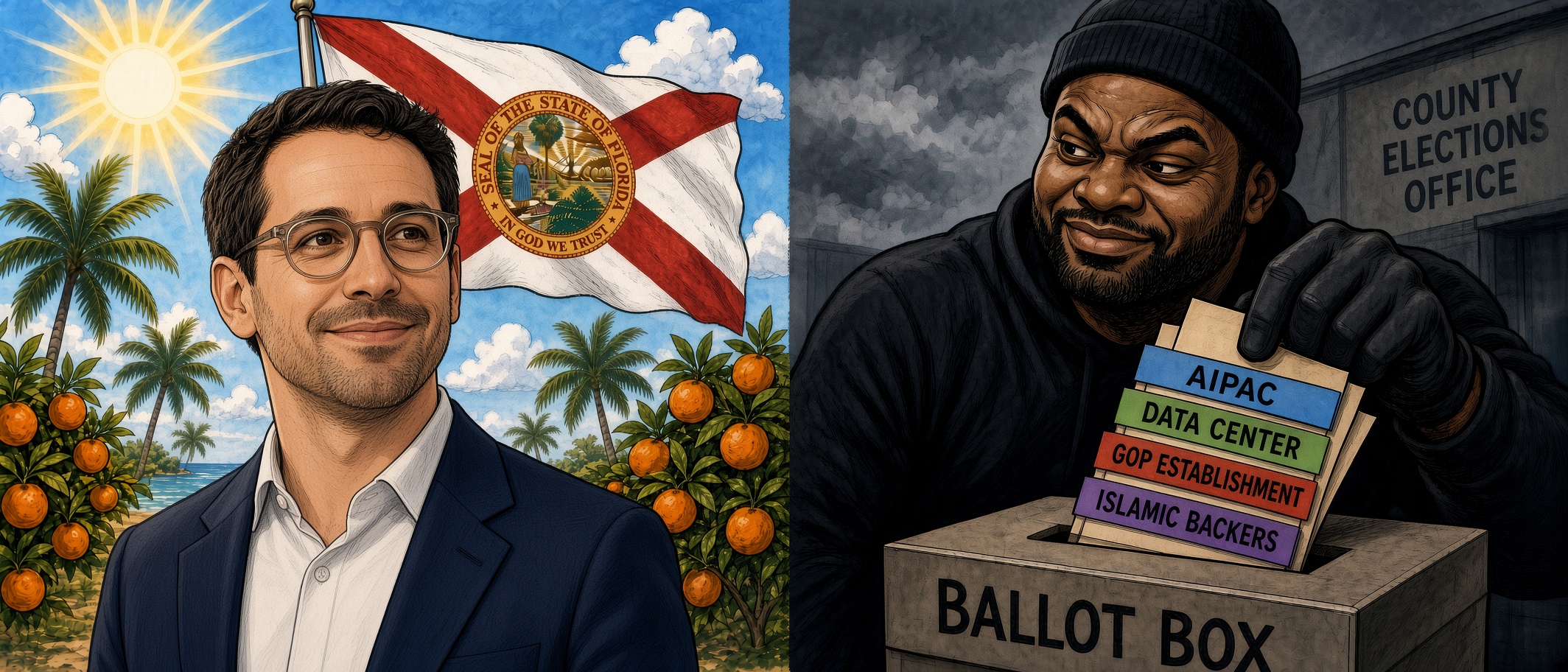
James Fishback is the only candidate who can galvanize a real Florida First movement for the people. Byron Donalds is trying to steal the nomination like a thief in the night—money, endorsements, debate refusals, and institutional muscle—while the actual fight for ordinary Floridians gets sidelined.

Fishback, the 31-year-old fourth-generation Floridian and outsider, is running straight at the core problem: Florida is being priced out from under the people who live here. He is the only one treating that as the central issue instead of a talking point. Ban new AI data centers that drive up power and water costs while delivering almost nothing back. Stop private equity and corporate buyers from vacuuming up single-family homes so young families can actually own instead of rent forever. Eliminate property taxes on homesteaded homes for residents while leaving them on vacation properties and non-residents. Put Floridians first over donors, tech developers, and the permanent political class. That is what “populist” means here—ordinary people over the interests that treat the state as a product.

The energy is real. Young voters are showing up for him in ways the other campaigns cannot match. Campus events, packed small venues, early turnout among under-40s. They hear someone who sounds like he understands the cost-of-living pressure and the sense that the state is being sold out. No one else in the race is converting that frustration into a coherent Florida First agenda the same way.

Donalds has the Trump endorsement, the fundraising advantage, and the party machinery. He leads the polls. That is the reality. The way he is running is the problem. He refuses debates. The party set thresholds that only he meets so no official debate happens. Opponents get treated as illegitimate rather than answered. The strategy is clear: close the race with money and institutional power before the people-first argument ever gets a real hearing. That is how you steal an election in the dark—win the process while the substance never has to face the voters who are actually struggling.

Fishback is the only candidate forcing that substance onto the table. The rest of the field is counting on voters not noticing until the primary is already decided. The question now is whether Florida Republicans want a nominee who leads the movement for the people who live here, or whether they will accept the quiet, well-funded path that treats that movement as an inconvenience.

Continue Reading

Politics

Online Provocateurs Try to Sabotage America First, Nick Fuentes, & the Groypers

Published

on

There’s a familiar pattern on the online right. Someone builds something real over years — an audience, a coherent worldview, a network of young people who actually show up, a brand that survives deplatforming and institutional hostility — and then a new wave of operators appears to declare it illegitimate. They didn’t organize the events, endure the bans, cultivate the base, or hold the line when it was costly. They simply want the throne, or at least the right to tear it down for engagement.

That’s the story with the latest round of attacks on Nick Fuentes and the Groypers.

Fuentes did not inherit a ready-made audience or a friendly institutional lane. He built America First the hard way: livestreams that were repeatedly banned, campus activism that forced conversations the mainstream right preferred to avoid, a persistent focus on immigration, foreign policy realism, and cultural continuity that resonated with a generation of young men who felt the older conservative institutions had failed them. The “Groyper” label stuck because it described a real, identifiable cohort that kept showing up — at events, online, and increasingly in the pipelines of young Republican staffers and campus organizations. Even hostile outlets now admit the influence is measurable enough to worry about.

Building and maintaining that requires consistency under pressure. It requires continuing after payment processors cut you off, platforms exile you, and former allies distance themselves the moment the heat rises. It requires producing content night after night while the same critics who call it a “cult of personality” or “just streaming for donations” produce little of comparable durability themselves.

Contrast that with the new critics. Many of the loudest voices attacking Fuentes right now never constructed a parallel youth movement. They did not spend years turning online discontent into organized pressure. Some are lifestyle influencers or late arrivals who discovered the America First energy after it had already been cultivated, then decided the man who did the cultivation is the problem. Others are established conservative media figures who spent years ignoring or dismissing the concerns that Fuentes amplified, only to pivot into anti-Groyper moralizing once the numbers became impossible to ignore. Still others are former adjacent figures whose main contribution has been internal drama, fed accusations, and calls for people to abandon the only sustained effort in that space.

The charge that Groypers “haven’t earned the right to a movement” is particularly rich coming from people who have earned even less. A movement is not measured solely by formal PAC filings or official party titles. It is measured by whether people keep showing up, whether the ideas spread into institutions that once excluded them, and whether the core message survives repeated attempts to isolate it. By those standards, the record is clear: the people now declaring the project dead or illegitimate are usually the ones who never built a comparable alternative. They critique the architecture while offering no blueprint of their own.

What many of these attacks actually reveal is resentment at the existence of an independent pole. Fuentes and the Groypers represent a faction that cannot be fully managed by the usual donor class, media gatekeepers, or careerist influencers. That independence is treated as the real offense. If the movement can be framed as pure grift, pure online toxicity, or pure personality cult, then the hard work of building it can be dismissed and the energy redirected toward safer, more controllable channels — or simply dissipated through endless internecine fights.

Sabotage does not always look like open opposition from the left. Sometimes it looks like people on the same side of the broader cultural fight deciding that the one person who actually constructed durable infrastructure must be brought down so that no one else can claim leadership without their permission. The result is predictable: energy that could go into organizing, messaging, and institutional pressure is instead spent on purity spirals, fed-jacketing, and performative denunciations.

None of this requires treating Fuentes as above criticism. No political figure is. Tactical disagreements, questions about tone, or debates over prioritization are legitimate. What is not legitimate is the posture that says the only people allowed to speak about the future of the right are those who never did the unglamorous work of building an actual base that persists beyond a news cycle. The people who spent years creating something durable have more claim to it than the people who arrived later to declare it worthless.

Movements are not granted by committee or by the approval of competing influencers. They are earned by the people who show up when it is hard, keep producing when the platforms turn hostile, and refuse to dissolve when the internal knives come out. The new online critics have not done that work. They have not maintained anything comparable. Their primary contribution, in too many cases, is the attempt to dethrone the people who did.

That is not leadership. It is freeloading on someone else’s foundation while trying to knock the walls down.

Continue Reading

Trending

Donate to Populist Wire

*Note: Every donation is greatly appreciated, regardless of the amount.