Connect with us

Iowa

Rob Sand: Peeling Back the Onion

Published

on

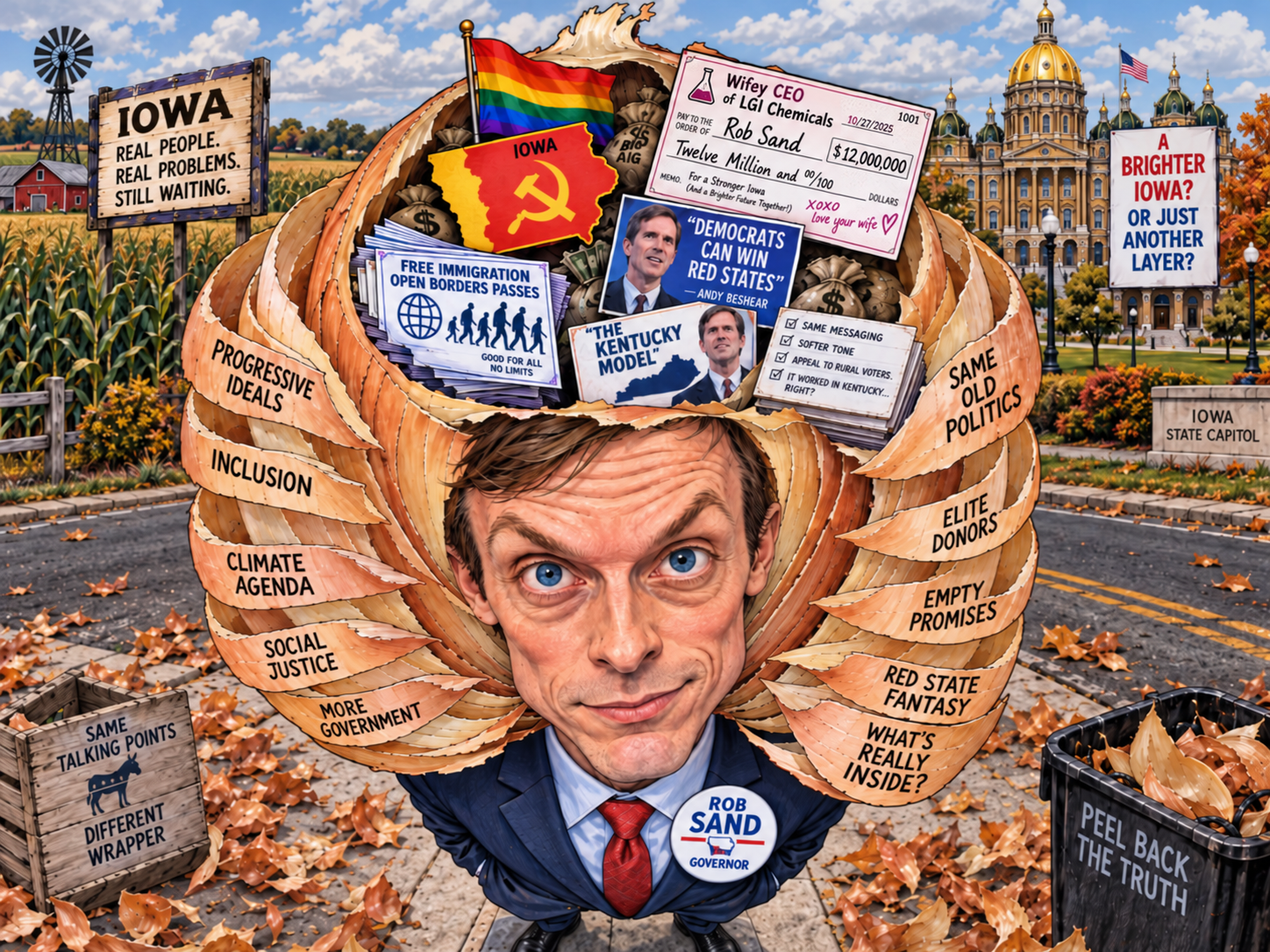
Rob Sand is asking Iowa to buy the outside of the man.

The outside is carefully grown. Decorah kid. Church on Sunday. Bowhunter. Former prosecutor who locked up lottery cheats and public thieves. Two-term state auditor, the last Democrat Iowans still elect statewide. He walks into rooms and asks the Republicans to raise their hands first. He almost never says Donald Trump’s name. He talks “costs, corruption and cancer” as if those were the only three words left in politics. He tells Democratic crowds he will veto “culture war bills.” He tells everybody else he is not really running as a Democrat at all — just as the adult in a one-party state that stopped working.

That is the skin. Peel it.

Layer one: the red-state rental

Sand did not invent this costume. He rented it from Kentucky.

Andy Beshear, Democratic governor of a state Donald Trump carries by landslide margins and chair of the Democratic Governors Association, flew in to baptize Sand’s general-election campaign. The sermon was the same one national Democrats have been workshopping since 2024 collapsed: soften the tone, talk family and faith, promise you will “put people first,” insist Democrats can win red states if they stop sounding like themselves. Beshear called himself “living, breathing proof.” Sand pointed at Kentucky’s even redder math and told Iowans their hill was smaller.

It is a franchise model. Same messaging. Softer tone. Appeal to rural voters. Check the boxes, ship it to Iowa, hope nobody notices the national committee still wants the scalp.

A governor in Des Moines will not get a Democratic legislature. Sand knows that. The play is not to pass San Francisco. The play is to take the mansion, veto from the inside, and give the national party a map it can sell in 2028. Iowa is the proof of concept. Sand is the packaging.

Layer two: the $12 million family

The packaging is expensive.

Since 2024, Sand’s wife, Christine Lauridsen Sand — CEO of the Lauridsen Group, the privately held Ankeny empire built on meat and dairy byproducts, animal nutrition, and related industrial products — and her parents and brothers have poured roughly $11.5 million into his campaign for governor. Count the same relatives back to his auditor races and the family total sits around $13.1 million. Christine alone has written checks in the millions. That is not grassroots. That is a family office underwriting a statewide takeover.

Sand’s answer is lawyerly. The money came from people, not a corporation. He rejects corporate PAC checks. Thousands of small donors exist too, some of them Republicans. Fine. None of that changes the structure. The largest personal underwriting of an Iowa gubernatorial campaign in memory sits in one household, attached to one private company, attached to the man who recites speeches about “insiders” and “special interests.”

He is not a billionaire in the Forbes sense, and the campaign likes to hide behind that distinction. His wife runs a global family firm measured in the billions of dollars of enterprise value and about a billion in annual revenue. Her relatives write the checks that keep the ads on television. If that is not elite donor politics, the phrase has no meaning.

Layer three: the water sermon and the family plant

Now peel the sermon.

Sand’s whole general-election identity is dirty water and cancer. Fund the monitors. Publish the manure plans. Restore wetlands. Deny chemical companies immunity. Build a “dirty water” alert system. Create a cabinet-level cancer task force. He tells rooms his own children drink Iowa water. He talks as if the state’s industrial mess were something that happened to his family, not something his family’s companies have had to answer for.

Lauridsen subsidiaries have not been spectators. Essentia Protein Solutions and related operations have shown up in Iowa DNR files over discharges, lagoons, ammonia, E. coli, and creeks. Lahn’s ads smear the details together and pretend the company itself cut Sand a $13 million check. That part is sloppy. The uncomfortable part is not. A candidate whose closing argument is “who poisoned the water” has spent his political life financed by the owners of plants that Iowa regulators have had to chase. Feather meal and blood meal from the family orbit are sold into fertilizer markets in a state drowning in nitrogen. Sand’s lawyers can explain product categories all day. Voters are allowed to notice the conflict without a permission slip.

If a Republican governor’s in-laws ran the plants, Sand the auditor would have held a press conference.

Layer four: “not a politician” with a politician’s list

Peel the anti-politics talk and the platform is a standard Democratic expansion dressed in auditor khaki.

He wants Iowa’s privatized Medicaid unwound from day one — he says illegal denials of care exploded after the state handed the program to for-profit managers, and he wants the machinery pulled back toward public or nonprofit control. He wants the school voucher program income-capped, audited, and tied to rules that treat private schools like public vendors. He wants the minimum wage moved toward $12. He wants adult-use cannabis legalized and taxed. He wants out-of-state landowners taxed harder, data-center breaks stripped or conditioned, utility “meter” fees capped, universal pre-K and school meals, caregiver credits, more wetlands, more monitors, more conservation subsidies, more state direction over water and land. He wants the auditor’s powers the Legislature clipped in 2023 handed back to him, which is convenient, because he would then be the man who both writes the rules and investigates the people who break them.

That is not “balanced government.” That is more government, aimed at the industries and institutions Iowa Republicans spent a decade building. Some of the targets deserve the hit. School vouchers without audits are an invitation. Chemical immunity is an insult. Rural hospitals and nitrate wells are not talking points. None of that converts a regulatory shopping list into a modest reform agenda. When Sand says he is done with culture war so the state can “fix real problems,” what he means is: let me move the economic machinery while you stop asking about the rest.

Layer five: the issues he wants offstage

The rest is still there.

Sand will tell a room he wants transgender Iowans to feel welcome and that stripping gender identity from the Iowa Civil Rights Act was wrong. He will also say transgender women and girls should not compete in female sports, which buys him a sentence in farm-county coverage and a “coward” shout in Iowa City. He will praise Bob Ray’s refugee tradition, mumble about people who “want to work and follow the rules,” and then sprint back to grocery prices. He will not run an open-borders campaign. He will also not run a secure-borders campaign. In a midterm defined nationally by immigration, that silence is the position.

Inclusion, climate, social justice, more government — those are not smears invented by an opponent’s ad maker. They are the actual stack underneath the hunting stories. Sand’s innovation is not moderation. It is sequencing. Put the popular fights first. Keep the coalition’s priorities in the platform and out of the first twenty minutes of the town hall. Hope rural Iowa grades the performance and never reads the rest of the script.

What is in the middle

There is no secret Soviet in the middle of Rob Sand. That charge is a gift to him, because it is easy to knock down. What is in the middle is more ordinary and more useful to see clearly.

A professional Democrat. A very good one. The only statewide Democrat who figured out that Iowa will not elect a lecture and might elect a prosecutor who whispers. A campaign sitting on tens of millions of dollars, a chunk of it from one industrial family, amplified by the Democratic Governors Association, validated by the man national Democrats want to run for president in 2028. A platform that grows the state’s hand over health care, schools, wages, energy, land, and water. A candidate who calls that accountability and calls everyone else’s donors corruption.

“Same talking points, different wrapper” is the honest summary. The wrapper is Iowa-shaped. The talking points are the party’s. The money is his wife’s family. The strategy is Beshear’s. The bet is that Iowans are tired enough of Republican monopoly to stop peeling.

Real people in this state have real problems. They are not required to pretend a rebrand is a revelation. Peel Sand all the way down and you do not find a farmer who wandered into politics. You find a Democratic project that learned to dress for the county fair.

Election Day is November 3. The skin will still be on the ads. The inside will be on the desk in January if the ads work.

Continue Reading

Iowa

Zach Lahn & Chris Jones: Outsiders With Credentials That Can Finally Fix Iowa’s Water

Published

on

Iowa’s water problem is not a mystery. High nitrate loads from agricultural runoff have pushed drinking water utilities like Des Moines Water Works into record stretches of nitrate removal. The state’s cancer rates rank among the highest in the nation and continue rising. Streams that once supported fishing and recreation now carry the signature of the corn-soy-CAFO system. Politicians have promised action for years. Results have been scarce.

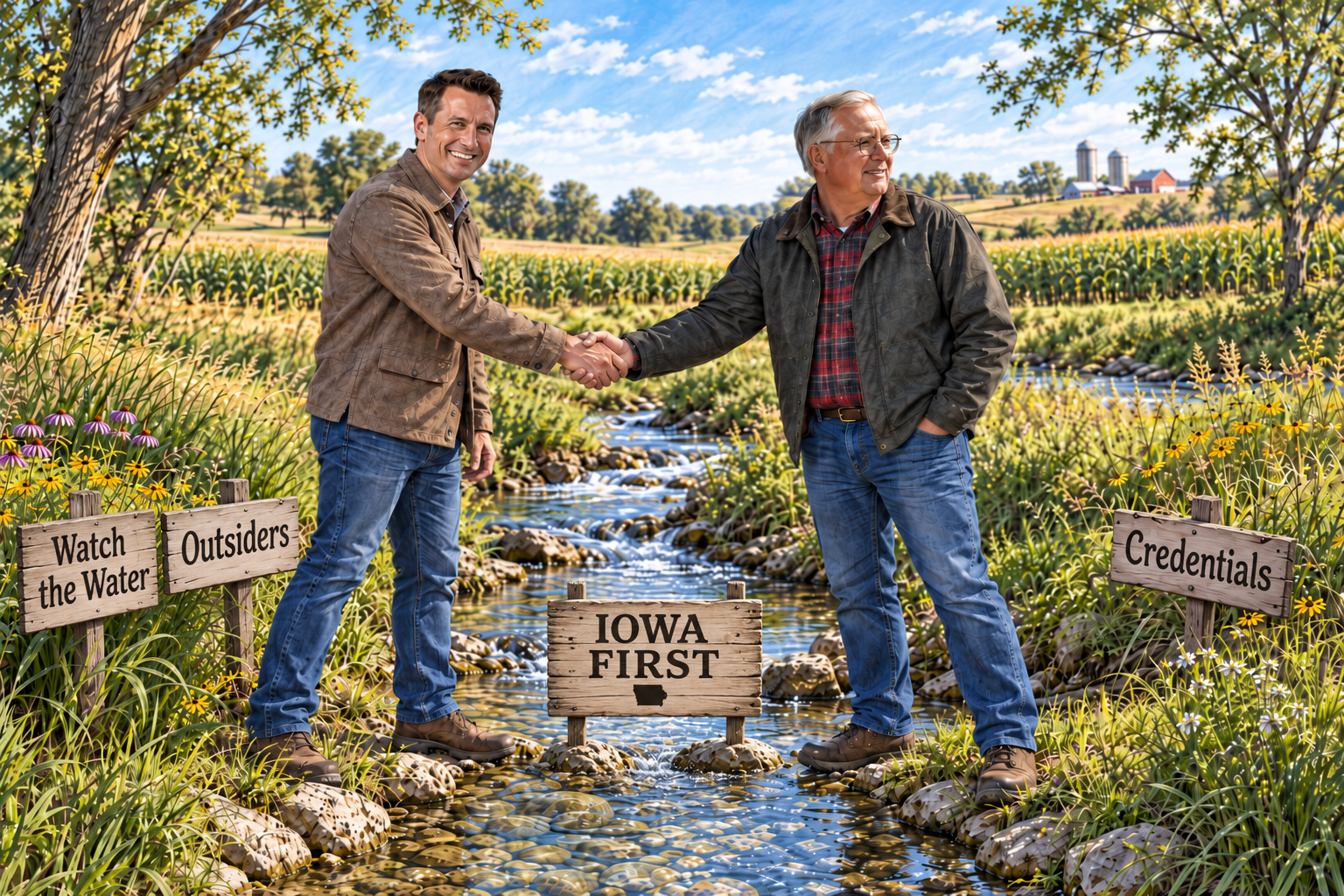
This cycle offers something different: two candidates whose combined credentials match the scale of the problem. Republican gubernatorial nominee Zach Lahn brings a farmer’s understanding of what works on the ground and the political will to fund it. Democrat Chris Jones, running for Secretary of Agriculture, brings decades of hands-on scientific expertise measuring, documenting, and explaining exactly what is happening in Iowa’s water. Together, even if Jones serves only a single term, they have the tools to produce measurable improvement where previous administrations produced only reports.

Zach Lahn’s Practical Path

Lahn is a sixth-generation Iowan who bought back his family’s Belle Plaine farmstead after it left family hands. He has made water quality and cancer rates central to his campaign, explicitly linking elevated nitrates to colorectal cancer and other health outcomes. His approach prioritizes proven practices that reduce nutrient loss without bankrupting family farms.

He has called for finally funding the Iowa Natural Resources and Outdoor Recreation Trust Fund—the IWILL program voters approved by a 63 percent margin in 2010 but that lawmakers left empty. Lahn wants that money directed first at the most impaired watersheds: the Des Moines and Raccoon rivers and their tributaries. He points to saturated buffers, which Iowa State University research has shown can remove essentially all nitrate from tile drainage in tested settings. He favors incentives structured so farmers make money adopting deeper nitrogen application and other conservation measures rather than merely break even. Upstream and downstream monitoring would measure results. The goal is targeted progress that keeps land in Iowa hands instead of accelerating consolidation through heavy regulation.

Lahn’s record is that of a farmer and businessman focused on implementation. He has argued that the status quo—talking about water while avoiding hard choices on funding and incentives—has failed. His plan is not radical. It is the first serious attempt by a Republican nominee to treat the problem as both an environmental and public-health priority that can be addressed while supporting working farms.

Chris Jones’s Unmatched Expertise

Jones arrives with credentials no other statewide candidate possesses. He holds a Ph.D. in analytical chemistry. For eight years he managed the water quality testing laboratory at Des Moines Water Works, overseeing operations at one of the world’s largest nitrate-removal facilities built specifically for agricultural runoff. He then spent four years as an environmental scientist with the Iowa Soybean Association, helping deploy some of the state’s earliest independent monitoring systems. At the University of Iowa he worked as a research engineer and helped create the first real-time public sensor network tracking nitrate and other pollutants across Iowa’s rivers—the system that later faced funding cuts.

His 2023 book, The Swine Republic, was selected by the Library of Congress as Iowa’s representative at the National Book Festival. He co-founded Driftless Water Defenders to protect northeast Iowa’s waters. For decades Jones has measured the loads, traced the sources, and explained in plain language why the current production system produces the outcomes Iowans see in their faucets and in the Gulf dead zone. He knows the data because he generated much of it.

That body of work is the difference between someone who tours a treatment plant and says he is “listening and learning” and someone who has spent a career inside the problem.

The Combination That Can Deliver

Lahn as governor would set the priority, secure the funding through IWILL and other mechanisms, and structure incentives that farmers can actually accept. Jones as agriculture secretary would bring the institutional knowledge to design the interventions, expand and protect monitoring, and ensure resources go where the data show the biggest return. The two roles are complementary. The governor controls the budget and the bully pulpit. The agriculture secretary oversees conservation programs, technical assistance, and much of the interface with producers. One term of Jones in that office, paired with a Lahn administration that treats water as a top-tier issue, could establish the monitoring baselines, the practice adoption targets, and the accountability mechanisms that have been missing for a generation.

Critics will note the party difference. Lahn has emphasized voluntary incentives and avoided broad mandates that risk farm bankruptcies. Jones has been more direct about the need for systemic changes in the corn-soy-ethanol model. On the narrow but decisive question of cleaning Iowa’s water, however, their credentials align more closely than those of any other pairing on the ballot. Expertise plus political will is a rare combination. Iowa has the first and can elect the second.

The Credentials Gap with Rob Sand

Democratic gubernatorial nominee Rob Sand has released a water plan that includes more monitoring funding, a dirty-water notification system, expanded wetlands, and tax credits for conservation practices. Those are reasonable ideas. What Sand does not have is any professional background in water science, laboratory management, sensor networks, or published research on Iowa’s nutrient problem. His education is a political science degree and a law degree. His career is prosecution and state auditing. He has described his own process as still listening and learning by visiting treatment facilities.

That is not a criticism of Sand’s intentions. It is a statement of fact about the difference between a generalist politician and a specialist who has managed the largest nitrate-removal operation in the region, built the state’s real-time monitoring capacity, and written the most detailed public account of how Iowa’s agriculture produces its water outcomes. When the problem is technical, decades in the making, and tightly linked to the dominant industry, credentials matter. Sand has none of the specialized ones Jones has spent a career accumulating.

Iowans have heard promises before. This year they have a chance to elect a governor who has made water a defining issue and an agriculture secretary whose life’s work is the subject. Zach Lahn and Chris Jones, working from their respective offices, offer the most credible path yet to measurable improvement—even if Jones’s tenure is limited to a single term. The alternative is more of the same: plans without the people who actually know how to execute them.

Continue Reading

Iowa

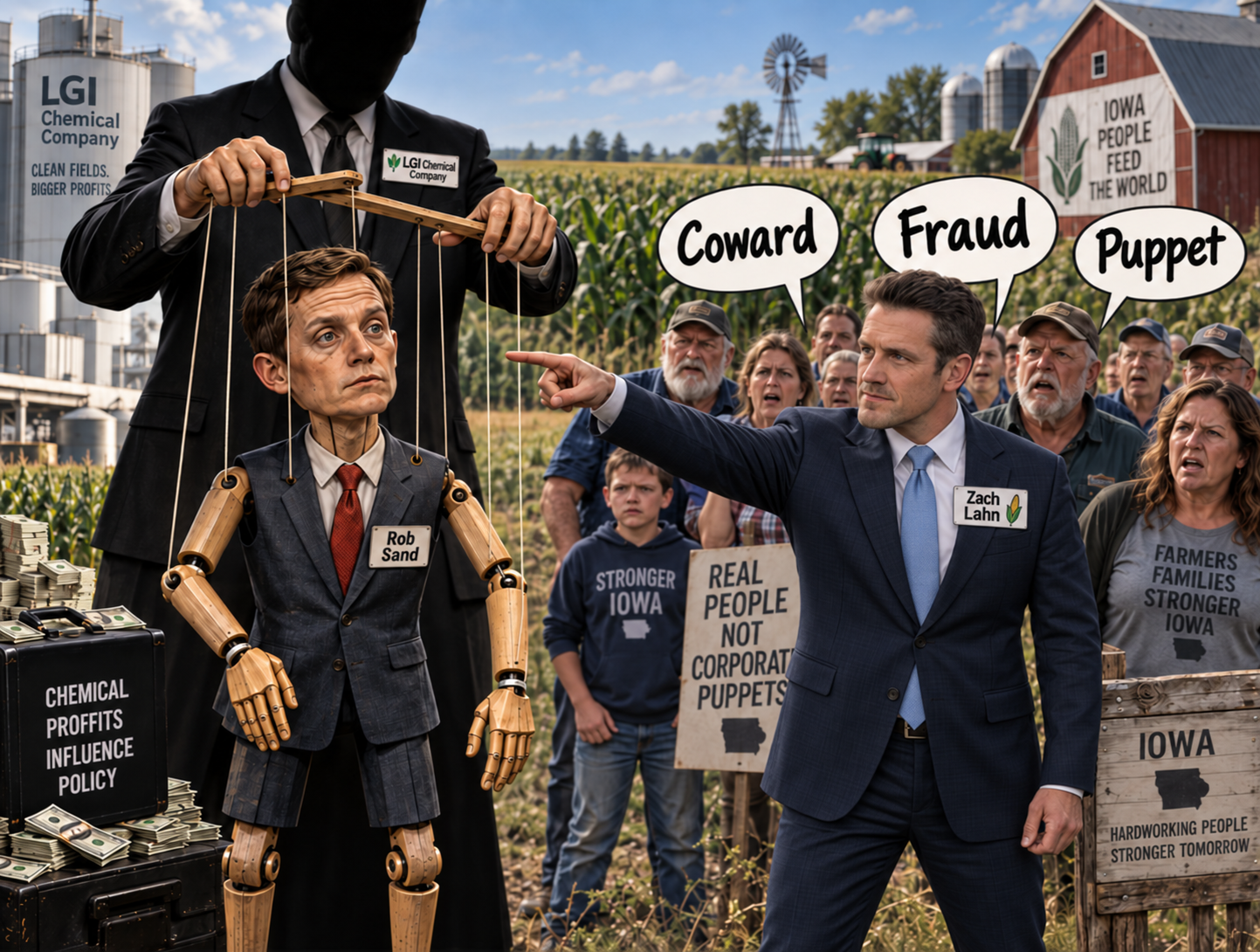
Rob Sand Scrambles as Handlers ‘LGI Chemical Co.’ Are Exposed

Published

on

Iowa’s open gubernatorial race has exposed a stark difference in substance and accountability. Democratic nominee and current State Auditor Rob Sand has spent the campaign leaning on accessible, low-complexity appeals—temporary gas tax relief, ending the privatized Medicaid system, raising the minimum wage to $12, and legalizing recreational marijuana regulated like alcohol. His cannabis plan, released on 4/20, focuses on capturing tax revenue currently flowing to neighboring states and treating the substance like beer. He also positions himself as an anti-partisan reformer calling for term limits, age limits, cognitive tests, and vetoes of “culture war bills.” These messages are easy to sell, but they avoid Iowa’s most entrenched problems.

Republican nominee Zach Lahn has taken a different approach, centering measurable goals on the issues that actually shape daily life in the state: the nation’s fastest-rising cancer rates, water quality tied to agricultural runoff and nitrates, the loss of roughly 10,000 family farms over two decades, and the steady outmigration of young Iowans. His proposals include funding the voter-approved IWILL program, offering refundable tax credits so farmers can adopt saturated buffers and regenerative practices without losing money, expanding water monitoring, pursuing antitrust action against major ag input companies, and creating an income-tax exemption for high-school graduates who stay or return, with the money directed toward a first-home down payment. He has also called for banning hedge funds from single-family homes, ending incentives for out-of-state corporations, restricting benefits for illegal immigrants, and abolishing Flock surveillance cameras. These are specific mechanisms, not slogans.

The contrast has sharpened as Lahn has directly exposed the funding and environmental record behind Sand’s campaign. Sand’s wife, Christine Lauridsen Sand, is CEO of The Lauridsen Group (LGI), a privately held Iowa holding company. Members of the Lauridsen family have contributed a combined $13.1 million to Sand’s campaigns since 2018—the largest amount from any single family source in recent Iowa history. One LGI subsidiary, Boyer Valley, markets high-nitrogen organic fertilizer products derived from poultry byproducts, including feather meal and blood meal. Another, Essentia Protein Solutions, has a documented history of Iowa Department of Natural Resources violations involving wastewater discharges, elevated ammonia, E. coli, lagoon overflows, and impacts on streams such as the West Fork Camp Creek. Lahn’s ads and debate exchanges have highlighted the donations alongside these records and asked what influence the funding carries on water-quality policy. Sand has pushed back, stating that the family business does not sell chemical nitrate fertilizer and that certain pollution claims were cleared, but the public record of contributions, DNR citations, and product marketing has forced him into repeated defensive explanations. The exposure has undercut Sand’s image as an independent reformer focused on clean water and has left him scrambling to reframe the story while Lahn continues pressing the issue on the trail and in debates.

Public polling currently shows Sand ahead, though some recent surveys have tightened (Emerson’s early-October numbers put it at a 4-point margin). That lead should be viewed with heavy skepticism. Iowa has long ranked among the hardest states in the country to poll accurately, a point analysts at FiveThirtyEight and others have made for years due to its rural electorate, high share of independents and non-party voters, low response rates, and the difficulty of reaching certain Republican-leaning demographics. The pattern of error has been consistent across recent cycles: polls systematically underestimated Donald Trump’s support in Iowa in 2016, 2020, and especially 2024, when the highly regarded Des Moines Register/Selzer poll had Kamala Harris ahead by 3 points only for Trump to win the state by roughly 13—a 16-point miss. Similar underestimation of Republican strength has appeared in past Iowa governor and statewide races. Non-response bias among rural and working-class voters who distrust media and polling operations has repeatedly produced results that look more favorable to Democrats until Election Day. If that same dynamic is repeating now, Sand’s current lead is inflated, and Lahn’s focus on water quality, cancer rates, family farms, and keeping young Iowans in the state is connecting with the voters who have been hardest for pollsters to reach.

Continue Reading

Iowa

Iowa’s Great Awakening has the Old Guard Crumbling

Published

on

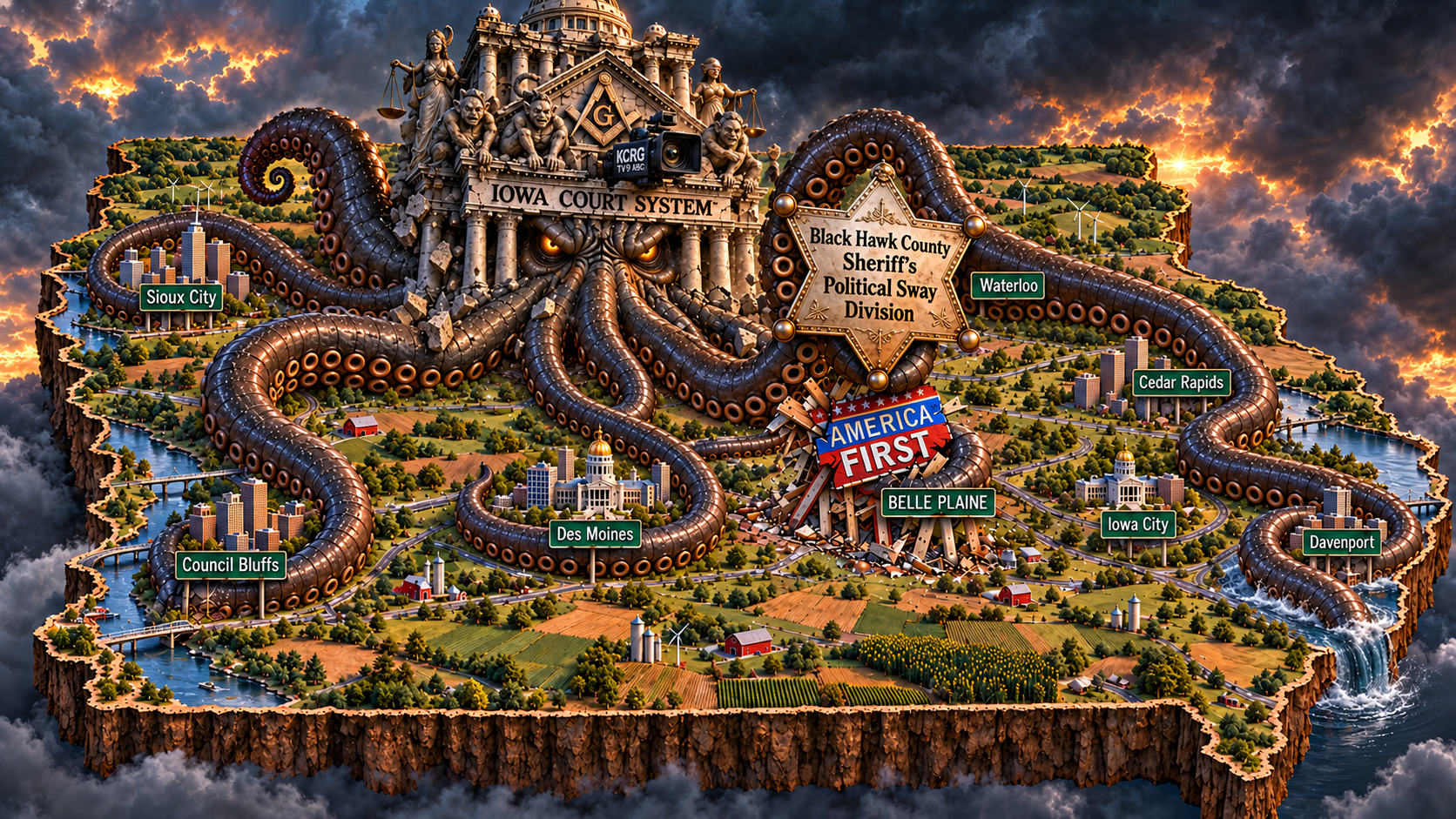
The tentacles in that image are not a metaphor the courts get to laugh off. They are the map.

The tentacles are not a metaphor the courts get to laugh off. Billy Dewayne Frazier IV already counted them. The federal gun case, he contends, was a fabricated prosecution in which the government failed to honor its own governing law, brought while he was preparing to challenge an illegal entry into his home and an unconstitutional search and seizure. Then came Linn County in 2016 and 2017. His children and stepchildren were effectively put on the table: take the plea or risk never seeing them again. He maintained his innocence. He was innocent. In April 2024 the pattern appeared again. He disputed an OWI arrest, and days later DHS came in through an ex parte order that he contends carried no case number and twelve allegations of child endangerment. By the summer of 2025 he had a federal civil RICO complaint in the Northern District of Iowa, habeas petitions, Eighth Circuit appeals, and a third amended complaint filed under duress on July 1, naming judges, prosecutors, public defenders, DHS, and law enforcement across eighteen years. The courts answered in order. Late stamp. Dismissed without prejudice. Certificate of appealability denied. Sanction warnings for filing again. Doors closed. The enterprise kept its badge. Frazier is what the Iowa court system does to a man who writes the names down. Derek Wulf is what it does when the name is already on a statewide ticket.

Wulf is the Republican nominee for lieutenant governor on Zach Lahn’s ticket, a state representative finishing his second term out of Black Hawk, Benton, and Tama counties, and the hog farmer behind Shallow Creek Land and Livestock. Lahn picked him in June and called him an Iowa First fighter. That is the offense. A bank already suing him, WCF Financial out of Webster City, called the Black Hawk County Sheriff’s Office on February 6, 2026, and reported possible fraudulent activity through that company. Sheriff Nate Neff’s office took the complaint, sat on the word “investigation,” and later told KCCI the findings had been turned over to the Black Hawk County Attorney. No charges have been filed. A farmer who owed money in a brutal hog market became, by September, a man under criminal investigation. The debt was real. The case was assembled.

Watch the hands. The Register went first, on September 4, with an active sheriff’s investigation the department would not describe. KCRG-TV9 was same-day: fraud accusations, a farm in receivership, the criminal line parked where a viewer cannot miss it and a lawyer cannot quote a charge. The camera on the courthouse pediment is not decoration. It is the distribution arm. A judge had already put Hertz Farm Management over the operation after WCF said a refinancing letter was late. Court papers had the lines of credit around $3.1 million as of early May, a checking account closed in November at $584,000 in arrears, a $182,000 hog bill from Four County Pig Placement, a $119,000 feed bill from Heartland Co-Op. Civil fights, most of them since settled. On October 3 Wulf said the Sioux County judgment was paid in full and the refinancing was done. The chyron did not retire. It had work to do.

The sheriff’s quote was the work. Lahn went on KCCI and said his running mate was not under criminal investigation, which was true in the only sense that matters: no charge, no warrant, no filed case. Neff answered with the line built for a lower third. “I can confirm that we have an investigation open involving Derek Wulf, but because it’s still ongoing, I can’t discuss the details of it.” An investigation that cannot be described, cannot be charged, and cannot be ended is not an investigation. It is a hold, issued to a camera. Days later Neff supplied the February bank report and the handoff to the county attorney, which is what a sheriff says once the political use of the file is complete. Dave Muhlbauer, Rob Sand’s running mate, had already called the selection disqualifying on September 10. The Iowa Democratic Party spent September 22 declaring Lahn caught in a lie, quoting the confirmation and skipping the absence of a charge. Lahn’s spokesman, Dan Capodilupo, called it a politicized witch hunt and said Wulf has not broken the law. He was describing a production, not a probe.

Nobody in that chain has to meet. They have done this long enough to know their marks. A lender makes the call. A sheriff confirms a case he will not describe. An affiliate camera and a Des Moines paper carry the word “investigation” into every living room. A Democratic ticket that had no criminal charge of its own borrows the badge. A county attorney sits on the handoff so the word stays alive through the race. Zach Lahn vetted a farmer. The courthouse vetted a threat. The star on the tentacle already has a name. Black Hawk County Sheriff’s Political Sway Division.

The Iowa establishment is freaking out because the machine is still running, and this time it got caught in the open. A bank complaint was dressed up as a case, walked out of the sheriff’s office, and handed to a camera. That used to be settled inside the building. It is now a public paint job, and the paint is not drying. Derek Wulf did not get investigated. He got painted. Zach Lahn did not get caught in a lie. The Iowa court system is the hand on the brush.

Continue Reading

Trending

Donate to Populist Wire

*Note: Every donation is greatly appreciated, regardless of the amount.