Politics
President Trump’s $5,000 Dividend is Populist Genius
Published
1 hour agoon
A successful country pays its owners. America is winning again. The people who live here should cash the dividend.
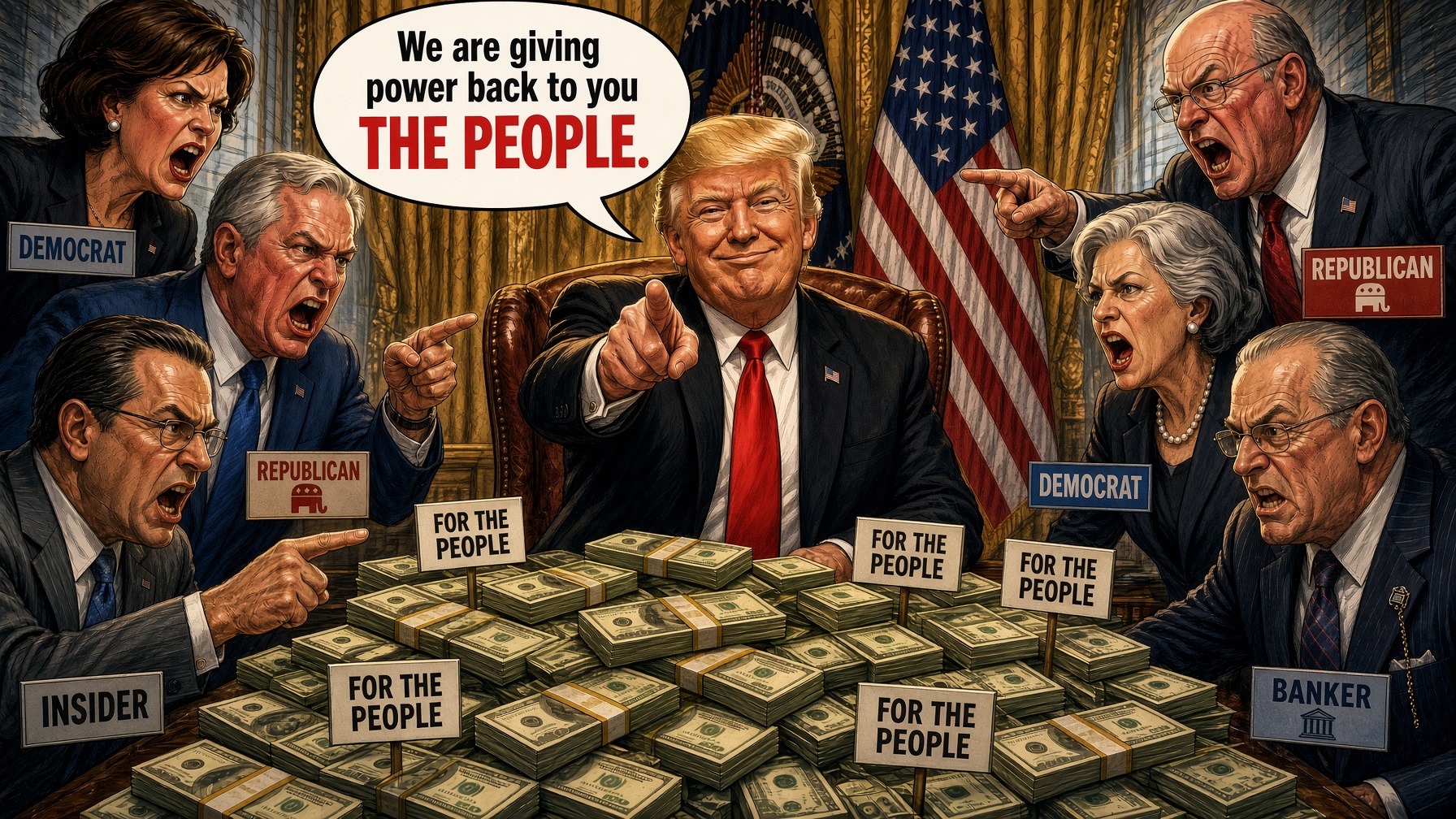
On September 9 in Dallas, President Donald Trump did what a president for the people is supposed to do. He looked at the American public — not the foundations, not the donor circuit, not the people who treat citizenship like a branding exercise — and he put a number on victory. If Republicans hold the House and the Senate on November 3, every adult U.S. citizen gets a $5,000 Trump Dividend, and that money gets spent in the United States. Not Canada. Not China. Not Germany. Here. He compared it to a winning company returning cash to its shareholders, and to the $1,776 checks his administration already put in the hands of American service members. That is the most American idea in the speech. The country is not a waiting room for the rest of the planet. It is an enterprise. Citizens are the shareholders. When the enterprise wins, the shareholders get paid.
This is exactly the fight populists have been in for a decade. We were told America First meant slogans. Trump is making it mean a check. Tariffs make foreign producers pay to sell into the richest market on earth. Factories come home. Energy comes back on. Borders close. Wages stop getting bid down by a conveyor belt of cheap labor. The surplus of that project does not belong to a think tank in Arlington and it does not belong to a contractor in Northern Virginia. It belongs to the nurse, the welder, the waitress, the retired couple, the kid trying to buy a truck. JD Vance said it after the speech: keep the project going and the public shares in the wealth it creates. That is not a theory. That is ownership.
The growth will eat the check — and then some
The professional class is already running the same tape they run every time money might reach an actual American household. They call it inflation. They call it a bribe. They call it socialism. Then they go back to waving through every foreign aid package, every bank rescue, every campus endowment, and every “allied” procurement that never created a single job in Youngstown. Ignore them. They have been wrong about this economy since the first tariff hit the dock.
America is not a broke charity. It is a country that, under this president, is pulling in investment, production, and tariff revenue on a scale the last crowd said was impossible. Commerce Secretary Howard Lutnick has already said the dividend is not a raid on the paycheck of the American worker and not another Washington deficit stunt. It is a distribution of success. That is the right frame. Five thousand dollars is not an emergency ration. It is a down payment on a boom that is going to run past the check. Growth compounds. Plants that open this year throw off wages, local taxes, and supplier orders for a decade. Energy that is cheap again makes every factory in the Midwest more profitable than the spreadsheet said it would be. A dividend spent inside the United States is not money leaving the system. It is money hitting American registers, American shops, American labor — and then coming back around again.
There is no reason to treat $5,000 as a ceiling. If the country keeps winning the way it is winning, the next distribution should be larger. Shareholders do not apologize for a good year. They take the dividend and they ask what next year’s looks like. That is the attitude this coalition was built for. We did not spend ten years fighting globalist trade, open borders, and a uniparty that shipped the industrial base overseas so we could get shy the minute the winnings showed up. The winnings are supposed to show up. In American pockets. In American towns. In cash you can spend at a store that employs your neighbor.
The leftover libertarians missed the plot
The loudest no on the right is coming from the same quarter that never made peace with the coalition that actually wins elections. The Cato dinner circuit. The Heritage memo. The National Review column that still thinks 2012 was the peak of Western civilization. They have a word for any check with a government logo on it, unless the check is made out to a defense prime, a semiconductor campus, or a fund manager who will offload the jobs the minute the ribbon-cutting photo hits LinkedIn. That view had its run. It gave us hollowed towns and a conservative movement that could recite Hayek while the middle class got carved up.
Working families did not walk out of the old GOP because they wanted another lecture about abstract virtue. They walked out because the party could find discipline for a waitress in Ohio and flexibility for everyone above her. Trump’s instinct is the correction. He talks like the country has owners, and he talks like those owners are allowed to get paid. The leftover libertarians hear “check” and they reach for 19th-century vocabulary. The rest of the country hears “finally.” Alaska has paid its people a resource dividend for decades and it did not turn into a cautionary tale. The military checks last December did not ruin the republic. A $5,000 dividend spent on American goods is the same idea at the scale the moment deserves.
The “must be spent in America” rule is the part they will pretend not to understand because it is the part that makes the policy serious. It is a border for capital. You take the dividend and you buy American groceries, American parts, American labor. That is economic nationalism in a form a normal person can cash. It is also why the growth argument is not a slogan. Money that stays here becomes payroll. Payroll becomes demand. Demand becomes another shift at the plant. That loop is how a country gets richer than the check it just wrote.
If Congress stalls, he does it himself
Republicans in Congress should pass it tomorrow. Adult citizens. Spent at home. No apology tour. That is the clean path, and they should take it. But this country has watched Congress sit on its hands while presidents found a way for wars, for bailouts, for foreign factories, and for every priority that never had to wait on a conference committee. A president for the people does not treat the American household as the one item that requires perfect parliamentary weather. Trump already said he does not think he needs a permission slip to deliver the dividend. Good. That is the correct posture. Serve the people first. Let the process people catch up.
Do it from the Oval Office if that is what it takes. Set the precedent out loud: this office exists to put American citizens first, and a winning country pays its owners. Every administration in living memory has stretched executive power for somebody. They stretched it for alliances. They stretched it for banks. They stretched it for agencies that never stand for election. Stretching it to put $5,000 in the pocket of the people who actually live here is not a scandal. It is the first time in a long time the stretch would run toward the public instead of away from it. If the old rules could move a trillion dollars anywhere but an American kitchen table, then the new precedent is simple. The president finds a way. There is not a version of this where the check dies in a hallway because a handful of senators wanted another hearing.
That is how you break the spell. You do not wait for the donor class to decide the American people are an approved recipient. You send the money. You make it normal. You make it expected. After that, every future president has to answer a new question: if he could deliver for citizens and he refused, whose president was he? That is the point of precedent. Not a loophole. A standard. The White House works for the country that voted, and when that country wins, the winnings show up at home.
Send the money. Keep going.
The midterms are a referendum on whether this government still belongs to the people who live under it. Trump answered with a number and a rule. Congress can write it into statute and take the credit. If they will not, the president should pick up the pen and do the job he was hired to do. Either way, the dividend moves. That is leadership. That is what it looks like when a man remembers the presidency is not a chairmanship of a journal. It is the one office in this country that is supposed to look a working family in the eye and say: you own this place, the place is winning, and nobody in Washington gets to misplace your share.
Five thousand dollars is the right number for the first distribution. The boom behind it is bigger than the number. If the country keeps doing what it is doing — tariffs that make foreigners pay, energy that makes production cheap, borders that protect the wage, factories that actually open — there is no reason the next dividend is not larger. Win. Pay the owners. Win again. Cash the check. Spend it here. And get ready for more.
Iowa
Rob’s House of Sand Collapsing in Bid for Iowa Governorship
Published
4 days agoon
September 8, 2026
Iowa is hungry for a real populist. Not another consultant-built “outsider.” Not another man in Carhartt who talks like a neighbor and governs like a donor list. Someone who will put citizens first on the border, keep the Second Amendment intact, break the two-party racket instead of feeding it, and stop treating farm families as a costume.
Rob Sand has spent a year auditioning for that job. He asks Republicans to raise their hands and then claps for them. He quotes Scripture. He talks about bowhunting, pizza, and “not redder or bluer, but better and truer.” He tells rooms he hates the two-party system. It is a polished performance of the candidate Iowa actually needs.
The problem is the performance keeps colliding with the paperwork.
The Independent Who Can’t Stop Being a Democrat
Sand is not a mystery independent who wandered onto a ballot. He is Iowa’s only statewide Democrat, running as the Democratic nominee for governor after no other Democrat qualified. He interned for Tom Harkin. He has backed Howard Dean, Hillary Clinton, Joe Biden, and Kamala Harris. In college he called himself “extremely liberal,” and he now says his values have not changed — only that “the parties may have moved.”
That last line is the tell. If your values never moved, the independent branding did.
He still says the quiet part out loud when he thinks the room is friendly. At a Grundy County town hall he explained party registration like a man who had to pick a locker: “I am a Democrat because when I realized that I had to pick a party in order to vote in a primary, I did so.” Then the theology: Jesus is for the little guy, and the Democratic Party “at its best” is too.
On X in October 2024 he put it even cleaner: “I’m mostly a Democrat because of my Christian faith, not in spite of it.” Critics who saved a later, more explicit “I am a Democrat” post say that one disappeared. Whether the deletion was cleanup or panic, the pattern is the same. The brand is independent. The confession, when it leaks, is partisan.

A populist does not need to hide his tribe. A marketer does.
Follow the Money, Not the Town-Hall Applause
Sand’s campaign loves small-dollar language. Teachers, nurses, $10 checks, all 99 counties. Some of that is real. So is the other ledger.
His wife, Christine Sand, is CEO of The Lauridsen Group, a global agribusiness and nutrition conglomerate built on livestock, dairy, feed, and animal-byproduct processing. Since 2024, Christine, her parents, and her brothers have poured on the order of $11.5 million into his race. That is not a bake sale. That is a family office writing the down payment on a governorship.
Then the coastal and institutional money arrived: Reid Hoffman of LinkedIn for $250,000; the Democratic Governors Association for $2.5 million; AFSCME, IBEW, the Iowa State Education Association, Fred Hubbell, Illinois Gov. J.B. Pritzker. Transparency USA filings show Sand’s committee has sent more than $1.4 million to the Iowa Democratic Party. Gazette reporting put the weekly party checks at $675,000 in just over two months in spring 2026; later coverage had the campaign’s party transfers around $750,000 as he shared a stage with DGA chair Andy Beshear.
So the man who says the two parties are private clubs starving independents is one of the Iowa Democratic Party’s largest cash sources. He slams the duopoly on Tuesday and funds its ground game on Wednesday. That is not rising above the system. That is owning a floor of it.
A populist campaign can take working people’s money. It cannot take Silicon Valley, national party PACs, public-sector unions, and an in-law agribusiness fortune, then lecture Iowa about insiders.
“Hallmarks of an Iowan” — If You Crossed the Line
On immigration, Sand talks like a pastor and governs like a sanctuary brochure.
He will concede that the Biden border was a mess and that he supports legal immigration. Then the policy slides. At town halls he has argued that people here illegally who work, pay taxes, and lack a criminal record should not “feel unsafe” in Iowa. He called the deportation of a West Liberty construction worker who showed up for an ICE check-in “wrong. Period.” He quoted “welcome the stranger.” He has said the traits of people here without legal status — working, paying taxes, treating neighbors well — “are the hallmarks of an Iowan.” He even floated “some kind of medicine” for entering illegally, then waved it off as a federal question.
That is not border realism. That is amnesty with a hymn attached.
Populists are not confused about this. A nation that will not enforce its line is not compassionate. It is a labor market for employers who prefer a workforce that cannot vote, cannot complain, and cannot easily leave. Iowa already lives with the costs: schools, hospitals, housing, wages in meatpacking and construction. Sand’s answer is to treat presence plus a paycheck as citizenship-adjacent, while staying slippery on whether a Governor Sand would keep Iowa cooperating with ICE. Republicans have pressed that question for months. The dodge is the answer.
Working Iowans who waited in line, or whose kids compete for the same apartments and overtime, are not villains for wanting the law enforced. Calling non-criminal illegal presence the “hallmarks of an Iowan” tells them their citizenship is a vibe.
The Bowhunter Who Won’t Carry the Second Amendment All the Way
Sand’s hunting biography is the campaign’s favorite camouflage. Decorah kid. Fox and Club. Ruger 10/22 at 14. An 870, a Super Black Eagle, a couple of SIG Sauers. “I like guns.” “I’m a different kind” of Democrat.
Iowa is not a may-issue museum anymore. It moved from discretionary sheriffs to shall-issue, then to constitutional carry, then to a state constitutional amendment putting gun restrictions under strict scrutiny. That is the settlement rural Iowa already made.
Sand will not go there. Asked whether an Iowa permit should be enough to carry in schools, he said no. The Daily Signal, citing his opponent’s research, reports he has backed stricter controls including may-issue discretion — the old system where a bureaucrat, not the Constitution, decides whether a law-abiding adult may carry. He owns guns. He does not want Iowa’s carry regime to stay as free as Iowans voted to make it.
That is the dual nature in one frame: blaze orange for the photo, permission-slip politics for the statute book.
The Little Guy With a Brown Degree and a Culture-War Veto
Sand sells himself as the anti-culture-war candidate who will “get state government out of the culture wars” and veto the bills he doesn’t like. Convenient veto. The fights he wants to retire are the ones his coalition already lost with Iowa voters: school choice he opposes, public-school books he does not want restricted, abortion positions his critics say include late-term permissiveness, and a record of treating sex-and-gender fights in schools as something a governor should refuse to touch.
You can dislike cheap culture-war content and still notice the pattern. “Leave it alone” usually means leave the last progressive settlement in place. Parents who wanted boys out of girls’ sports and explicit material out of elementary shelves were not asking for a sermon about polarization. They were asking for a governor who would not gaslight them.
A populist takes those parents’ side without apology. A brand manager changes the subject to singing “America the Beautiful.”
Why the Costume Works — and Why It Shouldn’t
Give Sand this: he diagnosed the market. Iowans are exhausted by party churches. Independents are a third of the state and locked out of closed primaries. People will clap for anyone who talks like he works for them instead of a color. His auditor years — prosecuting corruption, hiring a Republican and an independent into senior roles, getting his own office kneecapped by the legislature after he found misspent money — are the strongest parts of the resume. Those facts are why the costume almost fits.
Almost is the word.
The populist Iowa needs would not run as a Democrat while denouncing parties. Would not wire hundreds of thousands, then millions, into the Iowa Democratic Party. Would not take Reid Hoffman and the DGA and call it a people’s campaign. Would not let an industrial-ag family underwrite the bid and then talk about insiders in Des Moines. Would not tell a packed room that illegal presence plus a job is the hallmark of an Iowan. Would not hunt on Saturday and flinch from constitutional carry on Monday.
Sand is what the professional class builds when it studies populism the way a focus group studies a beer commercial. The plaid is real. The bow is real. The piety is rehearsed until it sounds like conviction. Underneath is a durable Democratic operative with a family fortune, a national party apparatus, and a set of positions on sovereignty and arms that Iowa already rejected.
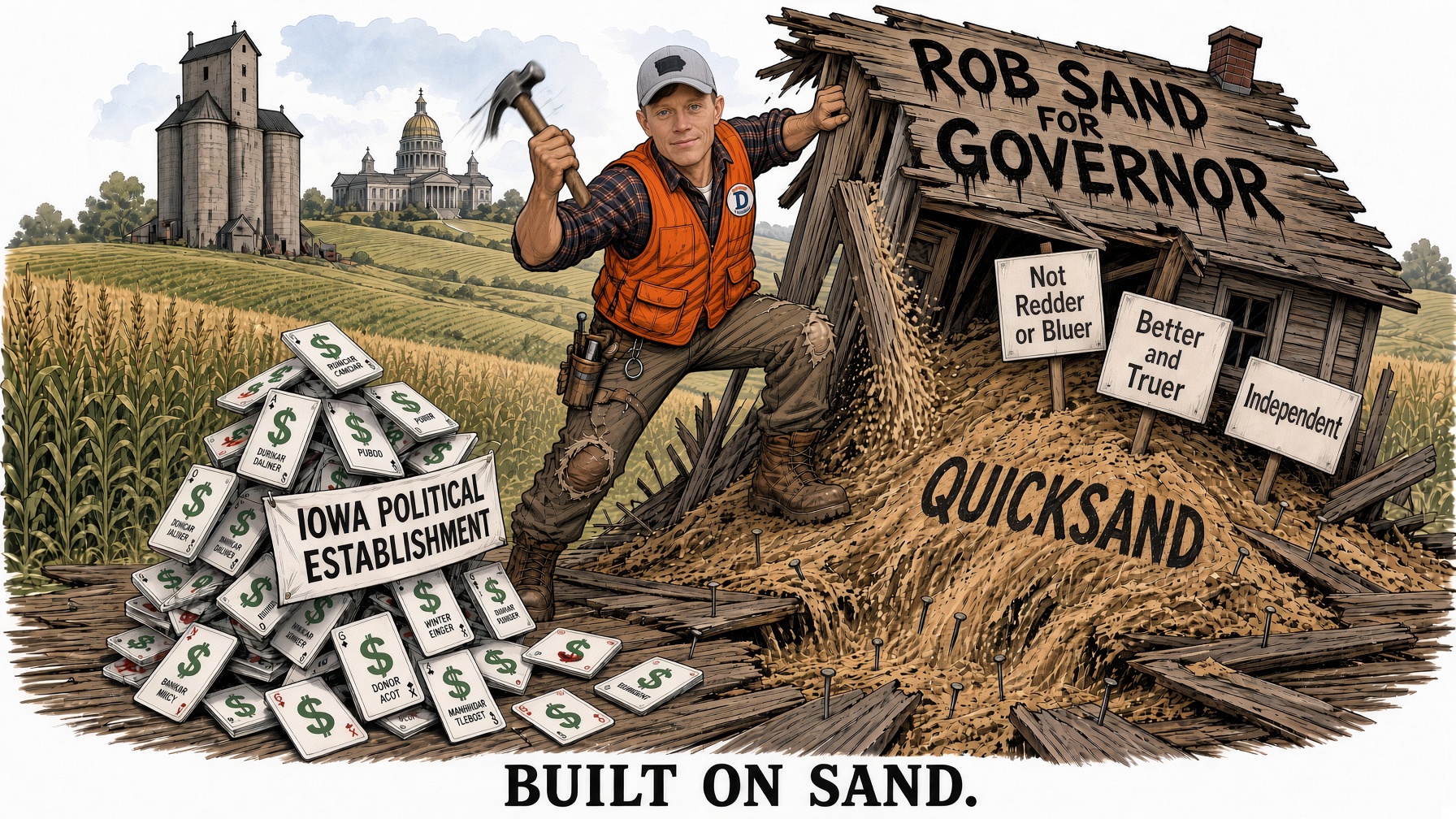
A house built on sand looks finished until the weather changes. November is weather. Iowans should look past the town-hall sing-along and ask the only question that matters in a populist year:
If he has to hide the D, hide the donors, and sand down the record to look like the man we need — what does that tell you about the man he is?
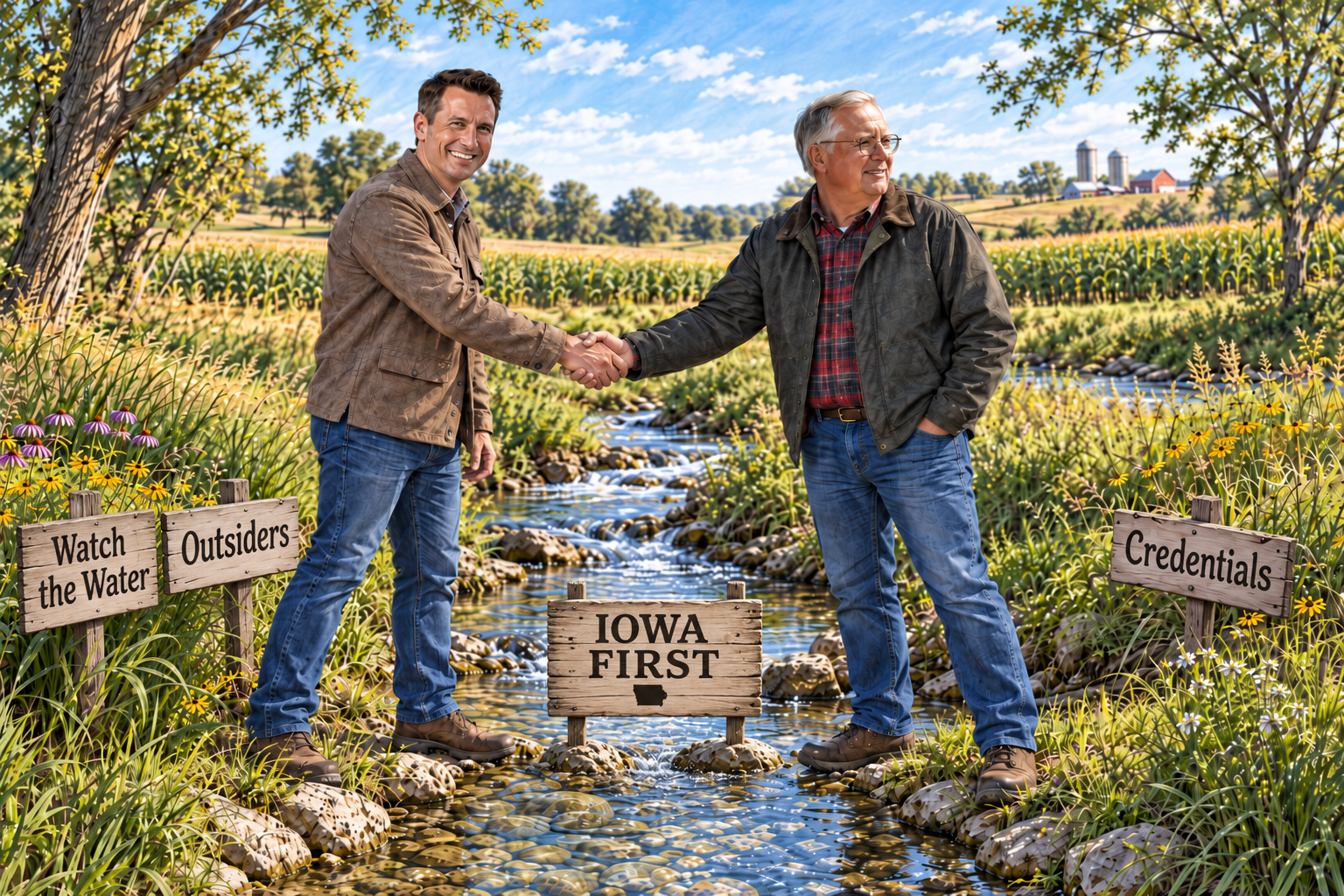
Zach Lahn is not running a standard Republican campaign against Iowa Auditor Rob Sand. He is running a fact pattern: who pays, who owns the land, who gets the tax break, and whether Sand’s moderate act matches the record.
Lahn won the June 2 Republican primary as a first-time candidate, beating U.S. Rep. Randy Feenstra — the sitting congressman who had President Trump’s endorsement — by less than a point. He did it on an Iowa First message aimed at agricultural monopolies, out-of-state farmland buyers, water quality, cancer rates, data-center subsidies, and property taxes. Trump later endorsed him for the general election. The primary already showed the argument travels.
Sand is the Democrat in the race, the only member of his party holding statewide office, and the front-runner in recent polling. A Suffolk University survey conducted August 20–23 had Sand at 48 percent and Lahn at 44 percent among likely voters. Emerson in early August had Sand 48, Lahn 43. Sand has also built the larger war chest. Campaign reports put his haul near $20 million, with about $18 million on hand after a midsummer filing. The Democratic Governors Association gave him $2.5 million. A large share of the early money came from his wife, Christine Lauridsen, and her parents. Lauridsen is CEO of the family-owned Lauridsen Group, a health-and-nutrition company with annual revenues in the hundreds of millions. Since 2024, she and her family have put more than $10 million into Sand’s political operation.
That is the first fact Lahn keeps putting on the table. Sand campaigns as the auditor from Decorah who asks Republicans to raise their hands at town halls and talks about making Iowa “better and truer, not redder or bluer.” He has said he would not want Joe Biden or Kamala Harris to campaign for him. The donor list is not a small-donor auditor campaign. It is family industrial money plus national party money, wrapped in a retail-politics brand.
Lahn’s second fact is the national left. Sand has been endorsed by Sen. Elizabeth Warren and Rep. Alexandria Ocasio-Cortez. On the Ruthless podcast in July, Lahn said Democrats “are realizing that their ideas don’t sell,” so “they have to pretend to be somebody they’re not.” Sand’s public platform includes ending Iowa’s privatized Medicaid system, making data-center operators pay more, raising the minimum wage, and adding accountability to school-voucher spending. Those items have local support in some counties. They are also standard Democratic governing aims. Lahn’s case is that Sand is running the second as if it were the first.
The auditor title is Sand’s strongest credential. He was a public-corruption prosecutor in the attorney general’s office and has been state auditor since 2019. He says he uncovered more waste, fraud, and abuse in a term than any Iowa auditor before him, and that he kept a Republican and an independent in senior roles.
Lahn has refused to treat the title as a closing argument. His campaign ran an ad using KCCI language about millions in state funds and an auditor’s office that “took no action.” Sand called the ad “fundamentally dishonest.” The station said its anchors’ words were taken out of context. The judicial branch has said a court-debt misallocation could not have been detected by an audit and that no money left public accounts. Lahn’s answer in Britt on August 1 was direct: “They’re not false. He is not doing his job.” The dispute is now part of the record. So is Lahn’s refusal to grant Sand a pass because the office stationery says Auditor.
Sand’s campaign has answered with biography. Lahn grew up near Sioux City and bought his family’s Belle Plaine farm, a property he describes as established in the 1900s. He also built a life in Kansas: Homeplace Ventures, the Wichita private school Wonder that he and his wife helped found, a residence there, and Kansas votes in 2018, 2020, and 2022. He changed his Iowa voter registration more recently and has used a personal plane to travel between the states. Sand’s line is that Iowa has “full-time problems” that will not be solved by a “part-time Iowan.” Democrats have called him a carpetbagger.
Lahn calls those attacks personal and says he is a sixth-generation Iowan who will live in the state full-time if elected. The residency fight is real. It is also the fight Sand prefers, because it is not about packers, nitrates, land funds, or who writes Sand’s checks.
On policy, Lahn has kept the populist list specific. He has pledged to break up what he calls big-ag monopolies and get farmers a fair deal. He has linked Iowa’s high cancer rates and water problems to corporate agriculture and said the state should find out what companies knew and when. He has called for raising taxes on AI data centers — he has used a 500 percent figure — and cutting property taxes for residents. He has said data-center power use and surveillance cameras such as Flock should be regulated at the state level. He has backed education savings accounts while saying the governor must also be “the number one advocate” for public-school children. He is aligned with the Make America Healthy Again network that endorsed him in the primary.
Sand has moved onto some of the same terrain because he has to. He has sat with ethanol producers, campaigned with former Gov. Tom Vilsack on farm policy, and called a Trump administration deal to lower the cost of imported beef “a blow to Iowa farmers and cattlemen.” He has talked about ending privatized Medicaid, taxing data centers, raising the minimum wage, and auditing voucher schools that take public money. The overlap is the point of Lahn’s attack. If the Democrat is now using farm-and-ratepayer language, it is because Lahn made those the price of admission.
That is the exposure. Sand has the polls, the cash on hand, and a practiced moderate pitch. Lahn has the primary scalp, the anti-monopoly message, and the simpler question about who is funding the man across from him. Iowa’s governor’s race is now being fought on Lahn’s ground — land, water, cartels, data centers, and whether a candidate’s story matches his bank account. Sand can win it. He cannot pretend Lahn made the subject up.
Politics
James Fishback Can Stop Byron Donalds From Stealing This Election
Published
4 weeks agoon
August 15, 2026
James Fishback is the only candidate who can galvanize a real Florida First movement for the people. Byron Donalds is trying to steal the nomination like a thief in the night—money, endorsements, debate refusals, and institutional muscle—while the actual fight for ordinary Floridians gets sidelined.
Fishback, the 31-year-old fourth-generation Floridian and outsider, is running straight at the core problem: Florida is being priced out from under the people who live here. He is the only one treating that as the central issue instead of a talking point. Ban new AI data centers that drive up power and water costs while delivering almost nothing back. Stop private equity and corporate buyers from vacuuming up single-family homes so young families can actually own instead of rent forever. Eliminate property taxes on homesteaded homes for residents while leaving them on vacation properties and non-residents. Put Floridians first over donors, tech developers, and the permanent political class. That is what “populist” means here—ordinary people over the interests that treat the state as a product.
The energy is real. Young voters are showing up for him in ways the other campaigns cannot match. Campus events, packed small venues, early turnout among under-40s. They hear someone who sounds like he understands the cost-of-living pressure and the sense that the state is being sold out. No one else in the race is converting that frustration into a coherent Florida First agenda the same way.
Donalds has the Trump endorsement, the fundraising advantage, and the party machinery. He leads the polls. That is the reality. The way he is running is the problem. He refuses debates. The party set thresholds that only he meets so no official debate happens. Opponents get treated as illegitimate rather than answered. The strategy is clear: close the race with money and institutional power before the people-first argument ever gets a real hearing. That is how you steal an election in the dark—win the process while the substance never has to face the voters who are actually struggling.
Fishback is the only candidate forcing that substance onto the table. The rest of the field is counting on voters not noticing until the primary is already decided. The question now is whether Florida Republicans want a nominee who leads the movement for the people who live here, or whether they will accept the quiet, well-funded path that treats that movement as an inconvenience.
President Trump’s $5,000 Dividend is Populist Genius
Rob’s House of Sand Collapsing in Bid for Iowa Governorship
Why Donald Trump Is the Greatest President in American History
Populist Wire Endorses David Jolly: Why Byron Donalds Doesn’t Deserve to be Governor of Florida
Zach Lahn Uses Populist Rhetoric To Expose Rob Sand
Now Iowa is Watching the Water
James Fishback Can Stop Byron Donalds From Stealing This Election
Why Donald Trump Is the Greatest President in American History
Data Center Resistance Reckoning Against Tech-State