Politics
Trump’s Reverse Psychology to Expose Zionism
Published
4 months agoon
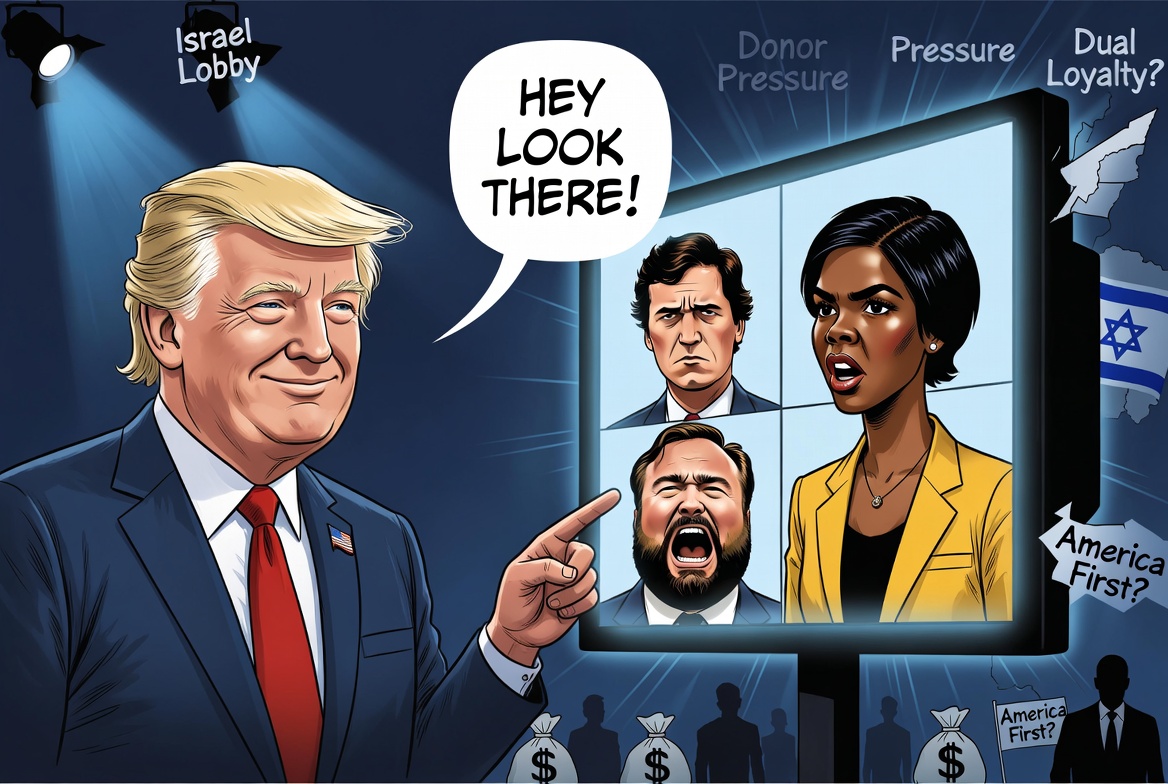
In a fiery Truth Social post this week, President Donald Trump unloaded on four prominent conservative voices—Tucker Carlson, Candace Owens, Alex Jones, and Megyn Kelly—calling them “low IQ,” “stupid people,” “nut jobs,” “troublemakers,” and “losers” who aren’t real MAGA. The trigger? Their vocal opposition to U.S. military escalation against Iran, which critics frame as part of a broader joint U.S.-Israeli campaign in the region. Trump spent hundreds of words attacking them while insisting his actions align with keeping nuclear weapons out of Iran’s hands, the number one state sponsor of terror.
The attacks were personal. Trump mocked Jones over his Sandy Hook-related bankruptcy, jabbed at Owens’ past comments on Brigitte Macron, questioned Carlson’s education, and dismissed them all as irrelevant podcast hosts chasing publicity. In response, Owens quipped it might be time to “put Grandpa up in a home.” Jones suggested Trump had changed and prayed for him to be freed from “demonic influences,” while Carlson has repeatedly called Trump a “slave” to Israel, arguing the war serves Israeli interests over America First.
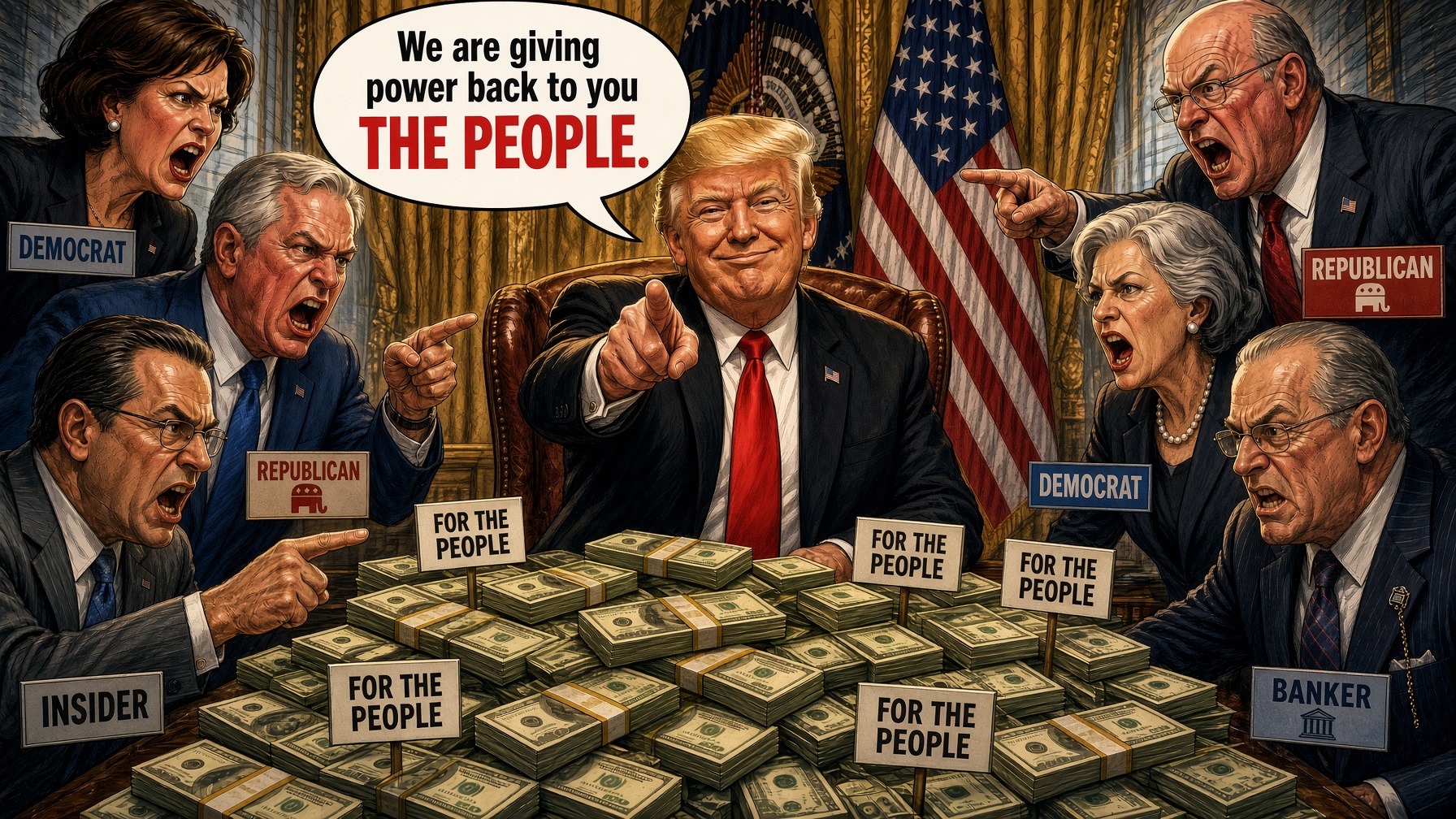
On the surface, this looks like a messy MAGA civil war: Trump, once boosted by these influencers, now turning on them over foreign policy. But zoom out, and a sharper pattern emerges. Trump’s willingness to take the punch—alienating loud voices in his own coalition—functions like reverse psychology. By drawing a hard line and inviting the inevitable backlash, he spotlights the very issues his critics obsess over: Israel’s influence on U.S. policy, AIPAC-style lobbying, donor pressures (think Miriam Adelson’s past contributions), and accusations of “Zionist control” over decisions from embassy moves to strikes on Iranian targets.
The Feud in Context
These critics didn’t start the fight in a vacuum. Carlson has questioned whether Israel is “blackmailing” Trump or holding leaders “enslaved,” framing U.S. involvement in the Iran conflict as contrary to America First promises. Owens has accused Trump of betraying troops for Israel, warned of false flags, and tied various events to Zionist lobbying. Jones has echoed themes of external “influences” pulling strings. Their pushback intensified as Trump defended actions against Iran, with some alleging the timing and scope served Netanyahu’s agenda more than strict U.S. interests.
Trump’s response? Instead of ignoring or quietly sidelining them, he amplified the rift with over-the-top rhetoric. The result: millions of eyes now glued to the debate. Every reply from Jones, Owens, or Carlson recirculates claims about undue foreign influence, Epstein files speculation (often laced with conspiracy), Adelson donations, and the broader “Israel lobby.” What was once fringe muttering in echo chambers becomes mainstream conservative infighting—broadcast on X, podcasts, and news cycles.
This isn’t subtle. Trump has a long history of transactional deal-making, including strong pro-Israel moves in his first term (Jerusalem embassy, Abraham Accords, Golan recognition) that pleased evangelical bases and certain donors while advancing what he saw as U.S. leverage. He’s also repeatedly warned against endless wars and nation-building. By punching right on this fault line, he forces the “anti-Zionist” wing of MAGA to overplay their hand, turning abstract gripes into concrete examples of division.
Mastercraft or Self-Sabotage?
Call it masterful political jiu-jitsu or chaotic disruption—Trump absorbs the hits to expose fractures. Critics on one side see him “caving” to neocons, donors, or Israeli security needs against a nuclear Iran. On the other, his base loyalists view the influencers as grifters who abandoned him the moment policy got tough, prioritizing isolationism over confronting terror sponsors. Either way, the spectacle drags Zionist influence, lobbying power, dual-loyalty whispers, and Middle East entanglements into the open for public dissection.
- Pro-Trump read: He’s prioritizing American security (no Iranian nukes) and calling out disloyal voices who bash him while riding his coattails. The feud proves he’s not controlled—he’s fighting on multiple fronts.
- Critics’ read: The attacks confirm external pressures overriding campaign rhetoric, with Trump “mad that he got set up by Israel.”
- Neutral observer: Regardless of who’s “right” on Iran policy, the infighting spotlights real questions about foreign aid, lobbying transparency, and whether U.S. decisions should ever prioritize another nation’s survival over domestic priorities like borders and debt.
Trump’s brand has always been willingness to brawl in public, even with allies. He takes the punch knowing it generates attention, frames the narrative, and lets opponents reveal their priorities. Here, by escalating against popular podcasters, he ensures debates over “Zionism” vs. strategic alliances, influence ops, and America First consistency dominate the discourse. The louder the backlash, the more those topics—usually confined to niche corners—flood timelines and force ordinary voters to confront them.
Whether this is deliberate 4D chess or raw instinct, the effect is the same: exposure. The feud isn’t hiding Israeli or Zionist sway; it’s thrusting it under the spotlight for millions to judge. Trump’s history suggests he bets on his base seeing strength in the fight, not weakness in the fray. In a polarized media age, taking the punch while the critics swing wildly may be the ultimate way to make the underlying tensions impossible to ignore.
The right is splintering in real time. How it resolves will say as much about U.S. foreign policy priorities as it does about Trump’s unique style of disruption. One thing is clear: no one’s looking away.
Politics
Online Provocateurs Try to Sabotage America First, Nick Fuentes, & the Groypers
Published
5 days agoon
August 2, 2026
There’s a familiar pattern on the online right. Someone builds something real over years — an audience, a coherent worldview, a network of young people who actually show up, a brand that survives deplatforming and institutional hostility — and then a new wave of operators appears to declare it illegitimate. They didn’t organize the events, endure the bans, cultivate the base, or hold the line when it was costly. They simply want the throne, or at least the right to tear it down for engagement.
That’s the story with the latest round of attacks on Nick Fuentes and the Groypers.
Fuentes did not inherit a ready-made audience or a friendly institutional lane. He built America First the hard way: livestreams that were repeatedly banned, campus activism that forced conversations the mainstream right preferred to avoid, a persistent focus on immigration, foreign policy realism, and cultural continuity that resonated with a generation of young men who felt the older conservative institutions had failed them. The “Groyper” label stuck because it described a real, identifiable cohort that kept showing up — at events, online, and increasingly in the pipelines of young Republican staffers and campus organizations. Even hostile outlets now admit the influence is measurable enough to worry about.
Building and maintaining that requires consistency under pressure. It requires continuing after payment processors cut you off, platforms exile you, and former allies distance themselves the moment the heat rises. It requires producing content night after night while the same critics who call it a “cult of personality” or “just streaming for donations” produce little of comparable durability themselves.
Contrast that with the new critics. Many of the loudest voices attacking Fuentes right now never constructed a parallel youth movement. They did not spend years turning online discontent into organized pressure. Some are lifestyle influencers or late arrivals who discovered the America First energy after it had already been cultivated, then decided the man who did the cultivation is the problem. Others are established conservative media figures who spent years ignoring or dismissing the concerns that Fuentes amplified, only to pivot into anti-Groyper moralizing once the numbers became impossible to ignore. Still others are former adjacent figures whose main contribution has been internal drama, fed accusations, and calls for people to abandon the only sustained effort in that space.
The charge that Groypers “haven’t earned the right to a movement” is particularly rich coming from people who have earned even less. A movement is not measured solely by formal PAC filings or official party titles. It is measured by whether people keep showing up, whether the ideas spread into institutions that once excluded them, and whether the core message survives repeated attempts to isolate it. By those standards, the record is clear: the people now declaring the project dead or illegitimate are usually the ones who never built a comparable alternative. They critique the architecture while offering no blueprint of their own.
What many of these attacks actually reveal is resentment at the existence of an independent pole. Fuentes and the Groypers represent a faction that cannot be fully managed by the usual donor class, media gatekeepers, or careerist influencers. That independence is treated as the real offense. If the movement can be framed as pure grift, pure online toxicity, or pure personality cult, then the hard work of building it can be dismissed and the energy redirected toward safer, more controllable channels — or simply dissipated through endless internecine fights.
Sabotage does not always look like open opposition from the left. Sometimes it looks like people on the same side of the broader cultural fight deciding that the one person who actually constructed durable infrastructure must be brought down so that no one else can claim leadership without their permission. The result is predictable: energy that could go into organizing, messaging, and institutional pressure is instead spent on purity spirals, fed-jacketing, and performative denunciations.
None of this requires treating Fuentes as above criticism. No political figure is. Tactical disagreements, questions about tone, or debates over prioritization are legitimate. What is not legitimate is the posture that says the only people allowed to speak about the future of the right are those who never did the unglamorous work of building an actual base that persists beyond a news cycle. The people who spent years creating something durable have more claim to it than the people who arrived later to declare it worthless.
Movements are not granted by committee or by the approval of competing influencers. They are earned by the people who show up when it is hard, keep producing when the platforms turn hostile, and refuse to dissolve when the internal knives come out. The new online critics have not done that work. They have not maintained anything comparable. Their primary contribution, in too many cases, is the attempt to dethrone the people who did.
That is not leadership. It is freeloading on someone else’s foundation while trying to knock the walls down.
Iowa
Zach Lahn’s Win is a Populist Blueprint for America First Republicans
Published
6 days agoon
August 1, 2026
In early June 2026, a sixth-generation Iowa farmer and political newcomer named Zach Lahn did something most consultants said was impossible. He defeated a sitting congressman, Randy Feenstra, who carried President Trump’s endorsement, in the Republican primary for governor. Lahn won a narrow but decisive victory in a crowded five-candidate field, capturing roughly 38% of the vote to Feenstra’s 37%. The establishment was outspent in key ways, outworked on the ground, and ultimately rejected by voters who wanted something different.
Lahn ran explicitly as an “Iowa First” candidate. That slogan is not marketing fluff. It is the state-level application of the same principle that animates the national America First movement: the people who live in a place, work its land, raise its families, and bear the consequences of policy should come before corporate cartels, out-of-state investors, foreign interests, and the permanent political class.
The populist core of the campaign
Lahn’s platform centered on concrete grievances that ordinary Iowans feel every day. Iowa has some of the world’s best farmland, yet family farms have been disappearing by the thousands. More than a quarter of Iowa land is controlled by out-of-state and foreign owners. A handful of companies dominate inputs. Cancer rates in the state rank among the highest and fastest-rising in the nation, a crisis Lahn and many farmers attribute in part to the chemical and industrial agricultural system. Young people continue to leave. Communities hollow out.
Lahn’s response was blunt: break up the monopolies, keep Iowa land in Iowa hands, prioritize family farms over Big Ag, demand accountability from corporations that treat farmers and families as numbers rather than neighbors, and make the state healthy again through cleaner food, water, and medicine. He accepted the first endorsement from RFK Jr.’s MAHA Action PAC and framed the fight as one against a rigged system that benefits special interests over the people who actually live there.
In his victory speech he drove the point home: nobody thought it could be done. They were outspent, opposed by the establishment, told to wait their turn. The people of Iowa answered that the state does not belong to the lobbyists, special interests, and corporate giants. It belongs to them.
This is textbook populism. It is not left-wing redistribution or right-wing nostalgia. It is the insistence that concentrated power—whether corporate, bureaucratic, or globalist—has extracted too much value from the productive majority, and that the remedy is to restore sovereignty to the people who actually inhabit the place.
America First is the governing principle
“Iowa First” is simply America First applied to a state. The same logic scales. A nation that refuses to put its own citizens, workers, borders, industries, and cultural inheritance first will eventually cease to function as a coherent nation. The alternative—treating the country as an open platform for capital, labor, and ideology from anywhere—has produced precisely the hollowed-out communities, eroded trust, and elite detachment that voters are rejecting.
Lahn’s win shows the political potency of this approach even inside a party that already claims the Trump mantle. Trump’s endorsement of Feenstra was not enough to overcome a candidate who spoke more directly to local economic pain, health concerns, and cultural continuity. Voters rewarded the candidate who treated the soil, the water, the family farm, and the next generation as inheritance rather than commodities. That is the same instinct that fuels resistance to open borders, endless foreign wars that drain American blood and treasure, trade policies that gut domestic industry, and institutional capture by interests that view Americans as interchangeable units.
The uniparty dynamic Lahn criticized—career politicians on both sides who protect the same corporate and institutional arrangements—exists nationally. When voters sense that the system is designed to extract from them rather than serve them, they look for candidates willing to say the system itself is the problem. Lahn did that on the issues that matter most to rural and working people in his state. The same dynamic operates everywhere elites have insulated themselves from the consequences of their own policies.
Why this is the way forward
America First is not a slogan. It is a recognition of political reality. Nations that refuse to prioritize their own people eventually lose the capacity to provide security, prosperity, or continuity. Local versions of the same principle—Iowa First, Texas First, whatever the place—are how the larger project becomes durable. They rebuild the habits of stewardship and mutual obligation that abstract globalism dissolves.
Lahn’s narrow upset will not decide the November general election by itself. But it already demonstrated something important: when a candidate speaks clearly about protecting the productive base of a community from concentrated power, and does so without apology, voters respond. The political class can be beaten. Special interests can be named. The people who actually live in a place can still assert that the place belongs to them.
That is populism at its best. And it is why America First is not a temporary mood. It is the only coherent response to a system that has spent decades treating the American people as an afterthought. Iowa just offered another data point. The pattern is becoming hard to miss.
Iowa
Randy Feenstra Built on Kim Reynolds’ Betrayal of Steve King: The Artificial Replacement Who Ousted a Conservative Warrior
Published
2 months agoon
May 30, 2026
In the summer of 2020, Iowa’s 4th Congressional District witnessed one of the most brazen establishment takeovers in recent Republican politics. Nine-term Congressman Steve King—the fiery, unapologetic voice of rural conservatism, border security, and Western civilization—was unceremoniously dumped by his own party. In his place? State Senator Randy Feenstra, a polished, establishment-backed challenger who cruised to victory in the June 2 primary with 45.5% of the vote to King’s 35.8%.
This wasn’t a grassroots revolt. It was a calculated betrayal orchestrated by the very insiders King had helped elevate—including Governor Kim Reynolds, whom he had proudly endorsed and supported just years earlier.
The Endorsement: King Lifts Reynolds When She Needed Him Most
Flash back to 2017-2018. Kim Reynolds was running for a full term as governor after ascending from lieutenant governor. Steve King didn’t just back her—he went all-in. Reynolds named King a statewide campaign co-chair and proudly touted his endorsement. In a November 2017 press release, she gushed: “Congressman Steve King is a strong defender of freedom and our conservative values. He’s independent, principled, and is fighting the good fight in Washington, D.C. You never have to question where he stands.”
King delivered for Reynolds in the heavily conservative 4th District. She rode that support to victory in 2018. Their alliance was public, mutual, and mutually beneficial—classic Republican teamwork, or so it seemed.
The Betrayal: Reynolds Stabs King in the Back
Fast forward to January 2019. After years of King being smeared by the media for his blunt defense of immigration enforcement and cultural issues, House Republican leadership stripped him of his committee assignments over remarks questioning why “white nationalist” had become a slur. King’s enemies pounced. Enter Randy Feenstra, who announced his primary challenge against the incumbent.
Governor Kim Reynolds? She didn’t lift a finger to defend the man who had co-chaired her campaign. Instead, she publicly washed her hands of him. In an interview with WHO-TV, Reynolds declared she would “stay out of the primary” but pointedly noted King’s surprisingly close 2018 re-election as a “wakeup call.” Translation: She wasn’t backing King over Feenstra.
Prominent Iowa Republicans like Sens. Chuck Grassley and Joni Ernst followed suit and stayed neutral—abandoning the pattern of past support for King. Meanwhile, Feenstra raked in cash from the U.S. Chamber of Commerce, National Right to Life, the Republican Jewish Coalition, and other establishment heavyweights. He painted King as “caustic” and ineffective, precisely the line the D.C. and Des Moines insiders wanted to hear.
Steve King, the guy who had carried water for the party through thick and thin, was left twisting in the wind. The same Reynolds who once called him a “strong defender of conservative values” now stood aside while the machine dismantled him.
Feenstra: The Artificial Candidate
Randy Feenstra didn’t storm onto the scene as a populist firebrand with grassroots rage behind him. He was the safe, scripted alternative. A state senator from Hull whose district overlapped King’s, Feenstra resigned a powerful Ways & Means committee chairmanship to run full-time—signaling deep establishment buy-in. He outraised King dramatically and dominated his home turf, but the broader narrative was clear: this was the party clearing out the “problematic” incumbent for someone who wouldn’t rock the boat or make national headlines for the wrong reasons.
Feenstra’s campaign pitch boiled down to “effectiveness” over principle. He criticized King’s rhetoric while promising results—code for “we’ll keep the seat Republican without the drama.” National GOP groups poured in to protect the safe red district from any general-election risk. King, stripped of power in Washington, was portrayed as the reason the district lacked a “seat at the table.”
The voters in the primary bought it. Feenstra won. King was out. The establishment had its man.
Why This Still Matters: The Pattern of Artificial Republicans
This wasn’t about ideology—Feenstra and King both cast conservative votes. It was about control. Steve King represented the raw, unfiltered voice of the heartland that made the Republican Party a fighting force. The insiders—Reynolds, the Chamber, the national PACs—wanted someone more manageable. Someone who wouldn’t embarrass them on cable news. Someone “artificial”: manufactured by money, party machinery, and calculated neutrality from the very people King had once helped.
Fast-forward to today, and the irony is thick. Feenstra is now running for governor in 2026, positioning himself as the heir to the Reynolds legacy. Meanwhile, Steve King—still influential in conservative circles—has thrown his support behind a challenger attacking Feenstra as the ultimate establishment candidate.
The 2020 primary wasn’t a rejection of conservatism. It was the establishment’s successful coup against one of its own most outspoken warriors. Randy Feenstra didn’t earn that seat through pure populist fire—he was handed it after the party betrayed the man who had helped build their machine.
Iowa conservatives should never forget: when the insiders decide you’re too loud, too principled, or too effective at exposing the real threats facing America, they’ll find a “cleaner” replacement. Steve King learned that the hard way. The rest of us should learn from it before the same machine installs more artificial candidates across the country.
Online Provocateurs Try to Sabotage America First, Nick Fuentes, & the Groypers
Zach Lahn’s Win is a Populist Blueprint for America First Republicans
“Despite What You All Think”: Nearly $150 Million in New Water Commitments Follow Reynolds’ Defense of Iowa’s Record
Safe Elections By Any Means Necessary
Populist Wire is Back
“Despite What You All Think”: Nearly $150 Million in New Water Commitments Follow Reynolds’ Defense of Iowa’s Record
Zach Lahn’s Win is a Populist Blueprint for America First Republicans
Safe Elections By Any Means Necessary