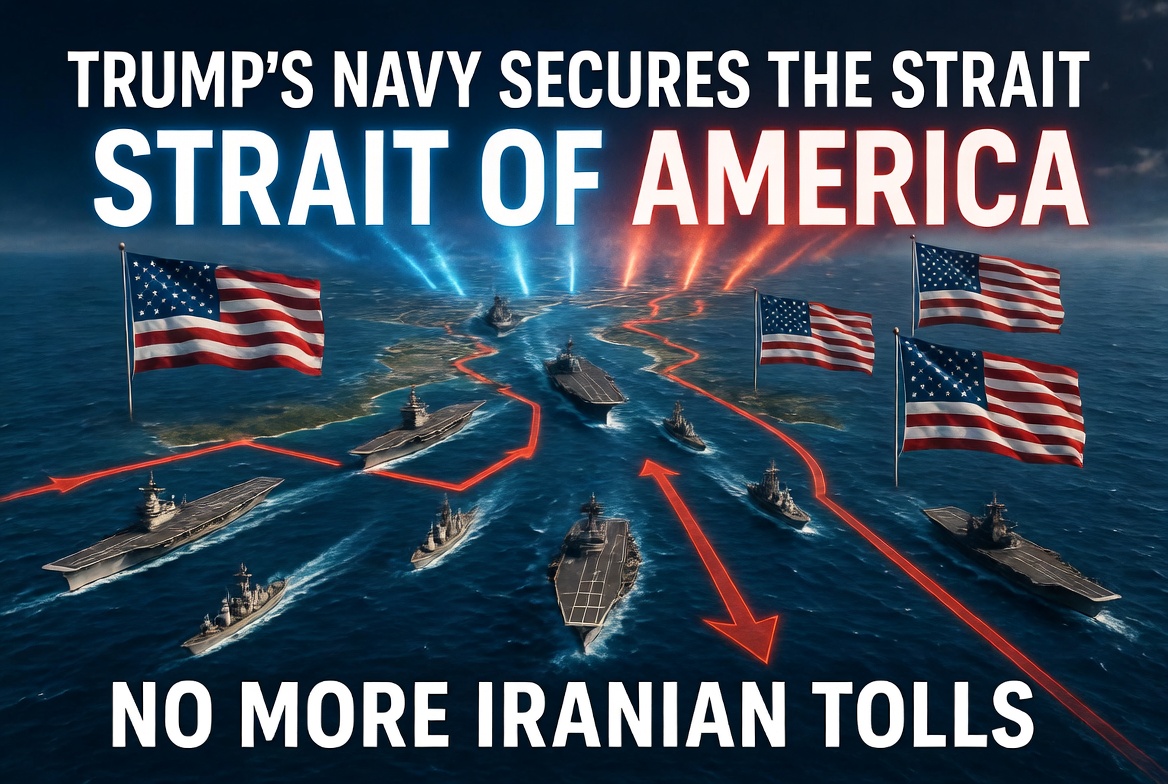
In a bold and decisive move that has sent shockwaves through global energy markets and geopolitical circles, President Donald Trump has effectively declared the Strait of Hormuz under American control. What was once Iran’s chokepoint for extorting the world’s oil supply is now being transformed into the Strait of America—a vital maritime artery secured by U.S. naval power, free from Iranian tolls, mines, and threats.
The announcement came swiftly on April 12, 2026, following the collapse of high-stakes peace talks between the United States and Iran in Islamabad, Pakistan. With no agreement reached on Iran’s nuclear ambitions or its destabilizing activities, President Trump took to Truth Social to issue a clear directive: “Effective immediately, the United States Navy, the Finest in the World, will begin the process of BLOCKADING any and all Ships trying to enter, or leave, the Strait of Hormuz.”
This is no mere threat. U.S. Central Command has confirmed the naval blockade will commence operations on Monday morning, targeting vessels that have paid illegal tolls to the Iranian regime. Mines laid by Iran’s Islamic Revolutionary Guard Corps are being cleared, with American warships already demonstrating freedom of navigation through the passage. Trump has made it explicit: no ship paying tribute to Tehran will enjoy safe passage on the high seas.
From Iranian Stranglehold to American Resolve
For decades, the Strait of Hormuz has been a flashpoint. Roughly 20% of the world’s oil and significant volumes of liquefied natural gas have passed through its narrow waters, giving Iran outsized leverage. During the ongoing conflict that escalated earlier in 2026, Iran mined the strait, attacked vessels, and began charging exorbitant “tolls” for passage—effectively holding global energy supplies hostage. Shipping traffic plummeted, oil prices spiked, and the world watched as a rogue regime attempted to dictate terms to the international community.
President Trump’s response has been characteristically direct and unapologetic. He has repeatedly set deadlines for Iran to reopen the strait, threatened strikes on Iranian power plants and infrastructure if demands were ignored, and now followed through with overwhelming naval force. “We’re putting on a complete blockade,” Trump stated. “We’re not going to let Iran make money on selling oil to people that they like and not people that they don’t like.”
This move echoes historic assertions of American maritime dominance. Just as the U.S. Navy has protected sea lanes in the past—from the Barbary Wars to modern freedom-of-navigation operations—Trump is reclaiming this critical chokepoint for free and fair passage. Allies and neutral nations reliant on Gulf oil are being quietly encouraged to support the effort, though the United States has signaled it is prepared to act decisively on its own.
Epic Show of Strength
Critics may wring their hands over rising oil prices or the risk of escalation, but the reality on the water tells a different story. U.S. forces have already sunk Iranian mine-laying vessels, cleared paths through the strait, and demonstrated that American naval power can enforce order where diplomacy failed. Iran has issued warnings of a “strong and forceful response,” yet the U.S. Navy remains the most formidable fleet on the planet—equipped with advanced destroyers, aircraft carriers, and overwhelming technological superiority.
This is the Trump Doctrine in action: maximum pressure, zero tolerance for extortion, and a clear message that America will not be bullied by adversaries who weaponize global trade. By securing the Strait of Hormuz, the United States is not only protecting its interests and those of its partners but also reasserting leadership in a region too long plagued by instability.
Oil markets reacted immediately, with prices surging on the news, underscoring the strait’s enduring importance. Yet long-term, a secured passage under American oversight promises stability—free from Iranian mines, arbitrary tolls, and attacks on commercial shipping. The “Strait of America” is more than a provocative nickname; it represents a strategic reality where the world’s most important energy corridor operates under the protection of the world’s preeminent naval power.
As operations unfold in the coming days, the world will witness whether Iran chooses confrontation or finally accepts that the era of unchecked aggression in the Gulf has ended. President Trump has drawn a line in the water—and the U.S. Navy stands ready to enforce it.
In the end, this is classic Trump: turning a crisis into an opportunity for American strength. The Strait of Hormuz, long a symbol of vulnerability, is becoming a monument to resolve. Welcome to the Strait of America.