By the Populist Wire Editorial Board
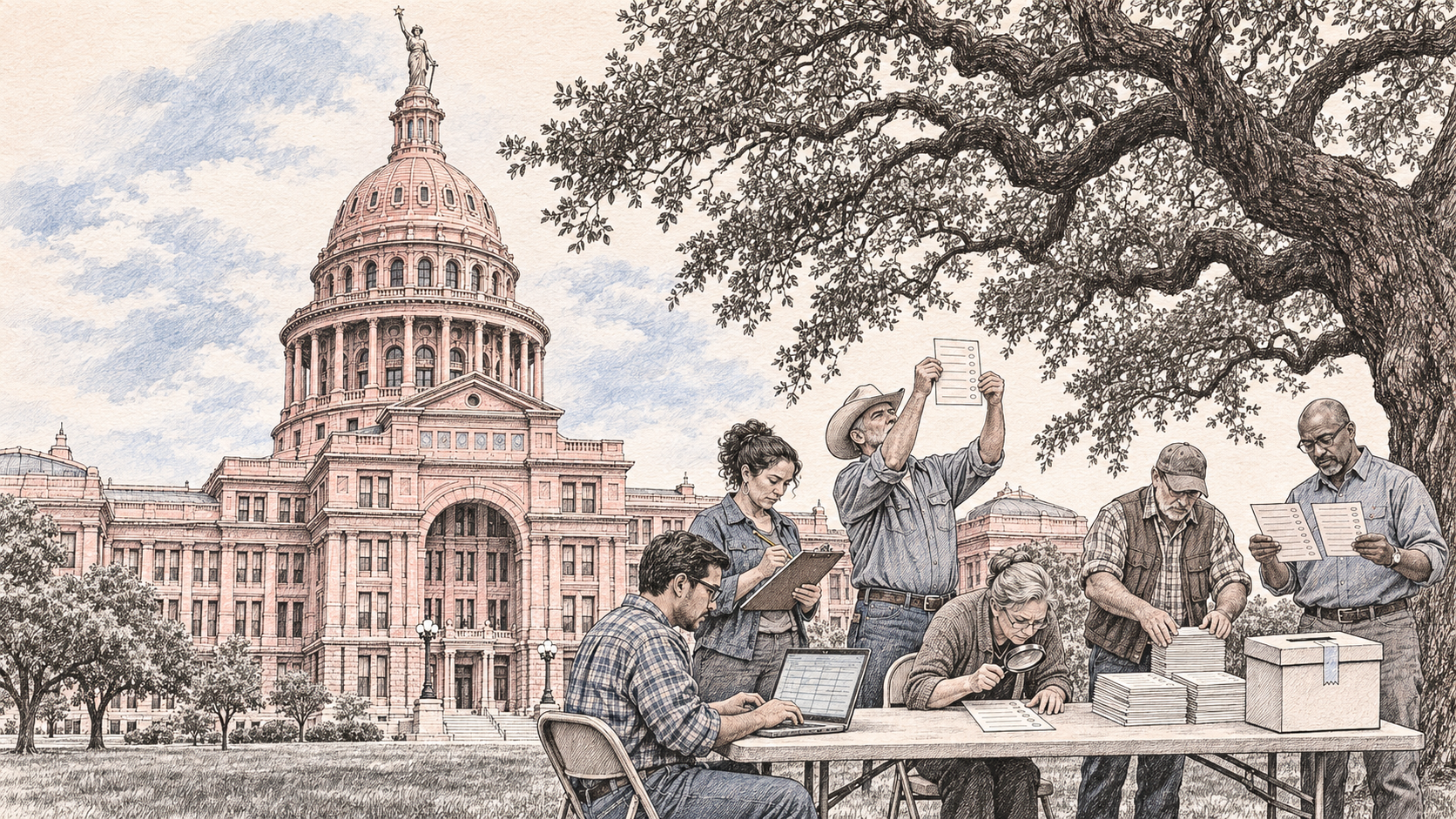
Texas Secretary of State Robert Howden wants you to take his word for it. On Friday, Nov. 20, his Elections Division told county officials the state’s first-ever statewide risk-limiting audit was a success. It sampled 1,200 paper ballots in the U.S. Senate race, met a 10 percent risk limit with a measured risk “of less than 1%,” and provided “strong statistical evidence that the outcome for U.S. Senator is correct.” No second round. Case closed.
On Wednesday, Nov. 25, at 1:14 a.m. Central, an independent researcher posting as Truth Is Freedom published something Howden did not: an audit of that audit. The review examined the Secretary of State’s published record for the Nov. 3 contest between Democrat James Talarico and Republican Ken Paxton. Its conclusion was blunt. Eight controls tested. Five fail. Three unverifiable. Zero pass.
That is not the same thing as a court throwing out the race, and it is not the same thing as the Secretary of State admitting defeat. Howden’s office still says the official audit passed. What the independent review claims is more basic, and more damning if it holds up: the public record of this audit cannot be independently verified. In the reviewer’s words, it “provides zero valid evidence to confirm the election results.”
What the Official Audit Claims
This was Texas’ first statewide risk-limiting audit, required under 2021 laws authored by Republican Sens. Bryan Hughes and Lois Kolkhorst. Gov. Greg Abbott appointed Howden secretary of state in July, replacing Jane Nelson. The Senate race was the contest chosen for the new audit.
According to the Texas Secretary of State’s election results page, last updated Nov. 4 with 100 percent of polling locations reporting, Talarico received 5,444,982 votes and Paxton received 4,249,373, a margin of about 1.2 million votes, or roughly 55 percent to 43 percent. Libertarian Ted Brown and a handful of write-in candidates made up the rest.
Texas Scorecard, citing the completed audit, reported that of the 1,200 sampled ballots, 613 were marked for Talarico and 494 for Paxton. The remaining ballots, the outlet said, were either not found and therefore counted for Paxton under the audit rules, or went to another candidate. Because the measured risk came in under the 10 percent limit in Round 1, Howden’s office said it would not pull a second sample.
On Wednesday, Nov. 18, the Secretary of State’s office announced that Howden would generate a 20-digit seed number “selected by chance” to decide which paper ballots got pulled, and it livestreamed the dice roll at 2:30 p.m. Central. The Maverick Times reported that the number posted on the board at the end of the stream was 55781 83866 83067 31400.
Five Fails, Three Unverifiable, Zero Passes
The independent review, dated Nov. 25 and posted by the account Truth Is Freedom, says it examined the published audit spreadsheet for the 1,200 sampled ballots, Texas Election Advisory 2026-30, and the Secretary of State’s Nov. 16 news release. The reviewer, who describes a legal and financial background and is not a state official or a court-appointed auditor, graded eight process controls. According to that table:
Failed, according to the review: reproducible random selection, because a full seed was not published in a form that lets anyone regenerate the sample; disclosure of the ballot manifest, so the sampling frame can be checked; a guarantee that the selected ballots were the ones actually audited, with no substitutions; retrieval of every selected ballot, or a documented loss; and a reconciliation of the reported ballots-cast total with the sample, which the reviewer scored as a fail at p = 0.013.
Unverifiable, according to the review: documentation of ballot-card layouts for every card that did not include the Senate contest; the risk measurement itself, which the reviewer said had “no arithmetic error” in the published p-value but “proves nothing about the outcome” if the sample cannot be verified; and whether the sample’s candidate shares match the reported results, which the reviewer said the shares do, with the same caveat.
Read that last point twice. The independent review is not claiming the hand-counted sample pointed to a different winner. It is claiming the official audit does not do the one job that makes a risk-limiting audit worth running: let an outsider confirm that the sample was drawn fairly, from a complete list, and that the ballots pulled were the ballots counted.
The reviewer’s own standard is clear. “An RLA provides assurance only if (1) the random selection can be reproduced, (2) the sample was drawn from a complete and accurate ballot manifest, and (3) every selected ballot was retrieved as selected,” the report says. “The published record fails all three.” Until those deficiencies are cured, it concludes, “this RLA cannot be relied on as independent confirmation of the reported result.”
Asked whether that meant the official audit “did not do what it claimed to do,” the researcher answered yes. “The audit of the audit said the RLA was not reliable.”
A Livestream Is Not a Public Record
Howden’s office will say it was transparent. It rolled dice on a livestream. It announced a seed. It thanked all 254 counties for taking part. That is more than some states bother to do. It is not the same as publishing the materials an independent reviewer needs to reproduce the draw and check the frame.
The Maverick Times, writing the morning after the dice roll, said it could not find a list of the specific ballots or counties drawn by that seed on the Secretary of State’s website. If the full seed, the ballot manifest, and the retrieval log are sitting in a file ordinary Texans can use to regenerate the sample, Howden should put them where everyone can see them. If they are not, then the “milestone for Texas elections” is an official press release about an audit the public cannot audit.
Even some election-integrity advocates who do not dismiss risk-limiting audits outright have warned against treating this one tool as enough. Christine Welborn of Advancing Integrity told Texas Scorecard the RLA “tests a small sample to spot any potential errors,” but that “its potential drawbacks should keep it from being the only audit tool we use.” She called a post-election hand-count audit “a much better indicator of errors” and said that hand count, which counties were also required to run, should be expanded.
Don’t Confuse the Audit Fight With a Recount
By Wednesday afternoon, the independent review was spreading fast. Caroline Kane, a former Republican nominee in Texas’ 7th Congressional District, quote-posted it and wrote, “Well color me shocked, The Talarico-Paxton race has FAILED the SoS Audit.” That line is sharper than the document she was sharing. The Secretary of State did not declare that the race failed. The independent review declared that the official audit failed independent verification. Those are different sentences, and the distinction matters if you actually want the records released instead of a flame war.
The same researcher has also circulated a separate statistical analysis of Texas’ midterm totals, including a claim that adjusting county results with a formula would show Paxton winning by more than a million votes. That is a different argument from the audit of the audit. It has not been confirmed by the Secretary of State, a court, or a recount, and critics have already tried to knock it down. It should be tested in the open, not treated as a certified result, and it should not be blended into the narrower finding about the official audit’s published record.
What Texans Should Demand
Howden’s office wants Texans to treat a completed risk-limiting audit as the last word. It is not. If the official numbers are solid, sunlight will not hurt them. If they are not, Texans deserve to know that before anyone tells them the case is closed.
The demand is specific, and it should go to Howden’s office and to the Legislature that wrote this process into law, including Sens. Bryan Hughes and Lois Kolkhorst. Publish the full seed in a form anyone can use to regenerate the sample. Publish the complete ballot manifest, so the sampling frame can be checked. Publish the ballot retrieval logs, showing every selected ballot was located or that a loss was documented. And publish the reconciliation of the reported ballots-cast total with the sample. If those files are already sitting in a folder in Austin, put them where ordinary Texans can find them. If they are not, then the official audit has a hole in it.
This is also a national test. Howden’s own office said similar audits are already conducted in 16 other states, and it billed Texas’ first statewide risk-limiting audit as a milestone for transparency. Officials are rolling these audits out as the gold-standard check on electronic tallies. If Texas, after a public dice roll and a first-of-its-kind statewide audit, cannot or will not produce a record an independent reviewer can verify, then other states will be copying a press release. An audit nobody else can check is not an audit.