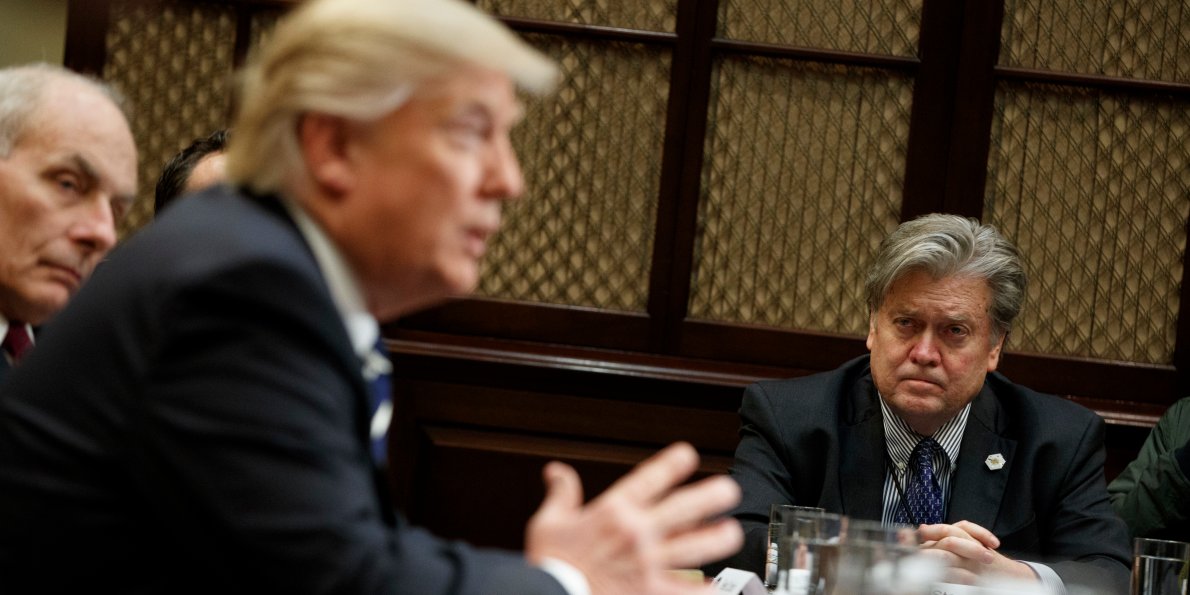
Update: CNN reports that Bannon has struck a deal with Mueller to avoid grand jury testimony and instead meet with Special Counsel Robert Mueller and his team for an interview. Furthermore, Bannon will answer questions about his stint in the White House because executive privilege would not apply, he said.
Tuesday was a difficult day for former White House Strategist Steve Bannon, who has seen his political influence and reputation as a “kingmaker” evaporate since the first excerpts of Michael Wolff’s book “Fire and Fury” were published earlier this year.
Bannon endured 10 hours of testimony before the House Intelligence Committee on Tuesday while refusing to answer any questions about his time in the White House or the transition, per the White House’s orders. The New York Times also reported that he had been served with a subpoena last week to testify before the grand jury in special counsel Robert Mueller’s probe into Russian collusion after refusing the offer of an informal interview.
Today, NBC News has reported some new details about Bannon’s legal situation that underscore the difficult situation the former Breitbart executive, who was ousted by the Mercer family as his political allies chafed at some of his more self-aggrandizing comments.
Bannon’s subpoena, as it turns out, was hand-delivered by FBI agents who showed up at his home last week to deliver the subpoena and discuss the Russia probe with Bannon. However, the agents were unaware that Bannon had retained counsel just hours before their visit, and subsequently redirected the subpoena to Bannon’s lawyer…
FBI agents showed up at Steve Bannon’s Washington home last week intent on serving him with a subpoena to appear before a grand jury investigating possible ties between President Donald Trump’s campaign and Russia, according to a source familiar with the proceedings.
The agents were unaware at the time that Bannon had retained Washington lawyer William Burck just hours earlier, according to two people familiar with the events that took place on Jan. 9. Once redirected, the agents sent the order to Burck, who is also representing two other witnesses in the probe being led by special counsel Robert Mueller, a former director of the FBI.
Bannon, who served as President Donald Trump’s chief strategist until he departed the White House in August, could end up being interviewed by Mueller’s team before the end of the month, according to one source who agreed to discuss the matter on the condition of anonymity.
Bannon is expected to be more forthcoming with Mueller’s team. “He’ll answer any questions” Mueller wants, one source close to Bannon told NBC News.
Rep. Mike Conway, R-Texas, who leads the House Intelligence Committee, said the committee’s subpoena remains in effect and described the interview as in “recess.” It was not clear whether Bannon would appear again before the committee, though Rep. Eric Swalwall, D-Calif., indicated late Tuesday that he was hopeful Bannon would return Thursday.
It’s believed the Mueller subpoenaed Bannon to thwart any attempt by the White House to silence him. Bannon reportedly told Wolff that Trump probably did meet Russian lawyer Natalia Veselnitskaya when she visited the White House in June 2016 for a meeting with Donald Trump Jr., Paul Manafort and Jared Kushner. Trump has previously denied knowing anything about the meeting.
The subpoena compels Bannon to testify before a grand jury, skipping the voluntary interview with Mueller’s team that many in Trump’s orbit have elected to take. But Mueller may still leave open the option for an interview in lieu of grand jury testimony. Bannon is likely to accept such an option if it is made available, according to a source close to Bannon.
Three people familiar with the special counsel’s investigation suggested Mueller moved to subpoena Bannon, rather than ask him to voluntarily appear for questioning, in order to thwart any potential attempt by the White House to pressure Bannon into refusing to cooperate.
Bannon revealed he’d been subpoenaed by the grand jury when he met with lawmakers Tuesday behind closed doors on Capitol Hill, where he was questioned for more than 10 hours.
William Burck, Bannon’s lawyer, is also representing White House Counsel Don McGahn and Trump’s former chief of staff, Reince Priebus, both of who have met with Mueller late last year.
While the White House has dismissed much of Wolff’s book as a fiction, and journalists and observers have pointed out many inconsistencies, Trump’s reaction to Bannon’s reported comments – he’s currently suing his former employee – has fueled speculation that at least the president believes that some of the reported remarks are true.
Now, the question is what will Bannon tell the Grand Jury? Could he possibly provide the long-sought “smoking gun” that will definitively prove that Trump campaign officials actively worked with the Russian government to sway the election?
After more than a year of fruitless searching, that scenario seems unlikely.
On My Disassociation from the Family Justice and Accountability Act (FJAA) and the Launch of Stone Soup for Justice
After an extensive period of prayer, reflection, and careful consideration, I must make a difficult and deeply serious announcement.
With a heavy heart, I am formally and fully ending my association—of any capacity—with the Family Justice and Accountability Act (FJAA) and its founder, Francesca Amato.
I do not make this decision lightly. I have worked too hard, for too long, to elevate the voices of my family, Iowa families, and families across this country; to build constructive relationships with lawmakers; and to earn trust through careful, honest advocacy. I cannot allow my name, reputation, or work to be tied to conduct and representations that I believe are dishonest, exploitative, and fundamentally misaligned with the kind of reform our children deserve.
Ethical and Policy Concerns
My decision is rooted in both policy and ethics.
I have personally witnessed parents paying thousands of dollars for “services” that delivered little meaningful support or tangible outcomes. I have also observed what I consider to be cult-like dynamics within the organization—expectations of unquestioning loyalty to leadership, pressure to accept narratives that conflicted with facts, and hostility toward legitimate professional accountability.
In my view, this environment harms vulnerable families who are seeking help, not control.
Misrepresentation to Lawmakers
I am especially troubled by a pattern of mistruths and overstatements directed at legislators and the public.
I was informed that Senator Chuck Grassley’s office and other U.S. Senate offices “100% stand behind” the FJAA bill. I know firsthand that this is not accurate. I have worked directly with Senator Grassley’s staff and other congressional offices and have earned their respect by being precise, honest, and careful in what I represent.
While Senator Grassley stands firmly for accountability and transparency—and remains fully supportive of his constituents—his office does not support the FJAA bill. He has expressed concern that it blurs state and federal authority and creates confusion rather than clarity.
I cannot and will not attach my name to claims of congressional support that I know are untrue, nor to a 94-page bill that, in my judgment, overreaches, confuses jurisdictional boundaries, and risks undermining broader reform efforts.
Retaliation and Unprofessional Conduct
I have observed a troubling pattern of unprofessional and retaliatory behavior from Francesca Amato that I find incompatible with serious policy work.
This has included:
Speaking negatively about advocates behind their backs while presenting warmth to their faces
Creating unnecessary conflict between advocacy groups
Encouraging supporters to attack other advocates in her defense
Demanding public gratitude or deference
Responding to substantive policy concerns with personal attacks
When I raised legitimate concerns about state–federal boundaries and Title IV-E compliance, the response was not honest policy discussion but attacks on my character.
Most concerning, my private medical information and lawful medical treatment were weaponized in an attempt to discredit me. Given that Francesca Amato presents herself as an ADA advocate, I view this as a serious violation of medical privacy and disability rights.
I have also observed a broader lack of personal responsibility in routine matters, which further eroded my trust. These are not the hallmarks of accountable leadership.
Implausible Claims and False Hope
I was repeatedly presented with grandiose and implausible claims, including assertions of imminent executive orders, high-level meetings, promises to personally take me to meet President Trump because he was “about to sign” the FJAA, and statements that Robert F. Kennedy Jr. was reviewing the bill.
When such claims are made without evidence—and used to build loyalty, financial commitment, or hope from traumatized families—that crosses a line.
Survivors of system harm deserve transparency, realism, and integrity. Not fantasies.
For all of these reasons, I am formally and completely disassociating myself from:
The Family Justice and Accountability Act (FJAA)
Its current bill
Any claim that I support or endorse Francesca Amato’s strategies, representations, or leadership
Moving Forward: Stone Soup for Justice
I remain deeply committed to child welfare reform, sibling preservation, and enforcement of federal law—particularly Title IV-E—in a way that is honest, targeted, and workable.
Going forward, I will be focusing my efforts on Stone Soup for Justice, a new collaborative team and legislative vehicle grounded in truth, accountability, and cooperation. Stone Soup for Justice reflects our belief that real reform is built collectively—through transparency, shared responsibility, and rigorous policy work—not through control or misinformation.
I am honored to move forward with the advisement and support of Kathleen Arthur, a long-respected and credible voice in Congress on child welfare and federal funding. Together with Stone Soup for Justice, we are developing legislation tightly focused on Title IV-E requirements and enforcement.
Our work will center on:
Misuse of Title IV-E funds
Federal compliance standards states must meet to receive and retain funding
Wrongful removals and wrongful terminations of parental rights
Removals and terminations that resulted in injury or death
Family-court-forced separations
Failures to prioritize kinship placement and sibling preservation
Violations of reasonable-efforts requirements
Systemic practices that bypass federally mandated protections for parents and children
At the end of the day, my goal is to deliver the results and meaningful change families deserve—especially those who placed their trust elsewhere—through honest advocacy, precise lawmaking, and steadfast accountability.
My loyalty is, and always will be, to the children and families of Iowa and to families across this country seeking real, sustainable change.
I will not compromise that mission to remain aligned with conduct I cannot defend.
— Kristin Mitchell
Supporting Statements
Kathleen Arthur (Left)
“Children must come first. I have been working on fixing the Families First Act since it was passed. It simply did not have enough protections or oversight. It did not solve the funding problems. Change is slow; however, we are on the edge of making major change in child welfare. This team has clicked with members of Congress better than any I have ever seen. Congress is ready. The ground is fertile. The time to plant the seeds is now.”
Tasha Ulshafer (Left)
“I’m excited to start this new journey with the amazing new group I’m with. Moving forward with people who stand for truth and real action feels empowering. I was misled before by Francesca Amato, but that chapter is closed.”
Melissa Owens (Left)
“I am withdrawing my support and any association with the Family Justice and Accountability Act 2025 and its organizer after discovering serious constitutional issues with the bill and witnessing harmful, cult-like organizational behavior. My commitment to families navigating the family court and CPS systems remains unchanged. I will now be working with a new group, including Kristin Mitchell, Kathleen Arthur, and others at Stone Soup for Justice, to develop federal legislation that truly protects children and keeps them in loving homes. While this change may come as a surprise to many people I deeply care about, this new path reflects my dedication to finding real, ethical, and effective solutions for those who are suffering and seeking true resolution.”
Linn County, Iowa — In a case that has already raised red flags for judicial conduct, DHS contradictions, and violations of federal sibling-preservation laws, one mother is now taking her fight far beyond the courtroom.
For Kristin Mitchell, the system that once separated her from her siblings as a child is now repeating the same trauma with her son WG, who was adopted through Iowa DHS, later removed from that adoptive home after abuse, and is now facing yet another rushed adoption while Mitchell appeals at multiple levels.
“I experienced harm in foster care as a child — and now my own child is living the same trauma,” she said.
Her intervention hearing in Linn County left her with more questions than answers. DHS issued her a Family Notice legally recognizing her as a qualifying relative. But in court, the agency reversed itself, and the judge denied her motion to intervene.
Not a single safety concern was presented about her home. The State called just one witness — the same DHS worker who separated Mitchell from her siblings decades ago.
“Nobody named a single safety concern. Not one reason why my home would not be good for WG.”
When evidence later surfaced showing the presiding judge and DHS workers viewed Mitchell’s private Facebook stories during deliberation — and the judge’s account disappeared shortly after — her concerns about impartiality only grew.
So Mitchell did something few parents in child welfare cases ever do.
She took the fight to Washington, D.C.
A Journey From Linn County to Capitol Hill
During the trip, Senator Mark Finchem conducted a full sit-down interview at the B&B where the team stayed. Kristin and her son were present throughout the discussion, had the chance to ask their own questions, and captured photos with the Senator during the extended conversation.
“We came with purpose,” Mitchell said. “Our team met with 10 senators or congressmembers — some meetings went over two hours.”
She visited offices across Capitol Hill. Her youngest son made popcorn and played with tractors in Senator Joni Ernst’s office. She took photos with Arizona Senator Mark Finchem. Congressional staff, she said, treated her evidence with seriousness and gravity.
“They listened closely. They took notes. They understood that what is happening in Iowa is part of a national pattern.”
Mitchell wasn’t just representing her own experience. She brought with her 27 credible stories from Linn County families, many describing similar systemic violations: retaliation, ADA discrimination, sibling separations, and rushed removals.
“The gap between federal foster-care standards and what’s happening in Linn County is enormous,” she said.
The same week Mitchell walked the halls of Congress advocating for reform, Donald Trump and Melania Trump signed a foster-care–related federal law.
“When I learned they signed that law while I was in D.C., I honestly felt it was no coincidence,” she said.
“It was incredibly validating. It gave me hope.”
She believes the synchronization signals something larger: “Our voices are finally reaching national leaders.”
The Push for Accountability
Mitchell delivered a clear message to federal officials: the Family Justice and Accountability Act is not about creating new rights — it is about enforcing rights the system already violates.
“I told them the FJAA is about accountability,” she said. “About enforcing constitutional rights, civil rights, human rights, and ADA protections.”
She also stressed the urgency of stopping rushed adoptions.
“I have appeals at multiple levels. And yet WG is being pushed toward another adoption before my appeals are decided. That is why this cannot wait.”
Her personal history magnified her purpose.
“I lived through sibling separation as a child. I know what it does to you. No child should live that twice — and that’s what’s happening to WG.”
Washington Responds
Multiple policymakers expressed interest in reviewing her documentation, obtaining evidence, and potentially examining Iowa DHS practices.
“I want to give them the space to conduct their reviews responsibly,” she said. “But yes — interest was real.”
Even the judge in her own case acknowledged she had “strong experience to speak to legislative reform,” a comment Mitchell found telling given the legal barriers she still faces in WG’s case.
The New Federal Law Sends a Message to Iowa
Mitchell believes the new foster-care law sends a direct warning to states like Iowa:
“Pretending to comply with federal mandates is no longer enough.”
She said, “Iowa has repeatedly violated the Fostering Connections Act. My case proves it. DHS recognized me as a relative in writing — then told the court I wasn’t one.”
The new law, she argues, makes one thing clear: “The era of unaccountable child-welfare agencies is ending.”
A Call to Other Iowa Families
As she continues her appeals — including exploring whether to overturn the original termination of rights, which the court stated was “not strictly necessary” — Mitchell is turning outward and calling on other survivors to come forward.
“If you’re in Iowa and you’ve been harmed by DHS, I want you to contact me.”
She emphasized that many families remain isolated or silenced, and she wants them to know there are safe channels and advocates ready to support them.
What Comes Next
“Our movement is gaining momentum,” Mitchell said.
“And we’re not stopping until every child is protected from the trauma the system has allowed for far too long.”
From the courtrooms of Linn County to the halls of Congress, Mitchell’s fight now sits at the center of a growing national reckoning over child welfare, accountability, and the long-overlooked rights of siblings.
In a seismic two-hour conversation that has ripped the conservative movement wide open, Tucker Carlson sat down with far-right firebrand Nick Fuentes on October 28, 2025, and what emerged wasn’t just a podcast episode—it was a reckoning. The interview, which rocketed to the fourth most-viewed video in Carlson’s post-Fox catalog, didn’t merely platform a controversial figure; it exposed the festering rift between genuine America First patriots and the neoconservative “Israel First” faction that’s been masquerading as MAGA for far too long.
Fuentes, the 27-year-old provocateur whose “Groyper” army has long challenged the GOP’s sacred cows, didn’t hold back. He eviscerated U.S. foreign policy as a “suicide pact” driven by Zionist lobbies that prioritize Tel Aviv over Toledo. Carlson, no stranger to bucking the establishment, nodded along, calling endless aid to Israel “insane” and questioning why American blood and treasure are funneled into a foreign war while our borders bleed. This wasn’t fringe talk; it was a mirror held up to the MAGA base, revealing how a vocal minority—think Heritage Foundation president Kevin Roberts defending Carlson amid backlash—has been hijacked by interventionists who wrap endless wars in the flag of evangelical Zionism.
The fallout was swift and savage. PBS labeled it a “rift among Republicans,” with a task force on antisemitism severing ties with Heritage over the scandal. NPR chronicled how isolationism and creeping antisemitism are eroding conservative support for Israel, once a bedrock of the movement. Even within MAGA, the knives came out: Ted Cruz and Josh Hammer decried Carlson’s platforming as normalizing extremism, while Fuentes’ defenders accused the critics of being “Zionist agents.”
At its core, this interview peeled back the layers of a movement Trump built on “America First”—no more forever wars, no more blank checks for allies. Yet, as Fuentes hammered home, neocons like those at the Daily Wire have turned MAGA into a Trojan horse for Israeli interests. Carlson’s agreement that “neoconservative policies harm America” struck a nerve because it’s true: billions in aid, vetoes at the UN, and now whispers of U.S. troops in Gaza—all while veterans sleep on streets and fentanyl floods our cities.
This isn’t about hate—it’s about priorities. Trump won by promising to drain the swamp, not refill it with Tel Aviv lobbyists. The Fuentes interview has forced MAGA to choose: Do we stand for American workers, secure borders, and fiscal sanity, or do we bow to foreign gods? Carlson and Fuentes may not be saints, but they’ve done the movement a favor by naming the elephant in the room. The “Israel First” crowd’s days of puppeteering from the shadows are numbered. America First isn’t negotiable—it’s the soul of MAGA. And it’s roaring back.