Connect with us

Iowa

2020: Democrat LA Mayor Stopping In Iowa

Published

on

(Via The Hill)


Los Angeles Mayor Eric Garcetti (D) will stoke speculation that he is considering running for president in 2020 when he makes several stops across Iowa next month.


Garcetti will travel to the Quad Cities in April to deliver a keynote address at the Scott County Democrats’ annual Red, White and Blue Dinner, his political spokesman said.


Later, he will make stops in Altoona, at a Carpenters Union training facility, and Des Moines, where he will take a tour with Mayor Frank Cownie (D). Garcetti will also stop in Waterloo, where his wife Amy has family.


In a statement, Garcetti spokesman Yusef Robb strongly hinted that the second-term Democratic mayor would begin pitching himself in the first-in-the-nation caucus state as an anti-Washington solution.


“The thrust of his visit is to support his fellow Democrats in the run-up to the midterms, but Mayor Garcetti is also eager to hear from people how we can help each other move ahead despite the extreme dysfunction in Washington,” Robb said in an email.


Full Article

Continue Reading
Click to comment

Leave a Reply

Your email address will not be published. Required fields are marked *

Health

Rob Sand Seeks Publicity While Zach Lahn Helps Iowa

Published

on

Governor-elect Rob Sand (@RobSandIA) waited four days to say anything about the Army’s plan to set off a lead bomb in southeast Iowa. When he finally did, he had nothing to offer but a press-release shrug. Since then? Crickets.

Here’s what happened. On Nov. 13, the EPA quietly issued an emergency permit letting the Army detonate degraded lead azide in place at the Iowa Army Ammunition Plant in Middletown, a town of about 300 people near Burlington. On Nov. 15, the Army posted its public advisory: two controlled detonations at about noon on Friday, Nov. 20. The plan covered 68 barrels, roughly 9,700 pounds of an explosive that has recrystallized and become so sensitive to friction and shock that the Army says it can’t safely be moved.

The Army’s own advisory included a plume map warning of toxic lead dust settling to the north, with children under six “especially vulnerable.” Residents near Middletown City Park were told to clear out from 8 a.m. to 2 p.m. ISU Extension told cattle producers to pull livestock off pasture and ponds and to watch for signs of lead poisoning, starting with “sudden death.” Gov. Kim Reynolds’ office says it learned of the plan Monday, Nov. 16.

Iowa had the whole weekend and most of the week to hear from the man about to take over the Statehouse. It got nothing.

Thursday morning, 11:35 a.m.
Sand finally posted at 11:35 a.m. Central on Thursday, Nov. 19. That was about four days after the Army’s advisory, six days after the EPA permit, and barely 24 hours before the scheduled blast. Here it is in full:


Read it twice. Safety should be the “top concern.” Iowans are “understandably concerned.” The public “deserves to know.” Swap “lead azide” for a bridge closure or a boil order and every word still works. No mention of Middletown. No mention of the farmers, the cattle, the water, or the kids in the plume path. No demand of the Army, the EPA, or anyone in Washington. And not one idea of his own.

The last line is the tell: if it isn’t as safe as possible, it shouldn’t happen. That’s a hedge, not a position. It lets him say he called for a pause if the blast goes badly and say he never opposed the Army if it goes fine.

Where was Rob? Deer Valley, Utah.
Here’s the part that should make every Iowan in the plume path furious. While southeast Iowa was pulling kids out of school and moving cattle off pasture, Sand was at a ski resort in Utah. On Nov. 19, the same day as his three-paragraph statement and the day before the blast was supposed to go off, he sat for an onstage interview at the POLITICO Pub at the National Governors Association’s New Governors Leadership Forum in Deer Valley, Utah. What made news? Not Middletown. POLITICO’s headline: “Rob Sand shuts down any talk of 2028.” A second POLITICO video promises Sand talking about his “model past.”

MAHA activist Kelly Ryerson (@GlyphosateGirl) noticed. At 11:20 p.m. Friday, she asked the question a lot of Iowans were already asking:


Forty minutes later she followed up, saying Sand had “been busy hanging at a Politico event in Deer Valley instead. As people in the state are very alarmed and evacuating.” POLITICO’s own coverage backs her up on where he was.

And since that Thursday statement? Sand’s X feed has a tribute to the late Sen. Wally Horn, a salute emoji, and on Saturday morning a string of jokey replies, one asking “Red hair, Niles?” and another calling something “the nicest thing anyone has ever said about me.” On the barrels in Middletown, not one new word.

Lahn was there first, with a plan
Zach Lahn doesn’t hold office. He lost this race. He was still out ahead of the governor-elect anyway.

At 8:47 p.m. Central on Wednesday, Nov. 18, roughly 15 hours before Sand said a word, Lahn went after the official line that lead dust can just be hosed off and stays “below levels of concern”:


At 9:38 a.m. Thursday, still two hours before Sand, he cut straight to it:

“When farmers have to keep cattle inside, off the water and grass, it’s clearly gone too far. We can catch a 250-ton rocket with chopsticks, but can’t dispose of an explosive without 100-mile neurotoxin plume? Pause, bring in the brightest minds, find another way.”

Then at 5:07 p.m. Thursday he did what Sand never did and laid out an actual plan. Lahn said he’d talked with people who know the situation, including officials in Washington, and he didn’t pretend there was a magic answer: “an unplanned detonation would clearly be the worst option.” He pointed out that the stockpile has reportedly been known about since 2004 with nothing done. Then he got specific:

Plan as if we’re going to detonate anyway. Keep every precaution in place.
Send in a robot instead of a person. Lahn proposed using an Optimus robot from @elonmusk to open each barrel and apply a chemical neutralizer like ceric ammonium nitrate, a documented way to break lead azide down into nitrogen gas, with nobody in harm’s way.
Accept that every outcome beats the status quo. Best case, it’s all neutralized and there’s no blast. Middle case, the blast is smaller. Worst case, a barrel goes off with every precaution already in place.
Make the Army pause. “The Army should pause tomorrow’s detonation long enough to think up crazy ideas that just may work.”
His bottom line: “Just going ahead as planned without trying to find a way to protect people, land, water, and soil is not an acceptable way to think about this.”


Call the robot idea a moonshot. Lahn did himself. It’s still a real idea. Sand’s contribution was a vibe. And for the record, the Army’s own environmental assessment rejected chemical neutralization because it would mean workers handling the drums for days or weeks. Taking the humans out of that equation is exactly the problem Lahn’s idea is aimed at.

Still working the phones
Lahn didn’t post once and move on. Nine minutes before midnight on Friday, he answered Ryerson directly:


“One of the main reasons I ran is because I truly care about the health of our state. An election outcome doesn’t change that,” he wrote, adding that he’d “been on the phone w/officials in the WH tonight trying to help find other options.”

At 9:34 a.m. Saturday he posted an update. By Lahn’s account, HHS Secretary Robert F. Kennedy Jr. (@seckennedy) called him Friday night about his “deep concern” over the detonation, then connected him with Vice President JD Vance’s team and the White House, both of whom called late that night. Lahn says he can “say with certainty that they are looking at every available alternative.” He also says a former senior Defense Department official with decades in weapons threat reduction sent him an analysis, now shared with those offices, recommending an independent review by one of the National Laboratories to determine how urgent the threat really is. “If time allows,” Lahn wrote, “there are indeed other options available to mitigate the risk.”


That’s the difference. One guy lost the election and is calling the White House at midnight to find another way. The other guy won it, put out one statement, and went back to talking about 2028 and his hair.

Where it stands
Thursday evening, Acting Army Secretary Adam Telle pushed the blast to Monday, Nov. 23, calling it the “latest possible moment” before colder weather destabilizes the material further. Late Thursday night, the 8th Circuit Court of Appeals issued a temporary administrative stay of the EPA permit at the request of the Iowa Environmental Council and Sierra Club Iowa. As of Saturday, that stay is still in place.

But don’t relax yet. On Friday, Justice Department lawyers representing the EPA told the court they’ll fight the stay, with a full response due by Sunday. They also pointed to an EPA rule that lets the Army treat waste without a permit in a qualifying emergency. Earthjustice, which represents the environmental groups, called that “an extraordinary and extreme backstop” and urged the Army not to use it. The Army hasn’t said whether it will. Friday evening, Gov. Reynolds activated the State Emergency Operations Center. And on Saturday, the City of Fort Madison said it had been told the Army will “most likely” detonate on Monday, Nov. 23, or Tuesday, Nov. 24. So the Monday date may still be live, court stay or not.

For now, those barrels are still sitting in Middletown.

Southeast Iowa deserved a governor-elect who showed up early with answers. On this one, the guy who lost the race showed up first, and he’s still working the problem. Rob Sand showed up with talking points, then spent the day at a Utah ski resort talking about himself.

Continue Reading

Iowa

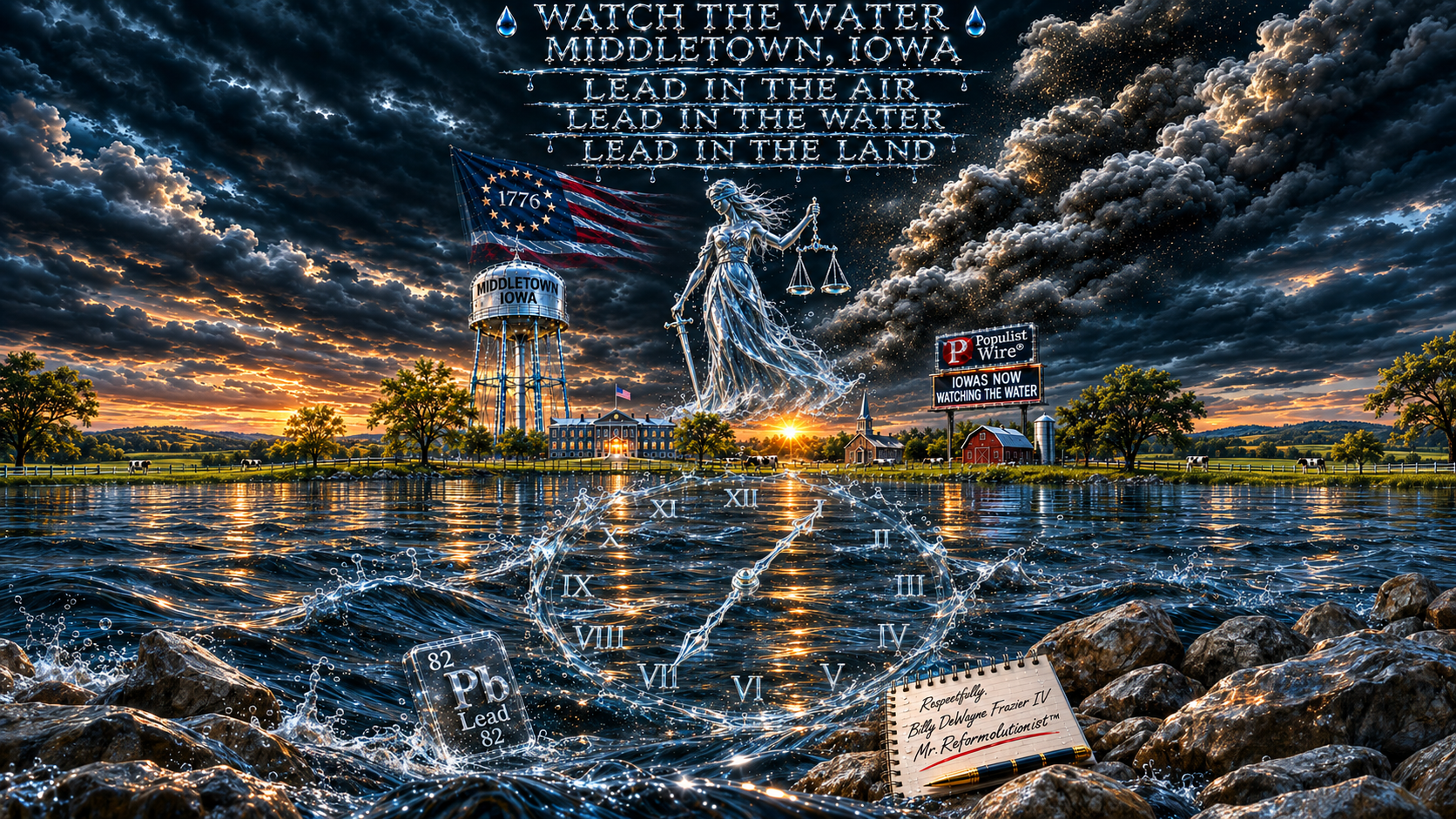
Will Notable Frazier: Watch The Water | Watch The Timeline

Published

on

💧WATCH THE WATER | WATCH THE TIMELINE 💧

IOWA IS NOW #1 IN GOOGLE SEARCH INTEREST FOR “LEAD.”
NOVEMBER 18, 2026 — LET’S RUN THE TIMELINE BACK.
According to Google Trends, Iowa ranks FIRST among U.S. states in relative search interest for “lead” over the past 48 hours.
📈 “Lead azide”: +250%.
📈 “Lead bomb”: +450%.
📈 “Lead bomb Iowa”: BREAKOUT.
THE PUBLIC IS ASKING QUESTIONS.
⚠️ NOVEMBER 20 — THE ARMY’S PLANNED LEAD DETONATION
The U.S. Army is preparing to destroy 68 drums of unstable lead azide at the Iowa Army Ammunition Plant in Middletown.
The EPA issued an emergency permit, and concerns remain about potentially airborne lead-containing particles, environmental monitoring and public exposure.
NOVEMBER 18 — ZACH LAHN SPEAKS OUT.
Lahn publicly questioned the planned detonation, warning about lead’s environmental persistence and challenging assurances that exposure would remain below levels of concern.

SOUND FAMILIAR?

⏱️ OCTOBER 10 — MY PERSONAL QUESTION TO ZACH LAHN
At his Marion meet-and-greet, with my children present, I personally asked:
“Would you support independent state oversight when residents challenge the accuracy of municipal water infrastructure records?”
He acknowledged municipal accountability and that not everyone can file a lawsuit.
KCRG interviewed me at that event.
https://www.kcrg.com/…/republican-candidate-governor…/
💧 NOW LET’S GO BACK EVEN FURTHER.
For years, I’ve been documenting and challenging Cedar Rapids drinking-water infrastructure concerns involving:

UNKNOWN / POSSIBLY LEAD service lines

Galvanized pipes and GRR classifications

Corrosion and deteriorating plumbing

Municipal inventory changes

Water-main breaks and corrosion-control requirements

Iowa Chapter 22 public-record requests

Housing and water-related litigation — CVCV108531

Populist Wire has published reporting about my investigation and related litigation:
https://populistwire.com/…/watch-the-water-iowa-water…/
https://populistwire.com/…/now-iowa-is-watching-the-water/

NOW IOWA IS SEARCHING FOR ANSWERS ABOUT LEAD.
Google Trends doesn’t establish why people searched, who influenced them or whether contamination occurred.
But the timing is worth documenting.
Lead in airborne dust and lead released from drinking-water plumbing are different environmental exposure pathways.
THE COMMON DENOMINATOR IS PUBLIC ACCOUNTABILITY.
What testing was performed?
Who verified the results?
What do the monitoring records show?
And will the public receive the complete documentation?

⚖️ MY MESSAGE TO EVERY IOWA OFFICIAL:
AUDIT THE RECORDS.
VERIFY THE CLASSIFICATIONS.
INVESTIGATE THE CONCERNS.
PROTECT THE PUBLIC.
BE TRANSPARENT.
📄 OFFICIAL EPA RECORD:
https://www.epa.gov/…/iowa-army-ammunition-plant…
📊 GOOGLE TRENDS:
https://trends.google.com/trends/explore?date=now%201-d&geo=US&q=lead
OUR DOCUMENTED CONTRIBUTIONS SHOULD NOT BE ERASED FROM IOWA’S WATER TIMELINE.
YOU CAN’T FIX WHAT YOU DON’T MEASURE.

💧 WATCH THE WATER.
⏱️ WATCH THE TIMELINE.
📄 FOLLOW THE RECORDS.
⚖️ DEMAND ACCOUNTABILITY.
Respectfully,
Billy Dewayne Frazier IV
Mr. Reformaloutionist™

Continue Reading

Iowa

Zach Lahn & Chris Jones: Outsiders With Credentials That Can Finally Fix Iowa’s Water

Published

on

Iowa’s water problem is not a mystery. High nitrate loads from agricultural runoff have pushed drinking water utilities like Des Moines Water Works into record stretches of nitrate removal. The state’s cancer rates rank among the highest in the nation and continue rising. Streams that once supported fishing and recreation now carry the signature of the corn-soy-CAFO system. Politicians have promised action for years. Results have been scarce.

This cycle offers something different: two candidates whose combined credentials match the scale of the problem. Republican gubernatorial nominee Zach Lahn brings a farmer’s understanding of what works on the ground and the political will to fund it. Democrat Chris Jones, running for Secretary of Agriculture, brings decades of hands-on scientific expertise measuring, documenting, and explaining exactly what is happening in Iowa’s water. Together, even if Jones serves only a single term, they have the tools to produce measurable improvement where previous administrations produced only reports.

Zach Lahn’s Practical Path

Lahn is a sixth-generation Iowan who bought back his family’s Belle Plaine farmstead after it left family hands. He has made water quality and cancer rates central to his campaign, explicitly linking elevated nitrates to colorectal cancer and other health outcomes. His approach prioritizes proven practices that reduce nutrient loss without bankrupting family farms.

He has called for finally funding the Iowa Natural Resources and Outdoor Recreation Trust Fund—the IWILL program voters approved by a 63 percent margin in 2010 but that lawmakers left empty. Lahn wants that money directed first at the most impaired watersheds: the Des Moines and Raccoon rivers and their tributaries. He points to saturated buffers, which Iowa State University research has shown can remove essentially all nitrate from tile drainage in tested settings. He favors incentives structured so farmers make money adopting deeper nitrogen application and other conservation measures rather than merely break even. Upstream and downstream monitoring would measure results. The goal is targeted progress that keeps land in Iowa hands instead of accelerating consolidation through heavy regulation.

Lahn’s record is that of a farmer and businessman focused on implementation. He has argued that the status quo—talking about water while avoiding hard choices on funding and incentives—has failed. His plan is not radical. It is the first serious attempt by a Republican nominee to treat the problem as both an environmental and public-health priority that can be addressed while supporting working farms.

Chris Jones’s Unmatched Expertise

Jones arrives with credentials no other statewide candidate possesses. He holds a Ph.D. in analytical chemistry. For eight years he managed the water quality testing laboratory at Des Moines Water Works, overseeing operations at one of the world’s largest nitrate-removal facilities built specifically for agricultural runoff. He then spent four years as an environmental scientist with the Iowa Soybean Association, helping deploy some of the state’s earliest independent monitoring systems. At the University of Iowa he worked as a research engineer and helped create the first real-time public sensor network tracking nitrate and other pollutants across Iowa’s rivers—the system that later faced funding cuts.

His 2023 book, The Swine Republic, was selected by the Library of Congress as Iowa’s representative at the National Book Festival. He co-founded Driftless Water Defenders to protect northeast Iowa’s waters. For decades Jones has measured the loads, traced the sources, and explained in plain language why the current production system produces the outcomes Iowans see in their faucets and in the Gulf dead zone. He knows the data because he generated much of it.

That body of work is the difference between someone who tours a treatment plant and says he is “listening and learning” and someone who has spent a career inside the problem.

The Combination That Can Deliver

Lahn as governor would set the priority, secure the funding through IWILL and other mechanisms, and structure incentives that farmers can actually accept. Jones as agriculture secretary would bring the institutional knowledge to design the interventions, expand and protect monitoring, and ensure resources go where the data show the biggest return. The two roles are complementary. The governor controls the budget and the bully pulpit. The agriculture secretary oversees conservation programs, technical assistance, and much of the interface with producers. One term of Jones in that office, paired with a Lahn administration that treats water as a top-tier issue, could establish the monitoring baselines, the practice adoption targets, and the accountability mechanisms that have been missing for a generation.

Critics will note the party difference. Lahn has emphasized voluntary incentives and avoided broad mandates that risk farm bankruptcies. Jones has been more direct about the need for systemic changes in the corn-soy-ethanol model. On the narrow but decisive question of cleaning Iowa’s water, however, their credentials align more closely than those of any other pairing on the ballot. Expertise plus political will is a rare combination. Iowa has the first and can elect the second.

The Credentials Gap with Rob Sand

Democratic gubernatorial nominee Rob Sand has released a water plan that includes more monitoring funding, a dirty-water notification system, expanded wetlands, and tax credits for conservation practices. Those are reasonable ideas. What Sand does not have is any professional background in water science, laboratory management, sensor networks, or published research on Iowa’s nutrient problem. His education is a political science degree and a law degree. His career is prosecution and state auditing. He has described his own process as still listening and learning by visiting treatment facilities.

That is not a criticism of Sand’s intentions. It is a statement of fact about the difference between a generalist politician and a specialist who has managed the largest nitrate-removal operation in the region, built the state’s real-time monitoring capacity, and written the most detailed public account of how Iowa’s agriculture produces its water outcomes. When the problem is technical, decades in the making, and tightly linked to the dominant industry, credentials matter. Sand has none of the specialized ones Jones has spent a career accumulating.

Iowans have heard promises before. This year they have a chance to elect a governor who has made water a defining issue and an agriculture secretary whose life’s work is the subject. Zach Lahn and Chris Jones, working from their respective offices, offer the most credible path yet to measurable improvement—even if Jones’s tenure is limited to a single term. The alternative is more of the same: plans without the people who actually know how to execute them.

Continue Reading

Trending

Donate to Populist Wire

*Note: Every donation is greatly appreciated, regardless of the amount.