Connect with us

Business

Average American Small Business Monthly Optimism Something “I’ve Never Seen”

Published

on

(Via Zerohedge

Love or hate him, President Trump certainly can make America’s small business feel good about their future.


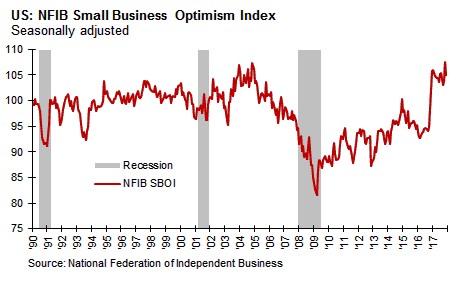
For confirmation look no further than the latest report from the NFIB Small Business Optimism Index, according to which “small business confidence blasted off the day after the 2016 election and remained in the stratosphere for all of 2017,” making last year an all-time record setter for the NFIB Index of Small Business Optimism.


Having hit an all time high in November, the December NFIB Small Business Optimism Index fell 2.6 points to 104.9 in December, down from the record 107.5 last month. The drop suggested that the burst of confidence in November was more of a rebound after two months of lower readings in September and October related to uncertainties after three brutal hurricanes in late August and early September. Discounting the November index, the December reading is in line with the overall strong tone for 2017 as a whole, and reflected solid conditions.


Two of the December components posted gains, five declined, and three remained unchanged. Moving the Index moderately lower were declines in Expected Better Business Conditions (11-point decline) which tends to fluctuate sharply and Inventory Plans (8-point decline). Small business owners were bedeviled by a labor shortage in 2017 that grew more intense as optimism rose. The NFIB Jobs Report last week showed that problem reaching record levels.

Offsetting the dip in Expected Better Business Conditions was a dramatic,14-point improvement in Actual Sales for December. In November, a net negative five percent of all firms reported sales increases. A net nine percent reported higher sales in December, indicating a very strong holiday season for small business.

But the real story was not the modest slowdown in December optimism, but the monthly data in 2017: “2017 was the most remarkable year in the 45-year history of the NFIB Optimism Index,” said NFIB President and CEO Juanita Duggan. “With a massive tax cut this year, accompanied by significant regulatory relief, we expect very strong growth, millions more jobs, and higher pay for Americans.”

The Optimism Index for last month came in at 104.9, slightly lower than the near-record November report but still a historically exceptional performance. That makes 2017 the strongest year ever in the history of the survey. The average monthly Index for 2017 was 104.8. The previous record was 104.6, set in 2004.


“We’ve been doing this research for nearly half a century, longer than anyone else, and I’ve never seen anything like 2017,” said NFIB Chief Economist Bill Dunkelberg. “The 2016 election was like a dam breaking. Small business owners were waiting for better policies from Washington, suddenly they got them, and the engine of the economy roared back to life.”


“There’s a critical shortage of qualified workers and it’s becoming a real cost driver for small businesses,” said Dunkelberg. “They are raising compensation for workers in order to attract and keep good employees, but that’s a positive indicator for the overall economy.”

Driving record optimism in 2017 was the expectation of better economic policies from Washington. Suspending the regulatory assault on business and now a massive tax cut answered two of the three top concerns for small business owners, according to NFIB research.

“The lesson of 2017 is that better policies make for better economic results,” said Duggan. “The evidence is overwhelming that small business owners pay close attention to Washington, and that federal policies affect their decisions on whether to hire, whether to invest, whether to grow inventory, and whether to seek capital.”

Continue Reading
Click to comment

Leave a Reply

Your email address will not be published. Required fields are marked *

Business

Enjoy Your Tasty Wheat: How AI Corporate Greed is Killing Humanity

Published

on

Why the elite have decided it’s better to feed machines than humans.

We have a lower class of CEOs. And AI is making it worse.

In the past, these titans of industry would invest in their communities: libraries, public works projects, parks, or actual philanthropy.

Today’s C-suite “geniuses” engage in fake activism, bribery disguised as donations, and a complete nihilism from the communities they proclaim to serve at the safety of their gated communities.

It used to be a source of great pride for an owner to discuss how many employees they have. They would boast about how they put food on the table for families. They would talks about benefits, and how well they take care of their workers. Hell, they used to even describe them as “family.”

Now, they can’t wait to tell shareholders how they automate everything themselves, outsource to foreign countries for pennies on the dollar, and utilize AI to cut their entire labor force (we will get to this soon.)

The common thread is that those at the top are completely divorced from their workforce, the very people that happen to also be their consumers.

This was the situation largely even before AI. It’s gotten worse. They are absolutely foaming at the mouth to displace workers.

The only way to describe it is a race to the bottom. Investing millions into replacing humans with AI. This is already happening, and the reward has been big short-term gains from cutting jobs that look like more profitability to investors.

What’s more is that these AI data centers need billions of gallons of water, insane amounts of electricity, and tons of facilities to expand growth. It’s so astronomical they’re talking about moving it into space.

Think about it for a minute: companies would rather provide “drinking” water, “feed” electricity, and pay to “house” MACHINES instead of paying a living wage to people.

In fact, it might even be cheaper to pay a living wage. That isn’t stopping industry leaders from chasing their human-less dreams, despite it taking less energy and resources for humans. Yet they’re still choosing machines.

They are even willing to operate at a loss simply for the idea that they can save the cost of paying a wage.

There are a few outcomes that are possible:

Best case: AI hype is exposed as overblown and companies understand that it’s simply a tool and they need actual operators behind the steering wheel. AI starts creating more jobs. It seems unlikely, but given that AI in actuality produces more slop than creative, it’s possible.

Worst Case: The arms race of displacing workers continues. Their greed hasn’t ever really showed signs of waning. To supplement the slop it creates, they will use freelance labor from countries like India to extinguish the fires it creates and justify not needing a full time employee. They will stop at nothing to chase their goal of a technocracy to increase profits. (Note: They think they don’t need you to even buy their products with the top 1% buying 50% of the goods.)

They trained AI on your work, fired you to save money, flooded the world with soulless garbage, empty warehouses, and call it innovation.

To them I say: enjoy your tasty wheat.

Continue Reading

Business

MAGA: From Shopping Mall to Manufacturing Hub 2.0

Published

on

Title: America’s Transition: From Shopping Mall to Manufacturing Hub 2.0

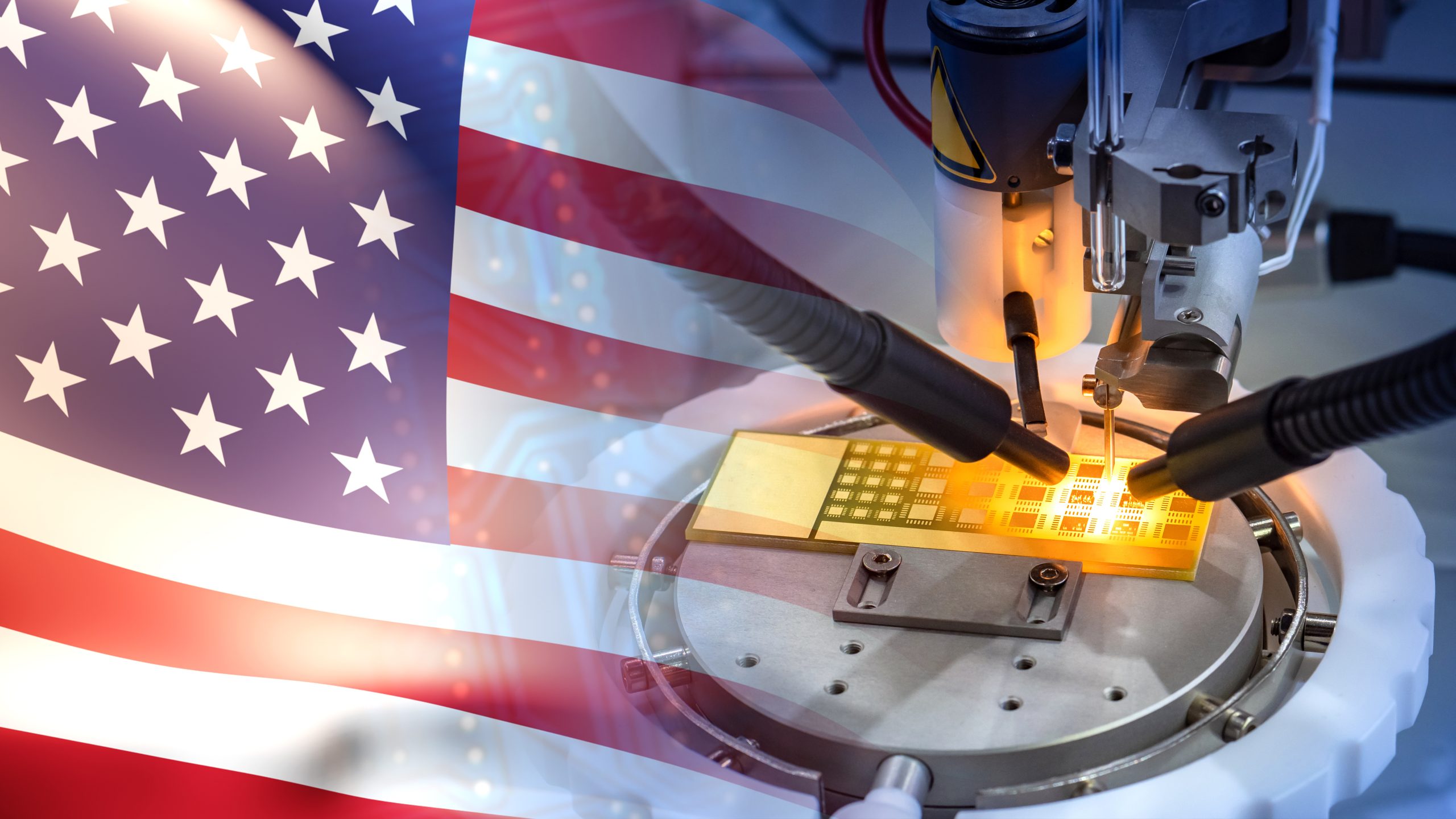
In the past few decades, America has often been described metaphorically as a giant shopping mall or auction house, where consumption and commercialism have dominated the landscape. However, with the rise of the Trump administration and the ambition to “Make America Great Again,” a new vision is emerging—one that aims to transform the nation into the world’s greatest manufacturing hub ever seen, leveraging AI, blue-collar labor, and a combination of innovative technologies.

The shift from a consumer-driven economy to a production powerhouse signifies a strategic move towards self-sufficiency, economic resilience, and global competitiveness. This transformation is not merely about revitalizing industries of the past but embracing cutting-edge technologies and sustainable practices to redefine the future of manufacturing.

At the heart of this evolution lies the integration of artificial intelligence (AI) into manufacturing processes. AI-driven automation streamlines production, enhances efficiency, and reduces costs, enabling American manufacturers to compete on a global scale. By harnessing the power of machine learning and predictive analytics, businesses can optimize supply chains, minimize waste, and customize products to meet diverse consumer demands.

However, the vision for America’s manufacturing renaissance extends beyond technological innovation. It embraces a diverse workforce, blending the traditional blue-collar skillset with the expertise of engineers, data scientists, and software developers. This fusion of talent creates a dynamic ecosystem where creativity, problem-solving, and collaboration drive continuous improvement and sustainable growth.

Moreover, the resurgence of American manufacturing is not confined to a single sector but encompasses a broad spectrum of industries, from automotive and aerospace to electronics and renewable energy. By leveraging cross-disciplinary expertise and fostering strategic partnerships, the United States can position itself as a global leader in advanced manufacturing, setting new standards for quality, innovation, and sustainability.

One of the key strengths of this manufacturing transformation is its adaptability and resilience. In contrast to the volatility of global markets and supply chains, a robust domestic manufacturing base provides stability and security, mitigating risks associated with geopolitical tensions, trade disputes, and natural disasters. By decentralizing production and embracing local sourcing, America can reduce its dependence on foreign imports and safeguard its economic sovereignty.

Furthermore, the transition towards a manufacturing-centric economy aligns with broader societal goals, such as job creation, workforce development, and regional revitalization. By investing in vocational training programs, apprenticeships, and re-skilling initiatives, the United States can empower individuals from diverse backgrounds to thrive in the digital age and secure meaningful employment opportunities in the manufacturing sector.

As America embarks on this journey towards manufacturing excellence, it must also prioritize sustainability and environmental stewardship. By embracing eco-friendly practices, renewable energy sources, and circular economy principles, manufacturers can minimize their carbon footprint, reduce waste generation, and preserve natural resources for future generations.

In essence, the vision of America as the world’s greatest manufacturing hub represents a paradigm shift—one that transcends partisan politics and embraces a collective aspiration for progress, prosperity, and shared prosperity. By harnessing the transformative power of AI, blue-collar ingenuity, and interdisciplinary collaboration, the United States can reclaim its status as an industrial powerhouse and pioneer a new era of manufacturing innovation on the global stage.

As the nation embarks on this ambitious journey, it must remain steadfast in its commitment to inclusivity, sustainability, and technological leadership, ensuring that the benefits of the manufacturing renaissance are felt by all Americans and resonate across borders, shaping a brighter and more prosperous future for generations to come.

Continue Reading

Business

Outrage As Robinhood CEO Confesses To Elon Musk: DTCC Shut Down Stocks In Gamestop; AMC Surge

Published

on

Did Congressional authority allow DTCC to help defraud middle-class investors buying Gamestop and AMC?

The CEO of Robinhood admitted to Elon Musk that the DTCC – The Depository Trust & Clearing Corporation – halted trading during a call Monday morning on the Clubhouse app.

Proof: https://youtu.be/K2CEImKce6s

This is not the first time this has happened…

2008 case: https://casetext.com/case/pet-quarters-v-depository-trust-clearing

Sound familiar?

This appears to be Pet Quarters having the same issue Robinhood has today.  When Pet Quarters took it to court, the courts said something along the lines of: f*** you, don’t ever come back here (citing technicalities).

Why did they win? Well, DTCC is given the authority by Congress to regulate despite technically being a private organization

There’s more – “To date, except for one case where DTCC’s dismissal motion is pending, all of the cases either have been dismissed by the courts or withdrawn by the plaintiffs.”

Proof: https://boards.fool.com/federal-court-dismisses-lawsuit-against-dtcc-24179123.aspx

Every AG in the country should be made aware of these facts and open investigations into the matter.

Why does Congress get to deputise a private organization as eco-hitmen for the market?

UPDATE (2/3/20 5:09 AM):

(Reuters) – Robinhood Chief Executive Vlad Tenev is expected to testify before a U.S. House committee on Feb. 18, Politico reported on Monday, citing people familiar with the matter.

The hearing before the House Financial Services Committee has not been formally announced, the report added

Continue Reading

Trending

Donate to Populist Wire

*Note: Every donation is greatly appreciated, regardless of the amount.