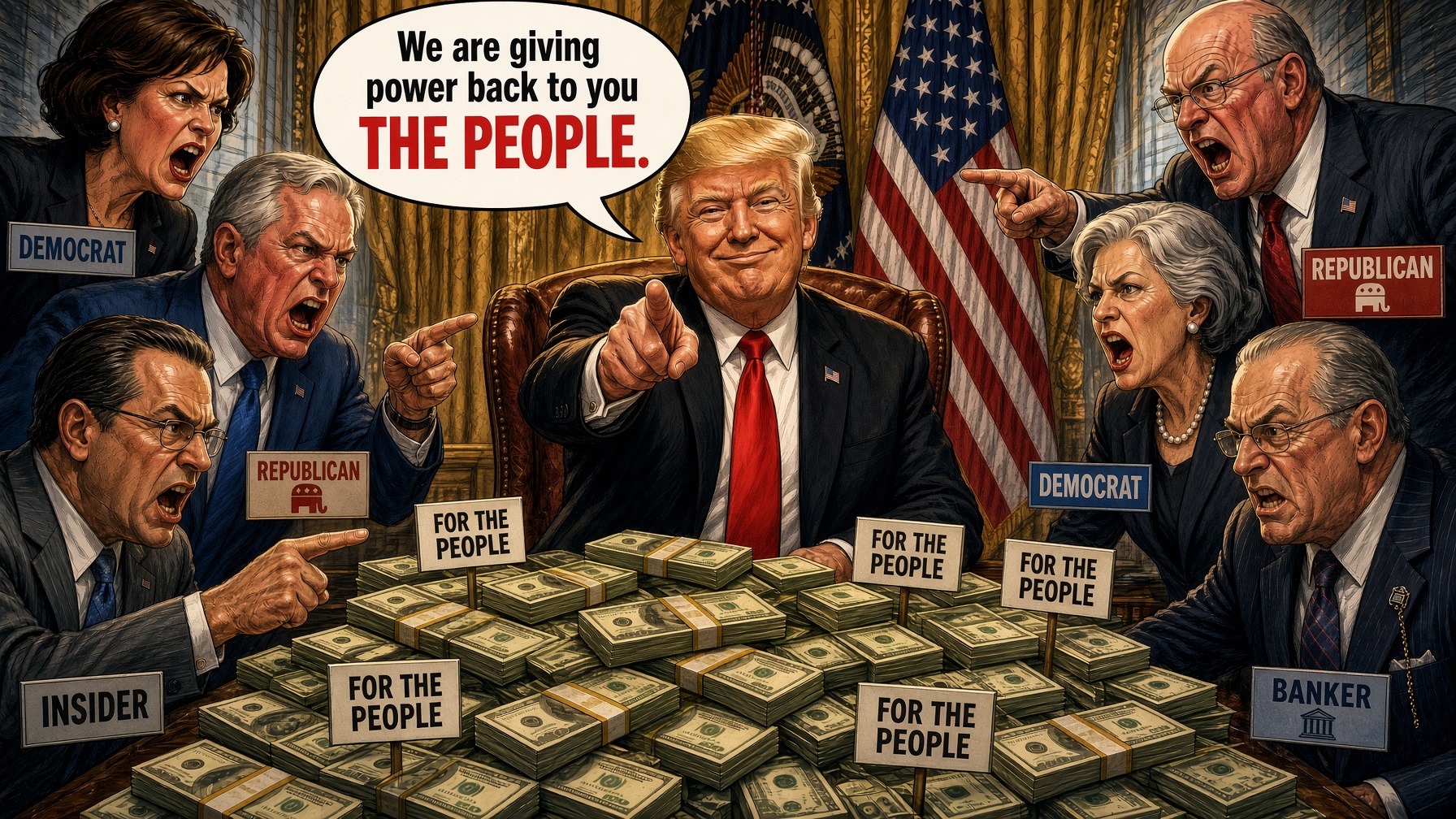
A successful country pays its owners. America is winning again. The people who live here should cash the dividend.
On September 9 in Dallas, President Donald Trump did what a president for the people is supposed to do. He looked at the American public — not the foundations, not the donor circuit, not the people who treat citizenship like a branding exercise — and he put a number on victory. If Republicans hold the House and the Senate on November 3, every adult U.S. citizen gets a $5,000 Trump Dividend, and that money gets spent in the United States. Not Canada. Not China. Not Germany. Here. He compared it to a winning company returning cash to its shareholders, and to the $1,776 checks his administration already put in the hands of American service members. That is the most American idea in the speech. The country is not a waiting room for the rest of the planet. It is an enterprise. Citizens are the shareholders. When the enterprise wins, the shareholders get paid.
This is exactly the fight populists have been in for a decade. We were told America First meant slogans. Trump is making it mean a check. Tariffs make foreign producers pay to sell into the richest market on earth. Factories come home. Energy comes back on. Borders close. Wages stop getting bid down by a conveyor belt of cheap labor. The surplus of that project does not belong to a think tank in Arlington and it does not belong to a contractor in Northern Virginia. It belongs to the nurse, the welder, the waitress, the retired couple, the kid trying to buy a truck. JD Vance said it after the speech: keep the project going and the public shares in the wealth it creates. That is not a theory. That is ownership.
The growth will eat the check — and then some
The professional class is already running the same tape they run every time money might reach an actual American household. They call it inflation. They call it a bribe. They call it socialism. Then they go back to waving through every foreign aid package, every bank rescue, every campus endowment, and every “allied” procurement that never created a single job in Youngstown. Ignore them. They have been wrong about this economy since the first tariff hit the dock.
America is not a broke charity. It is a country that, under this president, is pulling in investment, production, and tariff revenue on a scale the last crowd said was impossible. Commerce Secretary Howard Lutnick has already said the dividend is not a raid on the paycheck of the American worker and not another Washington deficit stunt. It is a distribution of success. That is the right frame. Five thousand dollars is not an emergency ration. It is a down payment on a boom that is going to run past the check. Growth compounds. Plants that open this year throw off wages, local taxes, and supplier orders for a decade. Energy that is cheap again makes every factory in the Midwest more profitable than the spreadsheet said it would be. A dividend spent inside the United States is not money leaving the system. It is money hitting American registers, American shops, American labor — and then coming back around again.
There is no reason to treat $5,000 as a ceiling. If the country keeps winning the way it is winning, the next distribution should be larger. Shareholders do not apologize for a good year. They take the dividend and they ask what next year’s looks like. That is the attitude this coalition was built for. We did not spend ten years fighting globalist trade, open borders, and a uniparty that shipped the industrial base overseas so we could get shy the minute the winnings showed up. The winnings are supposed to show up. In American pockets. In American towns. In cash you can spend at a store that employs your neighbor.
The leftover libertarians missed the plot
The loudest no on the right is coming from the same quarter that never made peace with the coalition that actually wins elections. The Cato dinner circuit. The Heritage memo. The National Review column that still thinks 2012 was the peak of Western civilization. They have a word for any check with a government logo on it, unless the check is made out to a defense prime, a semiconductor campus, or a fund manager who will offload the jobs the minute the ribbon-cutting photo hits LinkedIn. That view had its run. It gave us hollowed towns and a conservative movement that could recite Hayek while the middle class got carved up.
Working families did not walk out of the old GOP because they wanted another lecture about abstract virtue. They walked out because the party could find discipline for a waitress in Ohio and flexibility for everyone above her. Trump’s instinct is the correction. He talks like the country has owners, and he talks like those owners are allowed to get paid. The leftover libertarians hear “check” and they reach for 19th-century vocabulary. The rest of the country hears “finally.” Alaska has paid its people a resource dividend for decades and it did not turn into a cautionary tale. The military checks last December did not ruin the republic. A $5,000 dividend spent on American goods is the same idea at the scale the moment deserves.
The “must be spent in America” rule is the part they will pretend not to understand because it is the part that makes the policy serious. It is a border for capital. You take the dividend and you buy American groceries, American parts, American labor. That is economic nationalism in a form a normal person can cash. It is also why the growth argument is not a slogan. Money that stays here becomes payroll. Payroll becomes demand. Demand becomes another shift at the plant. That loop is how a country gets richer than the check it just wrote.
If Congress stalls, he does it himself
Republicans in Congress should pass it tomorrow. Adult citizens. Spent at home. No apology tour. That is the clean path, and they should take it. But this country has watched Congress sit on its hands while presidents found a way for wars, for bailouts, for foreign factories, and for every priority that never had to wait on a conference committee. A president for the people does not treat the American household as the one item that requires perfect parliamentary weather. Trump already said he does not think he needs a permission slip to deliver the dividend. Good. That is the correct posture. Serve the people first. Let the process people catch up.
Do it from the Oval Office if that is what it takes. Set the precedent out loud: this office exists to put American citizens first, and a winning country pays its owners. Every administration in living memory has stretched executive power for somebody. They stretched it for alliances. They stretched it for banks. They stretched it for agencies that never stand for election. Stretching it to put $5,000 in the pocket of the people who actually live here is not a scandal. It is the first time in a long time the stretch would run toward the public instead of away from it. If the old rules could move a trillion dollars anywhere but an American kitchen table, then the new precedent is simple. The president finds a way. There is not a version of this where the check dies in a hallway because a handful of senators wanted another hearing.
That is how you break the spell. You do not wait for the donor class to decide the American people are an approved recipient. You send the money. You make it normal. You make it expected. After that, every future president has to answer a new question: if he could deliver for citizens and he refused, whose president was he? That is the point of precedent. Not a loophole. A standard. The White House works for the country that voted, and when that country wins, the winnings show up at home.
Send the money. Keep going.
The midterms are a referendum on whether this government still belongs to the people who live under it. Trump answered with a number and a rule. Congress can write it into statute and take the credit. If they will not, the president should pick up the pen and do the job he was hired to do. Either way, the dividend moves. That is leadership. That is what it looks like when a man remembers the presidency is not a chairmanship of a journal. It is the one office in this country that is supposed to look a working family in the eye and say: you own this place, the place is winning, and nobody in Washington gets to misplace your share.
Five thousand dollars is the right number for the first distribution. The boom behind it is bigger than the number. If the country keeps doing what it is doing — tariffs that make foreigners pay, energy that makes production cheap, borders that protect the wage, factories that actually open — there is no reason the next dividend is not larger. Win. Pay the owners. Win again. Cash the check. Spend it here. And get ready for more.