Connect with us

U.S.

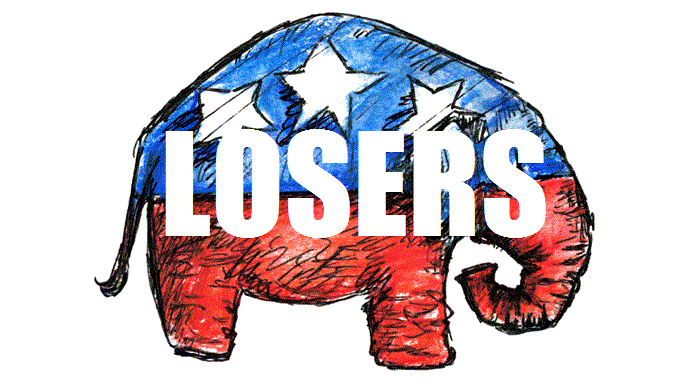
Republicans Are Weak, Spineless, & Complicit In The Death Of America

Published

on

While Americans continue to be hurt by stagnant wages, internet censorship, and being replaced by automation & migration…. the House of Representatives spent the entire day arguing about what Representative Steve King never said.  Read that again:

The House of Representatives spent the entire day arguing about what Representative Steve King never said.

The Failing New York Times creates yet another fake news story to frame Rep. King as a white supremacist.  Republicans salivated eagerly to be the first in line to denounce King.

I shouldn’t be surprised.  These are the people who refuse to go to bat against internet censorship even when it hurts their own campaign’s ability to win elections.  They refuse to build a wall.

For some reason, the party is taking the lead from 2012 loser (cannot be emphasized enough: loser) Mitt Romney and a California cuckservative is the House Minority Leader.

These are our leaders?  If so, expect to lose bigly in 2020 and beyond.

Continue Reading
Click to comment

Leave a Reply

Your email address will not be published. Required fields are marked *

Politics

Trump’s Reverse Psychology to Expose Zionism

Published

on

In a fiery Truth Social post this week, President Donald Trump unloaded on four prominent conservative voices—Tucker Carlson, Candace Owens, Alex Jones, and Megyn Kelly—calling them “low IQ,” “stupid people,” “nut jobs,” “troublemakers,” and “losers” who aren’t real MAGA. The trigger? Their vocal opposition to U.S. military escalation against Iran, which critics frame as part of a broader joint U.S.-Israeli campaign in the region. Trump spent hundreds of words attacking them while insisting his actions align with keeping nuclear weapons out of Iran’s hands, the number one state sponsor of terror.

The attacks were personal. Trump mocked Jones over his Sandy Hook-related bankruptcy, jabbed at Owens’ past comments on Brigitte Macron, questioned Carlson’s education, and dismissed them all as irrelevant podcast hosts chasing publicity. In response, Owens quipped it might be time to “put Grandpa up in a home.” Jones suggested Trump had changed and prayed for him to be freed from “demonic influences,” while Carlson has repeatedly called Trump a “slave” to Israel, arguing the war serves Israeli interests over America First.

On the surface, this looks like a messy MAGA civil war: Trump, once boosted by these influencers, now turning on them over foreign policy. But zoom out, and a sharper pattern emerges. Trump’s willingness to take the punch—alienating loud voices in his own coalition—functions like reverse psychology. By drawing a hard line and inviting the inevitable backlash, he spotlights the very issues his critics obsess over: Israel’s influence on U.S. policy, AIPAC-style lobbying, donor pressures (think Miriam Adelson’s past contributions), and accusations of “Zionist control” over decisions from embassy moves to strikes on Iranian targets.

The Feud in Context

These critics didn’t start the fight in a vacuum. Carlson has questioned whether Israel is “blackmailing” Trump or holding leaders “enslaved,” framing U.S. involvement in the Iran conflict as contrary to America First promises. Owens has accused Trump of betraying troops for Israel, warned of false flags, and tied various events to Zionist lobbying. Jones has echoed themes of external “influences” pulling strings. Their pushback intensified as Trump defended actions against Iran, with some alleging the timing and scope served Netanyahu’s agenda more than strict U.S. interests.

Trump’s response? Instead of ignoring or quietly sidelining them, he amplified the rift with over-the-top rhetoric. The result: millions of eyes now glued to the debate. Every reply from Jones, Owens, or Carlson recirculates claims about undue foreign influence, Epstein files speculation (often laced with conspiracy), Adelson donations, and the broader “Israel lobby.” What was once fringe muttering in echo chambers becomes mainstream conservative infighting—broadcast on X, podcasts, and news cycles.

This isn’t subtle. Trump has a long history of transactional deal-making, including strong pro-Israel moves in his first term (Jerusalem embassy, Abraham Accords, Golan recognition) that pleased evangelical bases and certain donors while advancing what he saw as U.S. leverage. He’s also repeatedly warned against endless wars and nation-building. By punching right on this fault line, he forces the “anti-Zionist” wing of MAGA to overplay their hand, turning abstract gripes into concrete examples of division.

Mastercraft or Self-Sabotage?

Call it masterful political jiu-jitsu or chaotic disruption—Trump absorbs the hits to expose fractures. Critics on one side see him “caving” to neocons, donors, or Israeli security needs against a nuclear Iran. On the other, his base loyalists view the influencers as grifters who abandoned him the moment policy got tough, prioritizing isolationism over confronting terror sponsors. Either way, the spectacle drags Zionist influence, lobbying power, dual-loyalty whispers, and Middle East entanglements into the open for public dissection.

  • Pro-Trump read: He’s prioritizing American security (no Iranian nukes) and calling out disloyal voices who bash him while riding his coattails. The feud proves he’s not controlled—he’s fighting on multiple fronts.
  • Critics’ read: The attacks confirm external pressures overriding campaign rhetoric, with Trump “mad that he got set up by Israel.”
  • Neutral observer: Regardless of who’s “right” on Iran policy, the infighting spotlights real questions about foreign aid, lobbying transparency, and whether U.S. decisions should ever prioritize another nation’s survival over domestic priorities like borders and debt.

Trump’s brand has always been willingness to brawl in public, even with allies. He takes the punch knowing it generates attention, frames the narrative, and lets opponents reveal their priorities. Here, by escalating against popular podcasters, he ensures debates over “Zionism” vs. strategic alliances, influence ops, and America First consistency dominate the discourse. The louder the backlash, the more those topics—usually confined to niche corners—flood timelines and force ordinary voters to confront them.

Whether this is deliberate 4D chess or raw instinct, the effect is the same: exposure. The feud isn’t hiding Israeli or Zionist sway; it’s thrusting it under the spotlight for millions to judge. Trump’s history suggests he bets on his base seeing strength in the fight, not weakness in the fray. In a polarized media age, taking the punch while the critics swing wildly may be the ultimate way to make the underlying tensions impossible to ignore.

The right is splintering in real time. How it resolves will say as much about U.S. foreign policy priorities as it does about Trump’s unique style of disruption. One thing is clear: no one’s looking away.

Continue Reading

Iowa

Watch the Water: Iowa Water Investigation

Published

on

Introduction

Water infrastructure rarely becomes headline news until something goes wrong. But across Iowa, a series of developments over the past year has raised growing questions about aging infrastructure, regulatory compliance, and public transparency.

Populist Wire began examining these issues through several reports focused on Cedar Rapids and Linn County. Those articles explored a series of events involving water quality awards, lead pipe inventories, and disputes tied to public records and housing enforcement.

This article provides a 2026 investigation update, connecting previous reporting with new statewide coverage of water issues affecting Iowa communities.


1. The Award and the Lead Risk

The first article in the series examined a striking contradiction.

Cedar Rapids received national recognition for water quality after its municipal water system won the “Best Tasting Water” competition from the American Water Works Association (AWWA).

At the same time, federal regulatory changes required cities to identify potential lead service lines. In Cedar Rapids’ case, municipal inventory data indicated that thousands of water service lines were classified as either lead or “unknown.”

Under updated federal guidance tied to the EPA Lead and Copper Rule Improvements, many “unknown” service lines must be treated as potential lead until verified.

The issue was explored in Populist Wire’s earlier report:
Cedar Rapids Wins AWWA Best Tasting Water Prize as 17% Face Lead Risks; AWWA Sues EPA Over Lead Regulations

The result created a paradox that triggered the initial investigation:

  • A national water quality award
  • Simultaneous identification of potential lead risk affecting thousands of service lines

The situation raised questions about how cities communicate water quality and infrastructure risk to residents.


2. The Lead Service Line Map

The second Populist Wire article examined Cedar Rapids’ publicly released service line inventory map.

Municipal water systems across the United States have been required to catalog every service line connection under federal drinking water regulations.

In Cedar Rapids, the map categorized pipes into several classifications:

  • confirmed non-lead
  • confirmed lead
  • galvanized lines
  • unknown material

Federal guidance states that unknown materials must be treated as potential lead until confirmed otherwise, because historical installation records are often incomplete.

The investigation focused on whether the classification and public presentation of these lines matched federal regulatory expectations.

The issue matters because infrastructure inventories directly influence:

  • public health risk assessments
  • pipe replacement priorities
  • federal infrastructure funding eligibility

Cities nationwide are now racing to complete these inventories before federal replacement deadlines take effect.

This issue was detailed in Populist Wire’s report:
RICO in Iowa: Cedar Rapids Lead Map Breaks EPA Rules


3. Housing Disputes and Institutional Response

The third Populist Wire report expanded the story beyond water infrastructure.

That article documented a housing dispute connected to residents who had raised questions about local governance and infrastructure transparency.

The situation involved:

  • housing enforcement actions
  • eviction proceedings
  • allegations that administrative pressure followed public scrutiny

While the housing issue is legally separate from water infrastructure, it raised broader questions about how institutions respond when infrastructure concerns are raised publicly.

The situation was explored further in:
RICO in Iowa: Housing Emergency

These concerns remain part of ongoing reporting.


4. Statewide Lead Pipe Replacement Efforts

Since the original articles were published, water infrastructure has continued to receive attention across Iowa.

Local reporting throughout 2026 has focused on several statewide challenges.

Cities across Iowa are now working to comply with federal regulations requiring the identification and replacement of lead service lines.

Communities including Cedar Rapids and others must develop replacement plans that may take years and hundreds of millions of dollars statewide.

Federal infrastructure funding through recent legislation is expected to help cover some of these costs, but municipalities still face significant financial and logistical hurdles.

Local reporting examining these challenges includes:

Up to 17% of Cedar Rapids water service lines could contain lead

Additional reporting on Cedar Rapids’ lead service line inventory includes:

Cedar Rapids identifies 8,500 potential lead lines, aiming for near-full inventory by 2037

The report highlighted that many cities are still working to determine how many service lines contain lead or unknown materials and how replacement costs will be distributed between municipalities and homeowners.

Infrastructure replacement could take years or even decades depending on funding availability.


5. Agricultural Runoff and Nitrate Concerns

Another major water issue affecting Iowa involves nitrate contamination caused by agricultural runoff.

Cities such as Des Moines have reported elevated nitrate levels in river water used for municipal supply, which can increase water treatment costs and trigger federal monitoring thresholds.

Environmental groups have long argued that fertilizer runoff contributes significantly to these contamination issues, while agricultural organizations emphasize the importance of voluntary conservation practices.

Coverage of this issue has appeared in statewide reporting such as:

Central Iowa rivers face high nitrate levels amid drinking water concerns

Additional reporting on growing public awareness of nitrate contamination includes:

Iowans requested a record number of nitrate test kits in 2025

Water treatment plants can remove nitrates, but the process increases operational costs and infrastructure demands for municipalities.


6. Political Debate Over Water Policy

Water infrastructure and environmental policy have also become part of broader political discussions across the state.

Both Republican and Democratic leaders have addressed water quality concerns, though their approaches often differ.

Statehouse discussions around funding, regulation, and agricultural practices have received coverage such as:

New state report lists more than 700 impaired waters in Iowa

Democratic lawmakers have generally emphasized stronger environmental protections and federal infrastructure investments.

Republican leaders have often raised concerns about regulatory burdens on farmers and municipalities while supporting targeted infrastructure funding.

These policy debates reflect the growing importance of water issues across Iowa.


7. Why Infrastructure Transparency Matters

Water systems are among the most critical pieces of infrastructure in any community.

Yet they are also among the least visible.

Most residents never see the pipes beneath their streets, the treatment processes at municipal plants, or the regulatory frameworks that govern drinking water safety.

When issues do emerge—whether related to lead pipes, nitrate pollution, or infrastructure inventories—they often reveal how complex these systems are.

Coverage across Iowa media has increasingly emphasized transparency and public access to infrastructure data, including reporting such as:

Cities Release Water Infrastructure Data as Lead Pipe Regulations Expand Nationwide

The purpose of the Watch the Water series is not to make conclusions prematurely, but to document developments as they occur and examine how public infrastructure is managed.

Continue Reading

Business

Enjoy Your Tasty Wheat: How AI Corporate Greed is Killing Humanity

Published

on

Why the elite have decided it’s better to feed machines than humans.

We have a lower class of CEOs. And AI is making it worse.

In the past, these titans of industry would invest in their communities: libraries, public works projects, parks, or actual philanthropy.

Today’s C-suite “geniuses” engage in fake activism, bribery disguised as donations, and a complete nihilism from the communities they proclaim to serve at the safety of their gated communities.

It used to be a source of great pride for an owner to discuss how many employees they have. They would boast about how they put food on the table for families. They would talks about benefits, and how well they take care of their workers. Hell, they used to even describe them as “family.”

Now, they can’t wait to tell shareholders how they automate everything themselves, outsource to foreign countries for pennies on the dollar, and utilize AI to cut their entire labor force (we will get to this soon.)

The common thread is that those at the top are completely divorced from their workforce, the very people that happen to also be their consumers.

This was the situation largely even before AI. It’s gotten worse. They are absolutely foaming at the mouth to displace workers.

The only way to describe it is a race to the bottom. Investing millions into replacing humans with AI. This is already happening, and the reward has been big short-term gains from cutting jobs that look like more profitability to investors.

What’s more is that these AI data centers need billions of gallons of water, insane amounts of electricity, and tons of facilities to expand growth. It’s so astronomical they’re talking about moving it into space.

Think about it for a minute: companies would rather provide “drinking” water, “feed” electricity, and pay to “house” MACHINES instead of paying a living wage to people.

In fact, it might even be cheaper to pay a living wage. That isn’t stopping industry leaders from chasing their human-less dreams, despite it taking less energy and resources for humans. Yet they’re still choosing machines.

They are even willing to operate at a loss simply for the idea that they can save the cost of paying a wage.

There are a few outcomes that are possible:

Best case: AI hype is exposed as overblown and companies understand that it’s simply a tool and they need actual operators behind the steering wheel. AI starts creating more jobs. It seems unlikely, but given that AI in actuality produces more slop than creative, it’s possible.

Worst Case: The arms race of displacing workers continues. Their greed hasn’t ever really showed signs of waning. To supplement the slop it creates, they will use freelance labor from countries like India to extinguish the fires it creates and justify not needing a full time employee. They will stop at nothing to chase their goal of a technocracy to increase profits. (Note: They think they don’t need you to even buy their products with the top 1% buying 50% of the goods.)

They trained AI on your work, fired you to save money, flooded the world with soulless garbage, empty warehouses, and call it innovation.

To them I say: enjoy your tasty wheat.

Continue Reading

Trending

Donate to Populist Wire

*Note: Every donation is greatly appreciated, regardless of the amount.