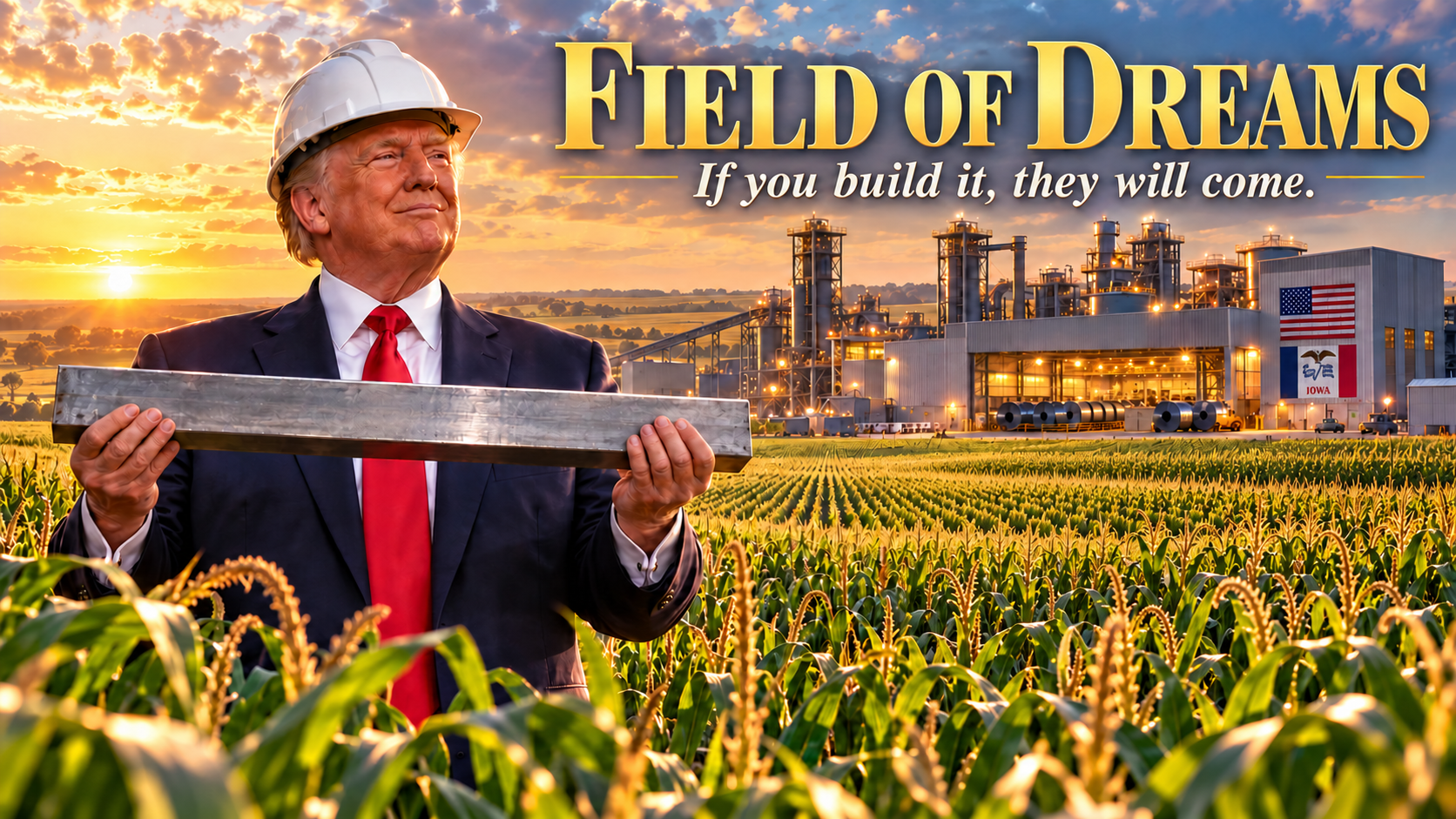
WASHINGTON — President Donald Trump announced Monday that Mesabi Metallics will build a roughly $15 billion steel mill in southeast Iowa — a project the White House calls the largest steel plant ever constructed in the United States.
Speaking in the Oval Office alongside company executives and administration officials, Trump framed the deal as proof that American manufacturing is coming back.
“Today, we’re thrilled to announce that Mesabi Metallics will be building the largest steel plant in American history in the great state of Iowa,” Trump said. “It’s the largest plant, one of the largest plants in the world, but it’s the largest plant in America by far.”
“In other words, this steel will be mined, melted and made right here in the USA,” he added. The project is expected to create up to 6,000 construction jobs, nearly 2,000 manufacturing and mining jobs, and $95 billion in economic activity, according to the White House.
The mill is planned for Lee County in southeast Iowa, near the Mississippi River, which the company intends to use to move iron ore from Minnesota. Rep. Mariannette Miller-Meeks, whose district includes the county, confirmed the location and said she joined the Oval Office announcement. Iowa lawmakers have discussed a possible special session to consider tax incentives before the November midterms.
Mine to mill, all in America
Mesabi Metallics, based in Nashwauk, Minnesota, and owned by India’s Essar Group, will feed the Iowa plant with iron ore from its new mine on Minnesota’s Mesabi Iron Range — the first new U.S. iron ore mine in about 50 years. The mine represents more than $2.5 billion in investment and is expected to produce about 7.5 million tons of direct-reduction-grade pellets a year and support roughly 350 jobs. Combined with the Iowa mill, the two projects total nearly $18 billion.
The company describes the supply chain as “100% American steel: mined, melted and poured in Minnesota and Iowa.” The U.S. Export-Import Bank has provided major financing for the Minnesota expansion.
The Iowa plant’s first phase is designed for 7.5 million tons of steel a year, with capacity later rising to 10 million tons — more than any other U.S. mill, according to the White House. First steel is targeted for 2030. Officials say it will use modern direct-reduced iron (DRI) and electric-arc furnace technology and can supply high-grade steel for defense, vehicles, shipbuilding, energy, and infrastructure.
Mesabi CEO Joe Broking called it “a major moment for U.S. made steel, combining the highest quality direct-reduction grade iron ore pellet from Minnesota’s Iron Range with the most advanced DRI to EAF steelmaking technology in Iowa.”
Permanent employment at the Iowa mill is projected at least 1,750 jobs. Some local reports put pay above $49 an hour. Construction is expected to begin soon.
Political and industrial context
The announcement comes weeks before the Nov. 3 midterm elections and after the administration raised steel tariffs to 50%. The White House is presenting the project as the first “mega” steel plant built in the United States since the 1960s and as evidence that tariffs and an America-first industrial policy are drawing capital back home.
White House spokeswoman Taylor Rogers said: “President Trump is delivering on his promise to rebuild American industry, reshore manufacturing, and create new jobs. Today’s announcement underscores the President’s historic efforts to revitalize the U.S. steel industry — supporting local communities, strengthening supply chains, and protecting our national security.”
Iowa Gov. Kim Reynolds welcomed the news: “American steel is BACK! … We’re proud to be the future home of the largest steel investment in US history—creating thousands of quality jobs, strengthening our economic trajectory, and ensuring strategic goods are Made in America.”
Commerce Secretary Howard Lutnick, EXIM Bank Chairman John Jovanovic, Mesabi Chairman Rewant Ruia, and Iowa officials including Sen. Joni Ernst attended the event.
U.S. raw steel output was about 82 million tons in 2025. A 10-million-ton Iowa mill would represent a significant share of national capacity and shift more production toward the Midwest.
The project still faces the usual hurdles of a multi-year industrial build: permitting, infrastructure, power supply, and state incentives. Production is four years away. But the administration and the company presented Monday’s announcement as a completed deal and the start of construction, not a concept.
For Iowa’s southeast corner and for a steel industry that has spent decades watching mills close, the numbers are large: billions in private capital, thousands of jobs, and a fully domestic mine-to-mill chain the White House says will not rely on foreign ore or foreign mills.