Politics
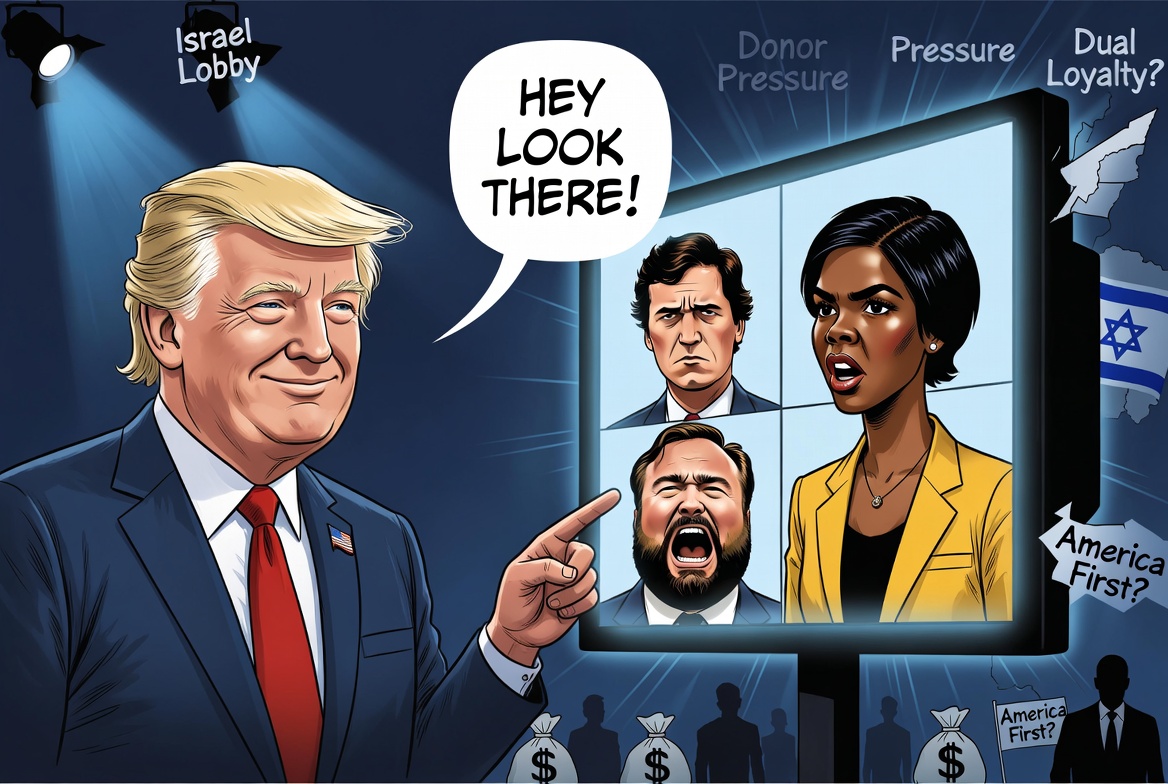
Trump’s Reverse Psychology to Expose Zionism
Published
2 hours agoon
In a fiery Truth Social post this week, President Donald Trump unloaded on four prominent conservative voices—Tucker Carlson, Candace Owens, Alex Jones, and Megyn Kelly—calling them “low IQ,” “stupid people,” “nut jobs,” “troublemakers,” and “losers” who aren’t real MAGA. The trigger? Their vocal opposition to U.S. military escalation against Iran, which critics frame as part of a broader joint U.S.-Israeli campaign in the region. Trump spent hundreds of words attacking them while insisting his actions align with keeping nuclear weapons out of Iran’s hands, the number one state sponsor of terror.
The attacks were personal. Trump mocked Jones over his Sandy Hook-related bankruptcy, jabbed at Owens’ past comments on Brigitte Macron, questioned Carlson’s education, and dismissed them all as irrelevant podcast hosts chasing publicity. In response, Owens quipped it might be time to “put Grandpa up in a home.” Jones suggested Trump had changed and prayed for him to be freed from “demonic influences,” while Carlson has repeatedly called Trump a “slave” to Israel, arguing the war serves Israeli interests over America First.
On the surface, this looks like a messy MAGA civil war: Trump, once boosted by these influencers, now turning on them over foreign policy. But zoom out, and a sharper pattern emerges. Trump’s willingness to take the punch—alienating loud voices in his own coalition—functions like reverse psychology. By drawing a hard line and inviting the inevitable backlash, he spotlights the very issues his critics obsess over: Israel’s influence on U.S. policy, AIPAC-style lobbying, donor pressures (think Miriam Adelson’s past contributions), and accusations of “Zionist control” over decisions from embassy moves to strikes on Iranian targets.
The Feud in Context
These critics didn’t start the fight in a vacuum. Carlson has questioned whether Israel is “blackmailing” Trump or holding leaders “enslaved,” framing U.S. involvement in the Iran conflict as contrary to America First promises. Owens has accused Trump of betraying troops for Israel, warned of false flags, and tied various events to Zionist lobbying. Jones has echoed themes of external “influences” pulling strings. Their pushback intensified as Trump defended actions against Iran, with some alleging the timing and scope served Netanyahu’s agenda more than strict U.S. interests.
Trump’s response? Instead of ignoring or quietly sidelining them, he amplified the rift with over-the-top rhetoric. The result: millions of eyes now glued to the debate. Every reply from Jones, Owens, or Carlson recirculates claims about undue foreign influence, Epstein files speculation (often laced with conspiracy), Adelson donations, and the broader “Israel lobby.” What was once fringe muttering in echo chambers becomes mainstream conservative infighting—broadcast on X, podcasts, and news cycles.
This isn’t subtle. Trump has a long history of transactional deal-making, including strong pro-Israel moves in his first term (Jerusalem embassy, Abraham Accords, Golan recognition) that pleased evangelical bases and certain donors while advancing what he saw as U.S. leverage. He’s also repeatedly warned against endless wars and nation-building. By punching right on this fault line, he forces the “anti-Zionist” wing of MAGA to overplay their hand, turning abstract gripes into concrete examples of division.
Mastercraft or Self-Sabotage?
Call it masterful political jiu-jitsu or chaotic disruption—Trump absorbs the hits to expose fractures. Critics on one side see him “caving” to neocons, donors, or Israeli security needs against a nuclear Iran. On the other, his base loyalists view the influencers as grifters who abandoned him the moment policy got tough, prioritizing isolationism over confronting terror sponsors. Either way, the spectacle drags Zionist influence, lobbying power, dual-loyalty whispers, and Middle East entanglements into the open for public dissection.
- Pro-Trump read: He’s prioritizing American security (no Iranian nukes) and calling out disloyal voices who bash him while riding his coattails. The feud proves he’s not controlled—he’s fighting on multiple fronts.
- Critics’ read: The attacks confirm external pressures overriding campaign rhetoric, with Trump “mad that he got set up by Israel.”
- Neutral observer: Regardless of who’s “right” on Iran policy, the infighting spotlights real questions about foreign aid, lobbying transparency, and whether U.S. decisions should ever prioritize another nation’s survival over domestic priorities like borders and debt.
Trump’s brand has always been willingness to brawl in public, even with allies. He takes the punch knowing it generates attention, frames the narrative, and lets opponents reveal their priorities. Here, by escalating against popular podcasters, he ensures debates over “Zionism” vs. strategic alliances, influence ops, and America First consistency dominate the discourse. The louder the backlash, the more those topics—usually confined to niche corners—flood timelines and force ordinary voters to confront them.
Whether this is deliberate 4D chess or raw instinct, the effect is the same: exposure. The feud isn’t hiding Israeli or Zionist sway; it’s thrusting it under the spotlight for millions to judge. Trump’s history suggests he bets on his base seeing strength in the fight, not weakness in the fray. In a polarized media age, taking the punch while the critics swing wildly may be the ultimate way to make the underlying tensions impossible to ignore.
The right is splintering in real time. How it resolves will say as much about U.S. foreign policy priorities as it does about Trump’s unique style of disruption. One thing is clear: no one’s looking away.
Europe
Populist Warning: Hungary’s Nationalist Fortress Falls
Published
2 hours agoon
April 12, 2026
In a stunning upset on April 12, 2026, Hungarian voters delivered a crushing blow to Prime Minister Viktor Orbán and his Fidesz party after 16 years of defiant nationalist leadership. The opposition Tisza Party, led by Péter Magyar—a slick former insider turned “change” candidate—stormed to victory with around 53% of the vote and a projected supermajority of 138 seats in the 199-member parliament. Orbán conceded defeat, calling it “painful,” as record turnout hit nearly 80%. What was sold as a grassroots revolt against “corruption” and “illiberalism” looks far more like a coordinated elite operation to drag Hungary back into the EU’s suffocating embrace. This isn’t just a Hungarian story; it’s a flashing red alert for every nation fighting to preserve its sovereignty against globalist machine politics.
The real story behind this result is a classic elite betrayal of working families who once rallied behind Orbán’s unapologetic defense of borders, traditional values, and resistance to endless migrant invasions and Brussels diktats. Magyar’s Tisza outfit, dressed up as “centre-right” and “pro-reform,” promises to “bolster the rule of law” and unlock frozen EU billions—code for surrendering Hungary’s hard-won independence on migration, family policy, and foreign affairs. Orbán built a bulwark against demographic replacement, gender ideology, and Ukraine war escalation that threatened to bleed Europe dry. Now, with high turnout fueled by anti-Orbán mobilization and possible foreign-backed campaigns, that wall is cracking. They—the Davos crowd, EU bureaucrats, and their media allies—painted Orbán as an authoritarian boogeyman while ignoring how his policies protected Hungarian workers from the cheap labor floods and cultural erosion devastating Western Europe. This shift reeks of the same globalist playbook we’ve seen time and again: undermine leaders who put citizens first, install pliable figures who prioritize “European values” over national survival.
The consequences for everyday Hungarians—and the broader populist movement—could be dire if this new regime follows through. Expect a rapid pivot toward open-border policies lite, accelerated EU integration that funnels sovereignty to unelected officials in Brussels, and a rollback of pro-family incentives that kept Hungary’s birth rates from total collapse. Hungarian families already squeezed by inflation and energy costs from green fantasies will face more “reforms” that benefit multinational corporations while eroding national identity. On the world stage, this weakens the America First alliance; Orbán stood as a rare European voice skeptical of forever wars and mass migration pacts that hurt American workers too. A pro-EU supermajority in Budapest hands globalists a propaganda win, signaling that even resilient populists can be toppled through relentless pressure, funding, and narrative control. For the U.S., it’s a reminder that our own battles against Big Tech censorship, bureaucratic overreach, and demographic swamping demand eternal vigilance—Trump’s return notwithstanding.
Patriots must treat Hungary’s fall as a cautionary tale, not a death knell. What needs to happen now is a fierce counter-mobilization: expose the foreign influences and elite capture behind Magyar’s rise, double down on securing borders and sovereignty wherever populists hold ground, and reject any “moderate” surrender that trades short-term EU cash for long-term national suicide. America First means learning from this—strengthen election integrity, rally working-class voters against cultural Marxism, and back leaders who refuse to bend the knee to globalist overlords. Hungary showed that high turnout can be weaponized against defenders of the nation; we must ensure ours delivers victories for citizens, not Davos. The fight for Western civilization isn’t over, but complacency invites exactly this kind of betrayal. Time to wake up, organize, and push back harder than ever before.
In the frozen heartland of America, Minneapolis has become a symbol of unchecked liberal chaos—a city where state and local officials have turned their backs on law and order, enabling fraud, violence, and open defiance of federal authority. The Trump administration’s bold crackdown on immigration fraud and illegal aliens through Operation Metro Surge has exposed the rot at the core of Minnesota’s Democratic leadership. But half-measures won’t cut it anymore. To root out the criminal networks embedded in state and local government, President Trump must invoke the Insurrection Act, deploy 25,000 to 30,000 troops, and orchestrate a coordinated takeover. This isn’t just about cleaning up one city; it’s a blueprint for reclaiming other corrupt blue states from the grip of radical progressives who prioritize open borders over American citizens.
The evidence of systemic corruption in Minnesota is overwhelming. For years, state programs have been plagued by massive fraud schemes, siphoning billions from taxpayer-funded initiatives like child nutrition, housing, and autism services. Federal prosecutors estimate up to $9 billion stolen, with most defendants tied to immigrant communities, particularly Somalis. Operation PARRIS, launched by DHS and USCIS, is reexamining thousands of refugee cases for fraud, focusing on Minnesota’s 5,600 recent refugees. Yet, Governor Tim Walz and Mayor Jacob Frey have actively aided these schemes by refusing to cooperate with ICE, releasing nearly 470 criminal aliens back into communities, and labeling federal enforcement as “racist” retaliation. Their sanctuary policies have turned Minneapolis into a haven for fraudsters, drug traffickers, and child predators, all while native Minnesotans suffer rising crime and economic strain.
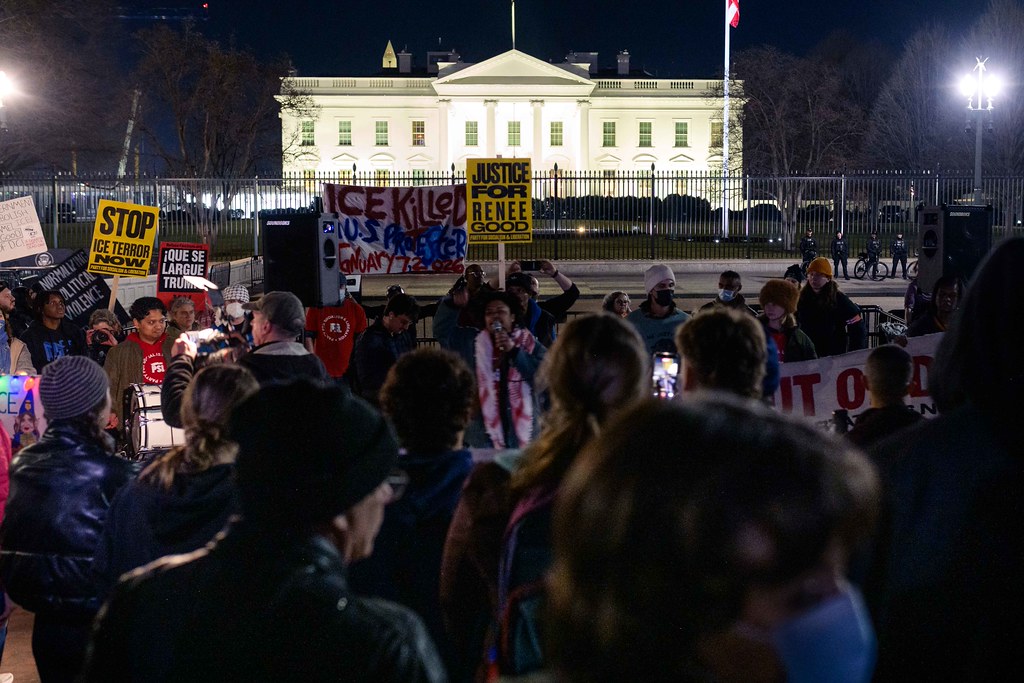
This obstruction isn’t passive—it’s deliberate sabotage. Walz and Frey have sued to halt the federal surge, claiming it’s politically motivated despite Minnesota’s fraud epidemic dwarfing national averages. They’ve instructed local police not to honor ICE detainers, allowing dangerous criminals to roam free. The DOJ is now investigating them for impeding federal enforcement, a clear violation of the law. And the violence? They’ve allowed riots to fester, with protesters clashing violently against ICE agents, throwing objects, blocking operations, and even pouring water to create icy hazards. Two shootings in a week— including the tragic death of Renee Good and a Venezuelan immigrant wounded—have escalated tensions, yet state leaders blame the feds instead of restoring order.
Worse still, this regime of radicals has blood on its hands. In June 2025, Democratic lawmaker Melissa Hortman and her husband were assassinated in a politically motivated attack by Vance Boelter, a former aide appointed under Walz’s administration. Boelter, with a hit list of 45 Democrats, also wounded State Sen. John Hoffman and his wife. Conspiracies swirl about Walz’s involvement, amplified by Trump’s posts, but the fact remains: under his watch, political violence has spiked, with officials promoting division and shielding suspects. This isn’t governance; it’s a criminal enterprise masquerading as progressive policy, agitating the left while failing to secure communities.
The numbers demand action. ICE has arrested hundreds of “worst of the worst” criminals—murderers, child rapists, and fraudsters—despite local interference. But with over 2,000 agents deployed, protests have turned the city into a war zone, outnumbering local police three to one. Judges have restricted ICE tactics, handcuffing agents from defending against agitators. Trump rightly threatened the Insurrection Act, a tool used by presidents like George H.W. Bush to restore order, but backed off—for now. Anything less invites more chaos, demotivating Trump’s base and emboldening open-borders advocates ahead of 2026 midterms.
Half measures—like limited surges or court battles—only exacerbate the issue, alienating patriots while handing victories to the left. Walz and Frey’s defiance has created a powder keg, energizing protesters who paint enforcement as inhumane. Amnesty whispers and carve-outs for workers undermine the mandate, signaling weakness. This piecemeal rot allows demographic shifts to continue, eroding America’s fabric.
The solution: Invoke the Insurrection Act now. Deploy 25,000-30,000 troops for a full takeover—expose the fraud networks, arrest complicit officials, and reconstruct governance under federal oversight. Start with Minneapolis as ground zero, then replicate in Chicago, Portland, and other blue bastions. No more excuses—with the One Big Beautiful Bill funding deportations, the tools are there. Anything less proves the “golden age” is fool’s gold, shattering the coalition and dooming the GOP. The military is the only way to deliver results and secure America’s future.
In the high-stakes arena of American politics, few issues ignite passion like immigration. For the core supporters of Donald Trump’s America First agenda, mass deportations weren’t just a campaign promise—they were the litmus test for whether this administration would deliver real change or revert to the empty rhetoric of past Republican leadership. Nick Fuentes, the outspoken leader of the America First movement, has emerged as a vocal critic, demanding tangible results: at least 1 million deportations per year, or Republicans can kiss goodbye any hope of retaining power in the 2026 midterms. Without swift, decisive action, Fuentes warns, the Trump administration risks alienating its true base, handing ammunition to pro-open borders advocates, and dooming the GOP to electoral oblivion.
Fuentes, whose “America First” platform has galvanized young conservatives with its unapologetic nationalism, has been relentless in holding the administration accountable. In a series of pointed posts on X, he has lambasted what he sees as sluggish progress on deportations, labeling them a “lie” and highlighting figures that fall far short of expectations. As of late 2025, Fuentes noted deportation rates averaging just 14,500 per month—projecting to under 700,000 over four years, a fraction of the promised scale. He has criticized key figures like Stephen Miller, calling out the lack of mass arrests and enforcement despite the hype. Fuentes’ message is clear: half-hearted efforts, such as prioritizing only criminals or offering amnesty to certain workers, are betrayals that compensate for broader failures, including foreign policy missteps and economic concessions.
The numbers tell a stark story. According to the Department of Homeland Security, as of December 2025, over 605,000 noncitizens had been deported since Trump took office, with an additional 1.9 million reportedly self-deporting via programs like the CBP Home app, which offers free flights and $1,000 incentives. The White House touts these figures as historic, claiming they’ve led to economic wins: two million native-born Americans gaining jobs while foreign-born employment drops, and declining home prices in high-immigration metro areas. Detention has surged too, with daily averages climbing from 39,000 to nearly 70,000 by early January 2026. Yet critics, including independent analyses, argue these totals inflate reality by including border returns and voluntary departures, not the interior removals that target long-term unauthorized immigrants. In fact, some reports peg actual deportations at around 390,000 for Trump’s first year, below the Biden administration’s final tally of 778,000 and well short of the pledged 1 million annually. Fuentes echoes this skepticism, updating his “Golden Age” scorecard to highlight paltry 325,000 deportations for 2025 amid other perceived betrayals like foreign aid and Epstein file redactions.
This shortfall isn’t just a policy quibble—it’s a political time bomb. Trump’s base, particularly the populist right that Fuentes represents, voted for transformation, not tweaks. If the administration fails to ramp up to mass-scale operations, it risks demotivating these voters ahead of the 2026 midterms, where control of Congress hangs in the balance. Fuentes has explicitly tied support to results: no 1 million deportations and a border wall means no votes for Republicans in 2026 or 2028. Polling already shows cracks, with Trump’s immigration approval dipping from 50% to 41% amid backlash over raids and family separations. Without proving its mettle, the GOP could see turnout plummet, allowing Democrats to reclaim ground by portraying Republicans as all bluster and no bite.
Worse, half measures exacerbate the problem. Fuentes cautions against “performative cruelty”—raids that grab headlines but achieve little, alienating communities without solving the issue. Such tactics agitate the left, energizing pro-open borders groups who paint enforcement as inhumane, while failing to deliver the systemic change needed to secure the border long-term. Amnesty carve-outs for farm or construction workers, as floated by Trump, only undermine the mandate, signaling weakness and inviting more illegal entries. This piecemeal approach hands victory to opponents, who can claim moral high ground while the demographic shifts they favor continue unchecked.
The clock is ticking. With new funding from the One Big Beautiful Bill securing $150 billion for deportations and wall construction, excuses are evaporating. Plans to expand ICE agents and detention to over 100,000 beds signal potential escalation, but words must become action. For Fuentes and his followers, anything less than 1 million deportations annually is bust— a failure that could shatter the coalition and pave the way for open-borders dominance. The Trump administration must deliver results, not rhetoric, or risk proving to its base that the “golden age” was just fool’s gold.
Populist Warning: Hungary’s Nationalist Fortress Falls
Trump’s Reverse Psychology to Expose Zionism
Strait of America
Watch the Water: Iowa Water Investigation