Iowa
Place Term Limits On Legislative Branch
Published
8 years agoon
The founding fathers did not intend for our elected officials to make careers out of public office. We have term limits for our President and for good reason; we should apply those same principles to the Legislative Branch. There are politicians that have been in office longer than Ive been alive.
Congressman Rod Blum established the first ever Term Limits Caucus in Congress and the support from other members to bring a vote to the floor to term limit themselves is disgracefully unpopular. If members aren’t willing to stand up next to Congressman Blum and put an end to Congressional jobs for life, we ought to vote them out.
Business
President Trump Secures Iowa Largest Steel Plant in U.S. History
Published
24 hours agoon
September 28, 2026
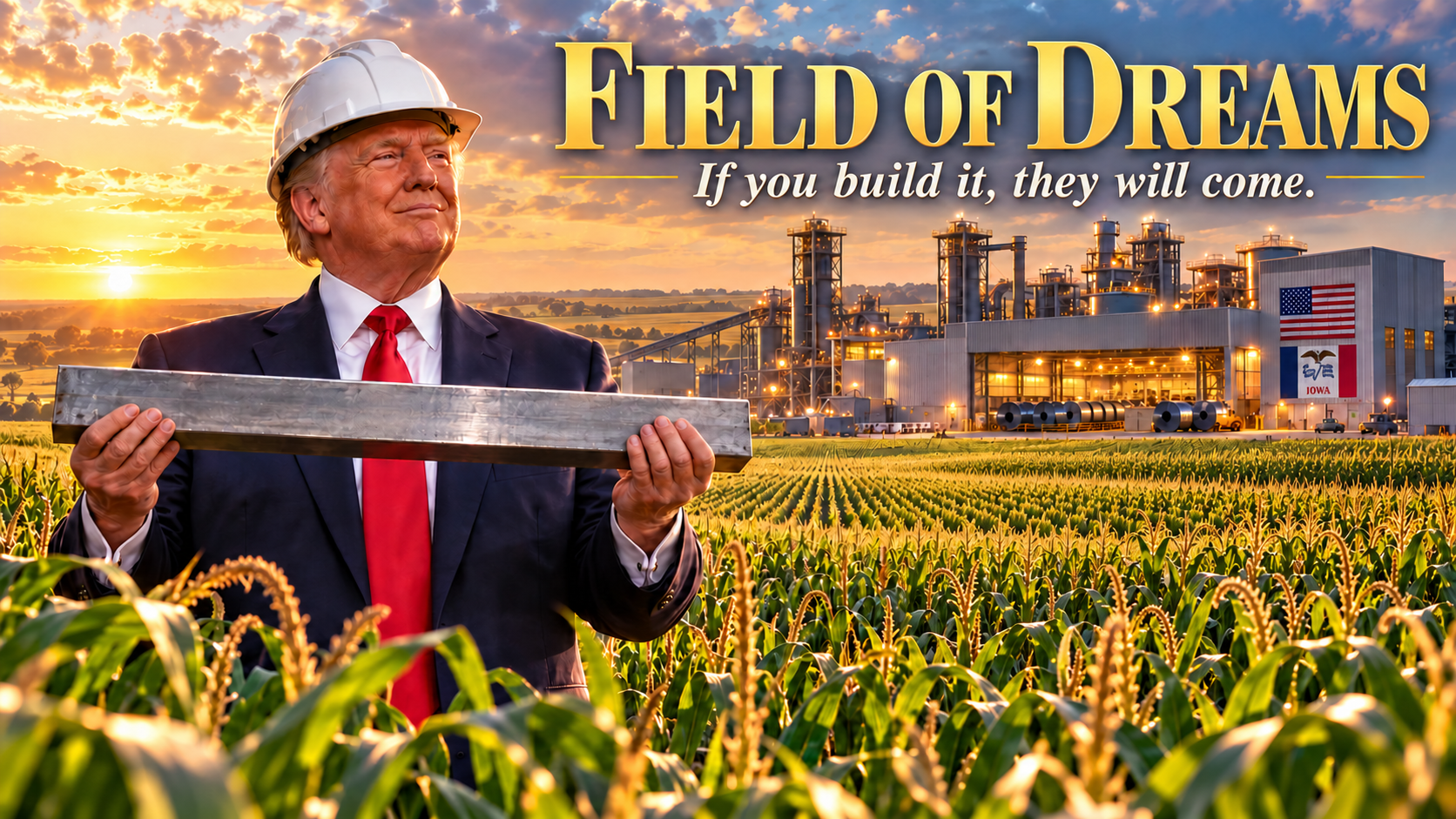
WASHINGTON — President Donald Trump announced Monday that Mesabi Metallics will build a roughly $15 billion steel mill in southeast Iowa — a project the White House calls the largest steel plant ever constructed in the United States.
Speaking in the Oval Office alongside company executives and administration officials, Trump framed the deal as proof that American manufacturing is coming back.
“Today, we’re thrilled to announce that Mesabi Metallics will be building the largest steel plant in American history in the great state of Iowa,” Trump said. “It’s the largest plant, one of the largest plants in the world, but it’s the largest plant in America by far.”
“In other words, this steel will be mined, melted and made right here in the USA,” he added. The project is expected to create up to 6,000 construction jobs, nearly 2,000 manufacturing and mining jobs, and $95 billion in economic activity, according to the White House.
The mill is planned for Lee County in southeast Iowa, near the Mississippi River, which the company intends to use to move iron ore from Minnesota. Rep. Mariannette Miller-Meeks, whose district includes the county, confirmed the location and said she joined the Oval Office announcement. Iowa lawmakers have discussed a possible special session to consider tax incentives before the November midterms.
Mine to mill, all in America
Mesabi Metallics, based in Nashwauk, Minnesota, and owned by India’s Essar Group, will feed the Iowa plant with iron ore from its new mine on Minnesota’s Mesabi Iron Range — the first new U.S. iron ore mine in about 50 years. The mine represents more than $2.5 billion in investment and is expected to produce about 7.5 million tons of direct-reduction-grade pellets a year and support roughly 350 jobs. Combined with the Iowa mill, the two projects total nearly $18 billion.
The company describes the supply chain as “100% American steel: mined, melted and poured in Minnesota and Iowa.” The U.S. Export-Import Bank has provided major financing for the Minnesota expansion.
The Iowa plant’s first phase is designed for 7.5 million tons of steel a year, with capacity later rising to 10 million tons — more than any other U.S. mill, according to the White House. First steel is targeted for 2030. Officials say it will use modern direct-reduced iron (DRI) and electric-arc furnace technology and can supply high-grade steel for defense, vehicles, shipbuilding, energy, and infrastructure.
Mesabi CEO Joe Broking called it “a major moment for U.S. made steel, combining the highest quality direct-reduction grade iron ore pellet from Minnesota’s Iron Range with the most advanced DRI to EAF steelmaking technology in Iowa.”
Permanent employment at the Iowa mill is projected at least 1,750 jobs. Some local reports put pay above $49 an hour. Construction is expected to begin soon.
Political and industrial context
The announcement comes weeks before the Nov. 3 midterm elections and after the administration raised steel tariffs to 50%. The White House is presenting the project as the first “mega” steel plant built in the United States since the 1960s and as evidence that tariffs and an America-first industrial policy are drawing capital back home.
White House spokeswoman Taylor Rogers said: “President Trump is delivering on his promise to rebuild American industry, reshore manufacturing, and create new jobs. Today’s announcement underscores the President’s historic efforts to revitalize the U.S. steel industry — supporting local communities, strengthening supply chains, and protecting our national security.”
Iowa Gov. Kim Reynolds welcomed the news: “American steel is BACK! … We’re proud to be the future home of the largest steel investment in US history—creating thousands of quality jobs, strengthening our economic trajectory, and ensuring strategic goods are Made in America.”
Commerce Secretary Howard Lutnick, EXIM Bank Chairman John Jovanovic, Mesabi Chairman Rewant Ruia, and Iowa officials including Sen. Joni Ernst attended the event.
U.S. raw steel output was about 82 million tons in 2025. A 10-million-ton Iowa mill would represent a significant share of national capacity and shift more production toward the Midwest.
The project still faces the usual hurdles of a multi-year industrial build: permitting, infrastructure, power supply, and state incentives. Production is four years away. But the administration and the company presented Monday’s announcement as a completed deal and the start of construction, not a concept.
For Iowa’s southeast corner and for a steel industry that has spent decades watching mills close, the numbers are large: billions in private capital, thousands of jobs, and a fully domestic mine-to-mill chain the White House says will not rely on foreign ore or foreign mills.
Rob Sand is asking Iowa to buy the outside of the man.
The outside is carefully grown. Decorah kid. Church on Sunday. Bowhunter. Former prosecutor who locked up lottery cheats and public thieves. Two-term state auditor, the last Democrat Iowans still elect statewide. He walks into rooms and asks the Republicans to raise their hands first. He almost never says Donald Trump’s name. He talks “costs, corruption and cancer” as if those were the only three words left in politics. He tells Democratic crowds he will veto “culture war bills.” He tells everybody else he is not really running as a Democrat at all — just as the adult in a one-party state that stopped working.
That is the skin. Peel it.
Layer one: the red-state rental
Sand did not invent this costume. He rented it from Kentucky.
Andy Beshear, Democratic governor of a state Donald Trump carries by landslide margins and chair of the Democratic Governors Association, flew in to baptize Sand’s general-election campaign. The sermon was the same one national Democrats have been workshopping since 2024 collapsed: soften the tone, talk family and faith, promise you will “put people first,” insist Democrats can win red states if they stop sounding like themselves. Beshear called himself “living, breathing proof.” Sand pointed at Kentucky’s even redder math and told Iowans their hill was smaller.
It is a franchise model. Same messaging. Softer tone. Appeal to rural voters. Check the boxes, ship it to Iowa, hope nobody notices the national committee still wants the scalp.
A governor in Des Moines will not get a Democratic legislature. Sand knows that. The play is not to pass San Francisco. The play is to take the mansion, veto from the inside, and give the national party a map it can sell in 2028. Iowa is the proof of concept. Sand is the packaging.
Layer two: the $12 million family
The packaging is expensive.
Since 2024, Sand’s wife, Christine Lauridsen Sand — CEO of the Lauridsen Group, the privately held Ankeny empire built on meat and dairy byproducts, animal nutrition, and related industrial products — and her parents and brothers have poured roughly $11.5 million into his campaign for governor. Count the same relatives back to his auditor races and the family total sits around $13.1 million. Christine alone has written checks in the millions. That is not grassroots. That is a family office underwriting a statewide takeover.
Sand’s answer is lawyerly. The money came from people, not a corporation. He rejects corporate PAC checks. Thousands of small donors exist too, some of them Republicans. Fine. None of that changes the structure. The largest personal underwriting of an Iowa gubernatorial campaign in memory sits in one household, attached to one private company, attached to the man who recites speeches about “insiders” and “special interests.”
He is not a billionaire in the Forbes sense, and the campaign likes to hide behind that distinction. His wife runs a global family firm measured in the billions of dollars of enterprise value and about a billion in annual revenue. Her relatives write the checks that keep the ads on television. If that is not elite donor politics, the phrase has no meaning.
Layer three: the water sermon and the family plant
Now peel the sermon.
Sand’s whole general-election identity is dirty water and cancer. Fund the monitors. Publish the manure plans. Restore wetlands. Deny chemical companies immunity. Build a “dirty water” alert system. Create a cabinet-level cancer task force. He tells rooms his own children drink Iowa water. He talks as if the state’s industrial mess were something that happened to his family, not something his family’s companies have had to answer for.
Lauridsen subsidiaries have not been spectators. Essentia Protein Solutions and related operations have shown up in Iowa DNR files over discharges, lagoons, ammonia, E. coli, and creeks. Lahn’s ads smear the details together and pretend the company itself cut Sand a $13 million check. That part is sloppy. The uncomfortable part is not. A candidate whose closing argument is “who poisoned the water” has spent his political life financed by the owners of plants that Iowa regulators have had to chase. Feather meal and blood meal from the family orbit are sold into fertilizer markets in a state drowning in nitrogen. Sand’s lawyers can explain product categories all day. Voters are allowed to notice the conflict without a permission slip.
If a Republican governor’s in-laws ran the plants, Sand the auditor would have held a press conference.
Layer four: “not a politician” with a politician’s list
Peel the anti-politics talk and the platform is a standard Democratic expansion dressed in auditor khaki.
He wants Iowa’s privatized Medicaid unwound from day one — he says illegal denials of care exploded after the state handed the program to for-profit managers, and he wants the machinery pulled back toward public or nonprofit control. He wants the school voucher program income-capped, audited, and tied to rules that treat private schools like public vendors. He wants the minimum wage moved toward $12. He wants adult-use cannabis legalized and taxed. He wants out-of-state landowners taxed harder, data-center breaks stripped or conditioned, utility “meter” fees capped, universal pre-K and school meals, caregiver credits, more wetlands, more monitors, more conservation subsidies, more state direction over water and land. He wants the auditor’s powers the Legislature clipped in 2023 handed back to him, which is convenient, because he would then be the man who both writes the rules and investigates the people who break them.
That is not “balanced government.” That is more government, aimed at the industries and institutions Iowa Republicans spent a decade building. Some of the targets deserve the hit. School vouchers without audits are an invitation. Chemical immunity is an insult. Rural hospitals and nitrate wells are not talking points. None of that converts a regulatory shopping list into a modest reform agenda. When Sand says he is done with culture war so the state can “fix real problems,” what he means is: let me move the economic machinery while you stop asking about the rest.
Layer five: the issues he wants offstage
The rest is still there.
Sand will tell a room he wants transgender Iowans to feel welcome and that stripping gender identity from the Iowa Civil Rights Act was wrong. He will also say transgender women and girls should not compete in female sports, which buys him a sentence in farm-county coverage and a “coward” shout in Iowa City. He will praise Bob Ray’s refugee tradition, mumble about people who “want to work and follow the rules,” and then sprint back to grocery prices. He will not run an open-borders campaign. He will also not run a secure-borders campaign. In a midterm defined nationally by immigration, that silence is the position.
Inclusion, climate, social justice, more government — those are not smears invented by an opponent’s ad maker. They are the actual stack underneath the hunting stories. Sand’s innovation is not moderation. It is sequencing. Put the popular fights first. Keep the coalition’s priorities in the platform and out of the first twenty minutes of the town hall. Hope rural Iowa grades the performance and never reads the rest of the script.
What is in the middle
There is no secret Soviet in the middle of Rob Sand. That charge is a gift to him, because it is easy to knock down. What is in the middle is more ordinary and more useful to see clearly.
A professional Democrat. A very good one. The only statewide Democrat who figured out that Iowa will not elect a lecture and might elect a prosecutor who whispers. A campaign sitting on tens of millions of dollars, a chunk of it from one industrial family, amplified by the Democratic Governors Association, validated by the man national Democrats want to run for president in 2028. A platform that grows the state’s hand over health care, schools, wages, energy, land, and water. A candidate who calls that accountability and calls everyone else’s donors corruption.
“Same talking points, different wrapper” is the honest summary. The wrapper is Iowa-shaped. The talking points are the party’s. The money is his wife’s family. The strategy is Beshear’s. The bet is that Iowans are tired enough of Republican monopoly to stop peeling.
Real people in this state have real problems. They are not required to pretend a rebrand is a revelation. Peel Sand all the way down and you do not find a farmer who wandered into politics. You find a Democratic project that learned to dress for the county fair.
Election Day is November 3. The skin will still be on the ads. The inside will be on the desk in January if the ads work.
Iowa
Rob’s House of Sand Collapsing in Bid for Iowa Governorship
Published
3 weeks agoon
September 8, 2026
Iowa is hungry for a real populist. Not another consultant-built “outsider.” Not another man in Carhartt who talks like a neighbor and governs like a donor list. Someone who will put citizens first on the border, keep the Second Amendment intact, break the two-party racket instead of feeding it, and stop treating farm families as a costume.
Rob Sand has spent a year auditioning for that job. He asks Republicans to raise their hands and then claps for them. He quotes Scripture. He talks about bowhunting, pizza, and “not redder or bluer, but better and truer.” He tells rooms he hates the two-party system. It is a polished performance of the candidate Iowa actually needs.
The problem is the performance keeps colliding with the paperwork.
The Independent Who Can’t Stop Being a Democrat
Sand is not a mystery independent who wandered onto a ballot. He is Iowa’s only statewide Democrat, running as the Democratic nominee for governor after no other Democrat qualified. He interned for Tom Harkin. He has backed Howard Dean, Hillary Clinton, Joe Biden, and Kamala Harris. In college he called himself “extremely liberal,” and he now says his values have not changed — only that “the parties may have moved.”
That last line is the tell. If your values never moved, the independent branding did.
He still says the quiet part out loud when he thinks the room is friendly. At a Grundy County town hall he explained party registration like a man who had to pick a locker: “I am a Democrat because when I realized that I had to pick a party in order to vote in a primary, I did so.” Then the theology: Jesus is for the little guy, and the Democratic Party “at its best” is too.
On X in October 2024 he put it even cleaner: “I’m mostly a Democrat because of my Christian faith, not in spite of it.” Critics who saved a later, more explicit “I am a Democrat” post say that one disappeared. Whether the deletion was cleanup or panic, the pattern is the same. The brand is independent. The confession, when it leaks, is partisan.

A populist does not need to hide his tribe. A marketer does.
Follow the Money, Not the Town-Hall Applause
Sand’s campaign loves small-dollar language. Teachers, nurses, $10 checks, all 99 counties. Some of that is real. So is the other ledger.
His wife, Christine Sand, is CEO of The Lauridsen Group, a global agribusiness and nutrition conglomerate built on livestock, dairy, feed, and animal-byproduct processing. Since 2024, Christine, her parents, and her brothers have poured on the order of $11.5 million into his race. That is not a bake sale. That is a family office writing the down payment on a governorship.
Then the coastal and institutional money arrived: Reid Hoffman of LinkedIn for $250,000; the Democratic Governors Association for $2.5 million; AFSCME, IBEW, the Iowa State Education Association, Fred Hubbell, Illinois Gov. J.B. Pritzker. Transparency USA filings show Sand’s committee has sent more than $1.4 million to the Iowa Democratic Party. Gazette reporting put the weekly party checks at $675,000 in just over two months in spring 2026; later coverage had the campaign’s party transfers around $750,000 as he shared a stage with DGA chair Andy Beshear.
So the man who says the two parties are private clubs starving independents is one of the Iowa Democratic Party’s largest cash sources. He slams the duopoly on Tuesday and funds its ground game on Wednesday. That is not rising above the system. That is owning a floor of it.
A populist campaign can take working people’s money. It cannot take Silicon Valley, national party PACs, public-sector unions, and an in-law agribusiness fortune, then lecture Iowa about insiders.
“Hallmarks of an Iowan” — If You Crossed the Line
On immigration, Sand talks like a pastor and governs like a sanctuary brochure.
He will concede that the Biden border was a mess and that he supports legal immigration. Then the policy slides. At town halls he has argued that people here illegally who work, pay taxes, and lack a criminal record should not “feel unsafe” in Iowa. He called the deportation of a West Liberty construction worker who showed up for an ICE check-in “wrong. Period.” He quoted “welcome the stranger.” He has said the traits of people here without legal status — working, paying taxes, treating neighbors well — “are the hallmarks of an Iowan.” He even floated “some kind of medicine” for entering illegally, then waved it off as a federal question.
That is not border realism. That is amnesty with a hymn attached.
Populists are not confused about this. A nation that will not enforce its line is not compassionate. It is a labor market for employers who prefer a workforce that cannot vote, cannot complain, and cannot easily leave. Iowa already lives with the costs: schools, hospitals, housing, wages in meatpacking and construction. Sand’s answer is to treat presence plus a paycheck as citizenship-adjacent, while staying slippery on whether a Governor Sand would keep Iowa cooperating with ICE. Republicans have pressed that question for months. The dodge is the answer.
Working Iowans who waited in line, or whose kids compete for the same apartments and overtime, are not villains for wanting the law enforced. Calling non-criminal illegal presence the “hallmarks of an Iowan” tells them their citizenship is a vibe.
The Bowhunter Who Won’t Carry the Second Amendment All the Way
Sand’s hunting biography is the campaign’s favorite camouflage. Decorah kid. Fox and Club. Ruger 10/22 at 14. An 870, a Super Black Eagle, a couple of SIG Sauers. “I like guns.” “I’m a different kind” of Democrat.
Iowa is not a may-issue museum anymore. It moved from discretionary sheriffs to shall-issue, then to constitutional carry, then to a state constitutional amendment putting gun restrictions under strict scrutiny. That is the settlement rural Iowa already made.
Sand will not go there. Asked whether an Iowa permit should be enough to carry in schools, he said no. The Daily Signal, citing his opponent’s research, reports he has backed stricter controls including may-issue discretion — the old system where a bureaucrat, not the Constitution, decides whether a law-abiding adult may carry. He owns guns. He does not want Iowa’s carry regime to stay as free as Iowans voted to make it.
That is the dual nature in one frame: blaze orange for the photo, permission-slip politics for the statute book.
The Little Guy With a Brown Degree and a Culture-War Veto
Sand sells himself as the anti-culture-war candidate who will “get state government out of the culture wars” and veto the bills he doesn’t like. Convenient veto. The fights he wants to retire are the ones his coalition already lost with Iowa voters: school choice he opposes, public-school books he does not want restricted, abortion positions his critics say include late-term permissiveness, and a record of treating sex-and-gender fights in schools as something a governor should refuse to touch.
You can dislike cheap culture-war content and still notice the pattern. “Leave it alone” usually means leave the last progressive settlement in place. Parents who wanted boys out of girls’ sports and explicit material out of elementary shelves were not asking for a sermon about polarization. They were asking for a governor who would not gaslight them.
A populist takes those parents’ side without apology. A brand manager changes the subject to singing “America the Beautiful.”
Why the Costume Works — and Why It Shouldn’t
Give Sand this: he diagnosed the market. Iowans are exhausted by party churches. Independents are a third of the state and locked out of closed primaries. People will clap for anyone who talks like he works for them instead of a color. His auditor years — prosecuting corruption, hiring a Republican and an independent into senior roles, getting his own office kneecapped by the legislature after he found misspent money — are the strongest parts of the resume. Those facts are why the costume almost fits.
Almost is the word.
The populist Iowa needs would not run as a Democrat while denouncing parties. Would not wire hundreds of thousands, then millions, into the Iowa Democratic Party. Would not take Reid Hoffman and the DGA and call it a people’s campaign. Would not let an industrial-ag family underwrite the bid and then talk about insiders in Des Moines. Would not tell a packed room that illegal presence plus a job is the hallmark of an Iowan. Would not hunt on Saturday and flinch from constitutional carry on Monday.
Sand is what the professional class builds when it studies populism the way a focus group studies a beer commercial. The plaid is real. The bow is real. The piety is rehearsed until it sounds like conviction. Underneath is a durable Democratic operative with a family fortune, a national party apparatus, and a set of positions on sovereignty and arms that Iowa already rejected.
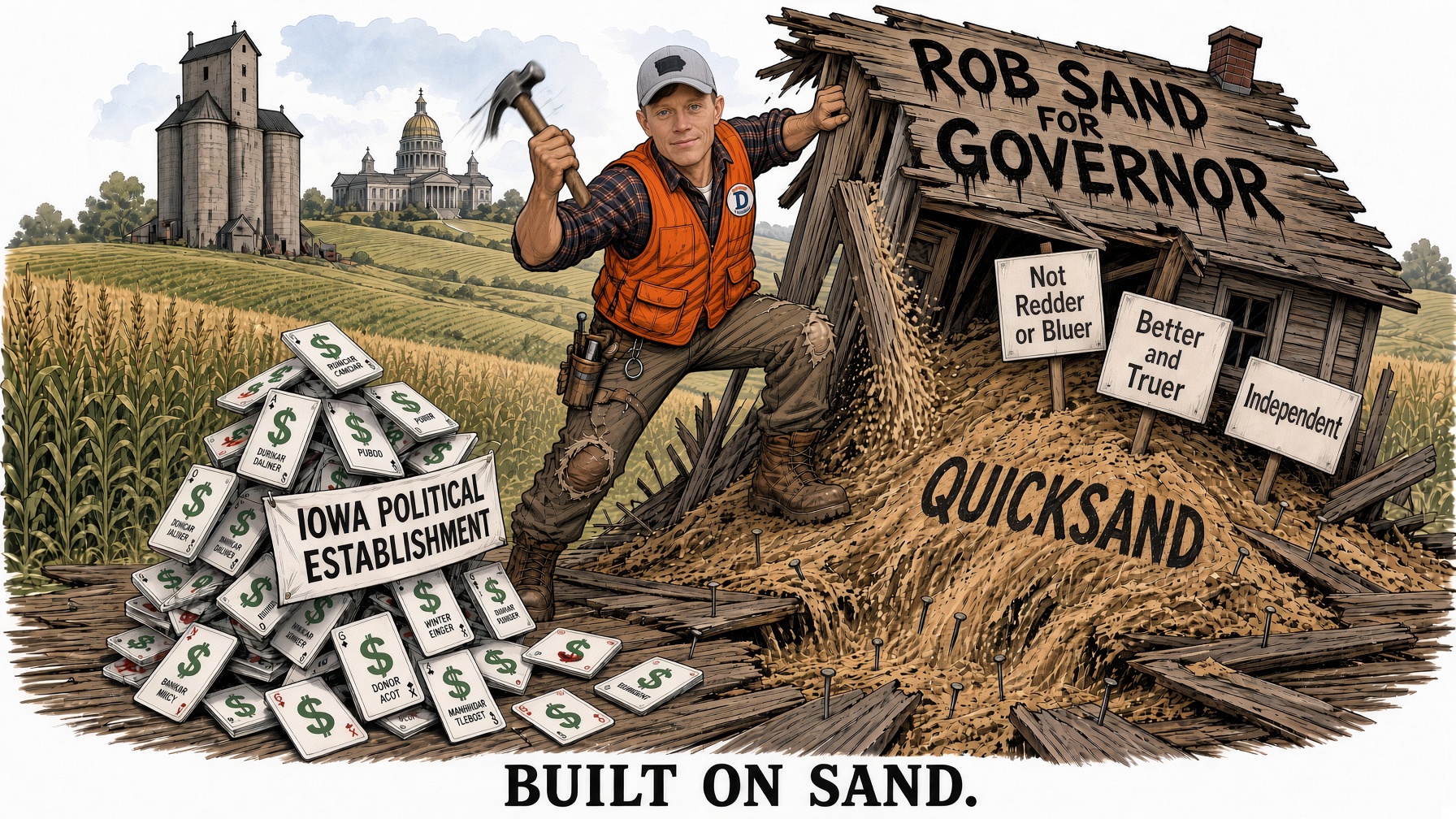
A house built on sand looks finished until the weather changes. November is weather. Iowans should look past the town-hall sing-along and ask the only question that matters in a populist year:
If he has to hide the D, hide the donors, and sand down the record to look like the man we need — what does that tell you about the man he is?
President Trump Secures Iowa Largest Steel Plant in U.S. History
Rob Sand: Peeling Back the Onion
President Trump’s $5,000 Dividend is Populist Genius
Rob’s House of Sand Collapsing in Bid for Iowa Governorship