Politics
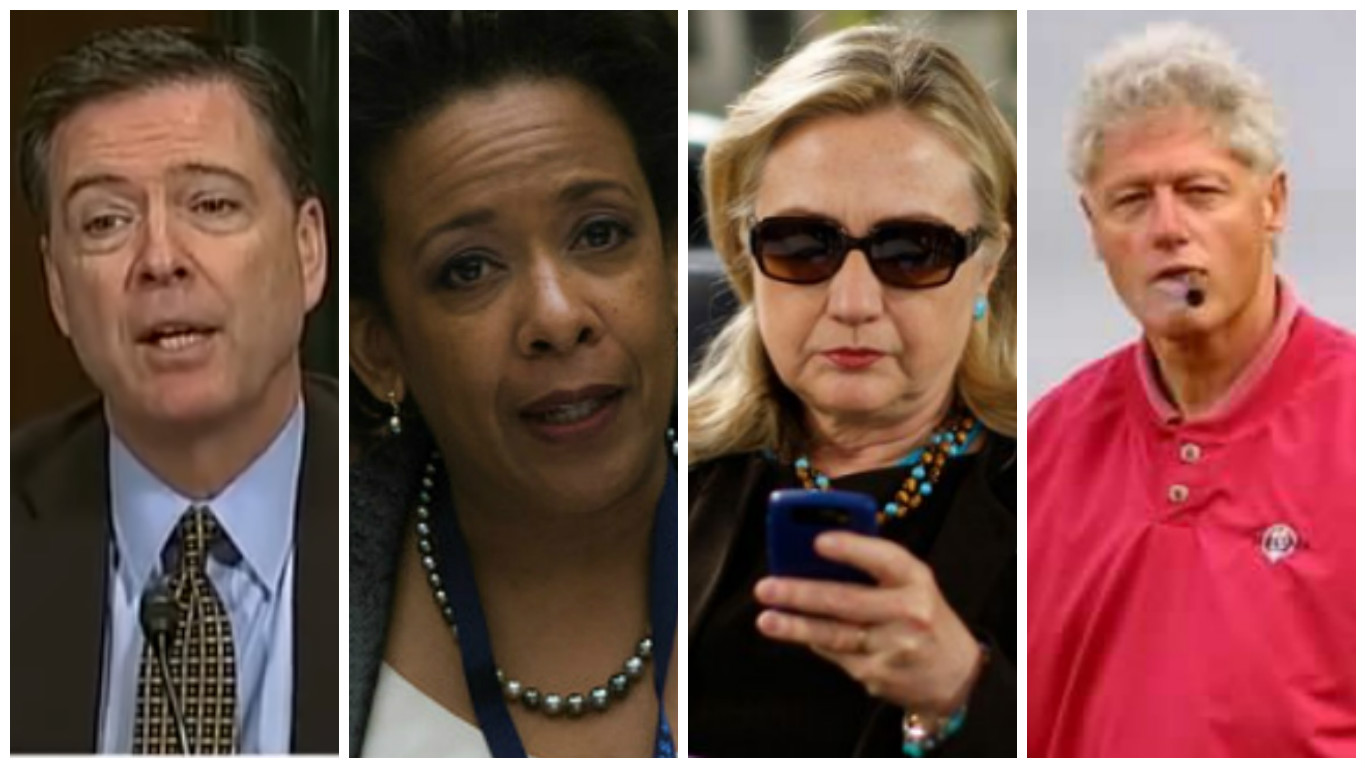
#LockThemUp: With Clinton, Comey, Lynch In Crosshairs, OIG Report To Trigger Second Counsel
Published
9 years agoon
(Via Zerohedge)
While most of the MSM fixated last week on whether or not President Trump eats McDonald’s in bed while watching Gorilla TV, a flurry of investigative bombshells involving Hillary Clinton, the Clinton Foundation, and conduct by the FBI’s top brass during the 2016 election splashed across the headlines. As a quick review:
The DOJ is “taking a fresh look” into the Hillary Clinton email ‘matter’
The FBI has launched a new investigation into the Clinton Foundation the day after the Clinton’s Chappaqua property catches fire
Former FBI Director James Comey’s full Clinton memo was released, revealing felony evidence of changes which “decriminalized” Hillary Clinton’s behavior. Oh, and every one of the memos he leaked to his Cornell professor buddy was classified, per a sworn statement by the FBI’s “chief FOIA officer” in a sworn declaration obtained by Judicial Watch.
The House Intelligence Committee will be granted access to “all remaining investigative documents,” unredacted, along with all witnesses sought per a deal reached between Deputy Attorney General Rod Rosenstein and Nunes
Opposition research firm Fusion GPS was forced to hand over banking records detailing various clients and their intermediary law firms, including the Clinton Campaign and a Russian money launderer whose lawyer was none other than Natalia Veselnitskaya of Trump Tower meeting fame
Most of these wheels which appear to be in motion are the result of corresponding groundwork laid on Capitol Hill you may not be aware of, including what might be the most important document in the entire process, expected in a little over a week.
On January 15, the DOJ’s internal watchdog – the Office of the Inspector General (OIG), is expected to present their findings to Congressional investigators regarding a wide variety of alleged bias and malfeasance by the FBI, the Clinton campaign, and the Obama Administration – both during and after the 2016 election. Moreover, the man heading up the OIG investigation, Michael Horowitz, fought the Obama Administration to regain investigative powers which were restricted by former Attorney General Eric Holder during the Fast and Furious scandal.
As you will read below, this highly anticipated report is likely to be the legal impetus behind a second Special Counsel – as detailed by an independent researcher from New York who goes by the Twitter handle “TrumpSoldier” (@DaveNYviii). His reporting, conveyed below, is a deep dig into the OIG’s ongoing investigation, how Congress and the OIG have worked in tandem to pave the way for a Special Counsel, and how Michael Horowitz went to war with the Obama Administration to restore the OIG’s powers.
Who is Michael Horowitz?
Horowitz was appointed head of the Office of the Inspector General (OIG) in April, 2012 – after the Obama administration hobbled the OIG’s investigative powers in 2011 during the “Fast and Furious” scandal. The changes forced the various Inspectors General for all government agencies to request information while conducting investigations, as opposed to the authority to demand it. This allowed Holder (and other agency heads) to bog down OIG requests in bureaucratic red tape, and in some cases, deny them outright.
What did Horowitz do? As one twitter commentators puts it, he went to war…
In March of 2015, Horowitz’s office prepared a report for Congress titled Open and Unimplemented IG Recommendations. It laid the Obama Admin bare before Congress – illustrating among other things how the administration was wasting tens-of-billions of dollars by ignoring the recommendations made by the OIG.
After several attempts by congress to restore the OIG’s investigative powers, Rep. Jason Chaffetz successfully introduced H.R.6450 – the Inspector General Empowerment Act of 2016 – signed by a defeated lame duck President Obama into law on December 16th, 2016, cementing an alliance between Horrowitz and both houses of Congress.
Horowitz’s efforts to roll back Eric Holder’s restrictions on the OIG sealed the working relationship between Congress and the Inspector General’s ofice, and they most certainly appear to be on the same page. Moreover, brand new FBI Director Christopher Wray seems to be on the same page as well.
Which brings us back to the OIG report expected by Congress a week from Monday.
On January 12 of last year, Inspector Horowitz announced an OIG investigation based on “requests from numerous Chairmen and Ranking Members of Congressional oversight committees, various organizations (such as Judicial Watch?), and members of the public.”
The initial focus ranged from the FBI’s handling of the Clinton email investigation, to whether or not Deputy FBI Director Andrew McCabe should have been recused from the investigation (ostensibly over $700,000 his wife’s campaign took from Clinton crony Terry McAuliffe around the time of the email investigation), to potential collusion with the Clinton campaign and the timing of various FOIA releases.
On July 27, 2017 the House Judiciary Committee called on the DOJ to appoint a Special Counsel, detailing their concerns in 14 questions pertaining to “actions taken by previously public figures like Attorney General Loretta Lynch, FBI Director James Comey, and former Secretary of State Hillary Clinton.”
The questions range from Loretta Lynch directing Mr. Comey to mislead the American people on the nature of the Clinton investigation, Secretary Clinton’s mishandling of classified information and the (mis)handling of her email investigation by the FBI, the DOJ’s failure to empanel a grand jury to investigate Clinton, and questions about the Clinton Foundation, Uranium One, and whether the FBI relied on the “Trump-Russia” dossier created by Fusion GPS.
On September 26, 2017, The House Judiciary Committee repeated their call to the DOJ for a special counsel, pointing out that former FBI Director James Comey lied to Congress when he said that he decided not to recommend criminal charges against Hillary Clinton until after she was interviewed, when in fact Comey had drafted her exoneration before said interview.
And now, the OIG report can tie all of this together – as it will solidify requests by Congressional committees, while also satisfying a legal requirement for the Department of Justice to impartially appoint a Special Counsel.
As illustrated below by TrumpSoldier, the report will go from the Office of the Inspector General to both investigative committees of Congress, along with Attorney General Jeff Sessions, and is expected on January 15.
Once congress has reviewed the OIG report, the House and Senate Judiciary Committees will use it to supplement their investigations, which will result in hearings with the end goal of requesting or demanding a Special Counsel investigation. The DOJ can appoint a Special Counsel at any point, or wait for Congress to demand one. If a request for a Special Counsel is ignored, Congress can pass legislation to force an the appointment.
And while the DOJ could act on the OIG report and investigate / prosecute themselves without a Special Counsel, it is highly unlikely that Congress would stand for that given the subjects of the investigation.
The OIG report could be in the hands of the DOJ as soon as January 8 for review, however it is unclear whether their response will be included in the copy of the report issued to Congressional investigators on January 15. Their comments are key. As TrumpSoldier points out in his analysis, the DOJ can take various actions regarding “Policy, personnel, procedures, and re-opening of investigations. In short, just about everything (Immunity agreements can also be rescinded).”
With the wheels set in motion last week seemingly align with Congressional requests and the OIG mandate, and the upcoming OIG report likely to serve as a foundational opinion, the DOJ will finally be empowered to move forward with an impartially appointed Special Counsel with a mandate to investigate whether or not we should “lock her up” (along with members of her motley crew). Maybe that’s why Sessions has been sitting on his hands?
Politics
Online Provocateurs Try to Sabotage America First, Nick Fuentes, & the Groypers
Published
3 days agoon
August 2, 2026
There’s a familiar pattern on the online right. Someone builds something real over years — an audience, a coherent worldview, a network of young people who actually show up, a brand that survives deplatforming and institutional hostility — and then a new wave of operators appears to declare it illegitimate. They didn’t organize the events, endure the bans, cultivate the base, or hold the line when it was costly. They simply want the throne, or at least the right to tear it down for engagement.
That’s the story with the latest round of attacks on Nick Fuentes and the Groypers.
Fuentes did not inherit a ready-made audience or a friendly institutional lane. He built America First the hard way: livestreams that were repeatedly banned, campus activism that forced conversations the mainstream right preferred to avoid, a persistent focus on immigration, foreign policy realism, and cultural continuity that resonated with a generation of young men who felt the older conservative institutions had failed them. The “Groyper” label stuck because it described a real, identifiable cohort that kept showing up — at events, online, and increasingly in the pipelines of young Republican staffers and campus organizations. Even hostile outlets now admit the influence is measurable enough to worry about.
Building and maintaining that requires consistency under pressure. It requires continuing after payment processors cut you off, platforms exile you, and former allies distance themselves the moment the heat rises. It requires producing content night after night while the same critics who call it a “cult of personality” or “just streaming for donations” produce little of comparable durability themselves.
Contrast that with the new critics. Many of the loudest voices attacking Fuentes right now never constructed a parallel youth movement. They did not spend years turning online discontent into organized pressure. Some are lifestyle influencers or late arrivals who discovered the America First energy after it had already been cultivated, then decided the man who did the cultivation is the problem. Others are established conservative media figures who spent years ignoring or dismissing the concerns that Fuentes amplified, only to pivot into anti-Groyper moralizing once the numbers became impossible to ignore. Still others are former adjacent figures whose main contribution has been internal drama, fed accusations, and calls for people to abandon the only sustained effort in that space.
The charge that Groypers “haven’t earned the right to a movement” is particularly rich coming from people who have earned even less. A movement is not measured solely by formal PAC filings or official party titles. It is measured by whether people keep showing up, whether the ideas spread into institutions that once excluded them, and whether the core message survives repeated attempts to isolate it. By those standards, the record is clear: the people now declaring the project dead or illegitimate are usually the ones who never built a comparable alternative. They critique the architecture while offering no blueprint of their own.
What many of these attacks actually reveal is resentment at the existence of an independent pole. Fuentes and the Groypers represent a faction that cannot be fully managed by the usual donor class, media gatekeepers, or careerist influencers. That independence is treated as the real offense. If the movement can be framed as pure grift, pure online toxicity, or pure personality cult, then the hard work of building it can be dismissed and the energy redirected toward safer, more controllable channels — or simply dissipated through endless internecine fights.
Sabotage does not always look like open opposition from the left. Sometimes it looks like people on the same side of the broader cultural fight deciding that the one person who actually constructed durable infrastructure must be brought down so that no one else can claim leadership without their permission. The result is predictable: energy that could go into organizing, messaging, and institutional pressure is instead spent on purity spirals, fed-jacketing, and performative denunciations.
None of this requires treating Fuentes as above criticism. No political figure is. Tactical disagreements, questions about tone, or debates over prioritization are legitimate. What is not legitimate is the posture that says the only people allowed to speak about the future of the right are those who never did the unglamorous work of building an actual base that persists beyond a news cycle. The people who spent years creating something durable have more claim to it than the people who arrived later to declare it worthless.
Movements are not granted by committee or by the approval of competing influencers. They are earned by the people who show up when it is hard, keep producing when the platforms turn hostile, and refuse to dissolve when the internal knives come out. The new online critics have not done that work. They have not maintained anything comparable. Their primary contribution, in too many cases, is the attempt to dethrone the people who did.
That is not leadership. It is freeloading on someone else’s foundation while trying to knock the walls down.
Iowa
Zach Lahn’s Win is a Populist Blueprint for America First Republicans
Published
4 days agoon
August 1, 2026
In early June 2026, a sixth-generation Iowa farmer and political newcomer named Zach Lahn did something most consultants said was impossible. He defeated a sitting congressman, Randy Feenstra, who carried President Trump’s endorsement, in the Republican primary for governor. Lahn won a narrow but decisive victory in a crowded five-candidate field, capturing roughly 38% of the vote to Feenstra’s 37%. The establishment was outspent in key ways, outworked on the ground, and ultimately rejected by voters who wanted something different.
Lahn ran explicitly as an “Iowa First” candidate. That slogan is not marketing fluff. It is the state-level application of the same principle that animates the national America First movement: the people who live in a place, work its land, raise its families, and bear the consequences of policy should come before corporate cartels, out-of-state investors, foreign interests, and the permanent political class.
The populist core of the campaign
Lahn’s platform centered on concrete grievances that ordinary Iowans feel every day. Iowa has some of the world’s best farmland, yet family farms have been disappearing by the thousands. More than a quarter of Iowa land is controlled by out-of-state and foreign owners. A handful of companies dominate inputs. Cancer rates in the state rank among the highest and fastest-rising in the nation, a crisis Lahn and many farmers attribute in part to the chemical and industrial agricultural system. Young people continue to leave. Communities hollow out.
Lahn’s response was blunt: break up the monopolies, keep Iowa land in Iowa hands, prioritize family farms over Big Ag, demand accountability from corporations that treat farmers and families as numbers rather than neighbors, and make the state healthy again through cleaner food, water, and medicine. He accepted the first endorsement from RFK Jr.’s MAHA Action PAC and framed the fight as one against a rigged system that benefits special interests over the people who actually live there.
In his victory speech he drove the point home: nobody thought it could be done. They were outspent, opposed by the establishment, told to wait their turn. The people of Iowa answered that the state does not belong to the lobbyists, special interests, and corporate giants. It belongs to them.
This is textbook populism. It is not left-wing redistribution or right-wing nostalgia. It is the insistence that concentrated power—whether corporate, bureaucratic, or globalist—has extracted too much value from the productive majority, and that the remedy is to restore sovereignty to the people who actually inhabit the place.
America First is the governing principle
“Iowa First” is simply America First applied to a state. The same logic scales. A nation that refuses to put its own citizens, workers, borders, industries, and cultural inheritance first will eventually cease to function as a coherent nation. The alternative—treating the country as an open platform for capital, labor, and ideology from anywhere—has produced precisely the hollowed-out communities, eroded trust, and elite detachment that voters are rejecting.
Lahn’s win shows the political potency of this approach even inside a party that already claims the Trump mantle. Trump’s endorsement of Feenstra was not enough to overcome a candidate who spoke more directly to local economic pain, health concerns, and cultural continuity. Voters rewarded the candidate who treated the soil, the water, the family farm, and the next generation as inheritance rather than commodities. That is the same instinct that fuels resistance to open borders, endless foreign wars that drain American blood and treasure, trade policies that gut domestic industry, and institutional capture by interests that view Americans as interchangeable units.
The uniparty dynamic Lahn criticized—career politicians on both sides who protect the same corporate and institutional arrangements—exists nationally. When voters sense that the system is designed to extract from them rather than serve them, they look for candidates willing to say the system itself is the problem. Lahn did that on the issues that matter most to rural and working people in his state. The same dynamic operates everywhere elites have insulated themselves from the consequences of their own policies.
Why this is the way forward
America First is not a slogan. It is a recognition of political reality. Nations that refuse to prioritize their own people eventually lose the capacity to provide security, prosperity, or continuity. Local versions of the same principle—Iowa First, Texas First, whatever the place—are how the larger project becomes durable. They rebuild the habits of stewardship and mutual obligation that abstract globalism dissolves.
Lahn’s narrow upset will not decide the November general election by itself. But it already demonstrated something important: when a candidate speaks clearly about protecting the productive base of a community from concentrated power, and does so without apology, voters respond. The political class can be beaten. Special interests can be named. The people who actually live in a place can still assert that the place belongs to them.
That is populism at its best. And it is why America First is not a temporary mood. It is the only coherent response to a system that has spent decades treating the American people as an afterthought. Iowa just offered another data point. The pattern is becoming hard to miss.
Iowa
Randy Feenstra Built on Kim Reynolds’ Betrayal of Steve King: The Artificial Replacement Who Ousted a Conservative Warrior
Published
2 months agoon
May 30, 2026
In the summer of 2020, Iowa’s 4th Congressional District witnessed one of the most brazen establishment takeovers in recent Republican politics. Nine-term Congressman Steve King—the fiery, unapologetic voice of rural conservatism, border security, and Western civilization—was unceremoniously dumped by his own party. In his place? State Senator Randy Feenstra, a polished, establishment-backed challenger who cruised to victory in the June 2 primary with 45.5% of the vote to King’s 35.8%.
This wasn’t a grassroots revolt. It was a calculated betrayal orchestrated by the very insiders King had helped elevate—including Governor Kim Reynolds, whom he had proudly endorsed and supported just years earlier.
The Endorsement: King Lifts Reynolds When She Needed Him Most
Flash back to 2017-2018. Kim Reynolds was running for a full term as governor after ascending from lieutenant governor. Steve King didn’t just back her—he went all-in. Reynolds named King a statewide campaign co-chair and proudly touted his endorsement. In a November 2017 press release, she gushed: “Congressman Steve King is a strong defender of freedom and our conservative values. He’s independent, principled, and is fighting the good fight in Washington, D.C. You never have to question where he stands.”
King delivered for Reynolds in the heavily conservative 4th District. She rode that support to victory in 2018. Their alliance was public, mutual, and mutually beneficial—classic Republican teamwork, or so it seemed.
The Betrayal: Reynolds Stabs King in the Back
Fast forward to January 2019. After years of King being smeared by the media for his blunt defense of immigration enforcement and cultural issues, House Republican leadership stripped him of his committee assignments over remarks questioning why “white nationalist” had become a slur. King’s enemies pounced. Enter Randy Feenstra, who announced his primary challenge against the incumbent.
Governor Kim Reynolds? She didn’t lift a finger to defend the man who had co-chaired her campaign. Instead, she publicly washed her hands of him. In an interview with WHO-TV, Reynolds declared she would “stay out of the primary” but pointedly noted King’s surprisingly close 2018 re-election as a “wakeup call.” Translation: She wasn’t backing King over Feenstra.
Prominent Iowa Republicans like Sens. Chuck Grassley and Joni Ernst followed suit and stayed neutral—abandoning the pattern of past support for King. Meanwhile, Feenstra raked in cash from the U.S. Chamber of Commerce, National Right to Life, the Republican Jewish Coalition, and other establishment heavyweights. He painted King as “caustic” and ineffective, precisely the line the D.C. and Des Moines insiders wanted to hear.
Steve King, the guy who had carried water for the party through thick and thin, was left twisting in the wind. The same Reynolds who once called him a “strong defender of conservative values” now stood aside while the machine dismantled him.
Feenstra: The Artificial Candidate
Randy Feenstra didn’t storm onto the scene as a populist firebrand with grassroots rage behind him. He was the safe, scripted alternative. A state senator from Hull whose district overlapped King’s, Feenstra resigned a powerful Ways & Means committee chairmanship to run full-time—signaling deep establishment buy-in. He outraised King dramatically and dominated his home turf, but the broader narrative was clear: this was the party clearing out the “problematic” incumbent for someone who wouldn’t rock the boat or make national headlines for the wrong reasons.
Feenstra’s campaign pitch boiled down to “effectiveness” over principle. He criticized King’s rhetoric while promising results—code for “we’ll keep the seat Republican without the drama.” National GOP groups poured in to protect the safe red district from any general-election risk. King, stripped of power in Washington, was portrayed as the reason the district lacked a “seat at the table.”
The voters in the primary bought it. Feenstra won. King was out. The establishment had its man.
Why This Still Matters: The Pattern of Artificial Republicans
This wasn’t about ideology—Feenstra and King both cast conservative votes. It was about control. Steve King represented the raw, unfiltered voice of the heartland that made the Republican Party a fighting force. The insiders—Reynolds, the Chamber, the national PACs—wanted someone more manageable. Someone who wouldn’t embarrass them on cable news. Someone “artificial”: manufactured by money, party machinery, and calculated neutrality from the very people King had once helped.
Fast-forward to today, and the irony is thick. Feenstra is now running for governor in 2026, positioning himself as the heir to the Reynolds legacy. Meanwhile, Steve King—still influential in conservative circles—has thrown his support behind a challenger attacking Feenstra as the ultimate establishment candidate.
The 2020 primary wasn’t a rejection of conservatism. It was the establishment’s successful coup against one of its own most outspoken warriors. Randy Feenstra didn’t earn that seat through pure populist fire—he was handed it after the party betrayed the man who had helped build their machine.
Iowa conservatives should never forget: when the insiders decide you’re too loud, too principled, or too effective at exposing the real threats facing America, they’ll find a “cleaner” replacement. Steve King learned that the hard way. The rest of us should learn from it before the same machine installs more artificial candidates across the country.
Online Provocateurs Try to Sabotage America First, Nick Fuentes, & the Groypers
Zach Lahn’s Win is a Populist Blueprint for America First Republicans
“Despite What You All Think”: Nearly $150 Million in New Water Commitments Follow Reynolds’ Defense of Iowa’s Record
Safe Elections By Any Means Necessary
Populist Wire is Back
“Despite What You All Think”: Nearly $150 Million in New Water Commitments Follow Reynolds’ Defense of Iowa’s Record
Zach Lahn’s Win is a Populist Blueprint for America First Republicans
Safe Elections By Any Means Necessary