Iowa
President Trump Fixed Obama’s Lead Bomb in Iowa While Rob Sand Was on Publicity Tour in Utah
Published
35 minutes agoon
By the Populist Wire Editorial Board
At 9 a.m. Central on Wednesday, Nov. 25, the United States Army did the job the Obama administration left sitting in a bunker in Middletown. Two controlled detonations at the Iowa Army Ammunition Plant destroyed 68 barrels of degraded lead azide, roughly 9,700 pounds of an explosive so sensitive the Army said it couldn’t safely be moved. One hour later, the EPA reported zero detection of airborne lead on every real-time monitor in the region. All 68 barrels were gone. No secondary explosion. No kickout. No damage to the plant.
President Donald Trump put it simply: the Army’s mitigation efforts “have far exceeded expectations.” Acting Army Secretary Adam Telle called it a “HUGE success.” The threat of an uncontrolled blast, he said, “has been eliminated.”
That’s the story the governor-elect of Iowa should have been celebrating. Instead, Rob Sand spent the week issuing statements, ducking the decision President Trump handed him, and, after the blast went off clean, complaining that the lead-up had been “chaotic and unclear.” There’s no public record of him ever setting foot in Middletown.
Obama Left a Ticking Time Bomb in Iowa
Trump didn’t mince words about how this started. On Monday he wrote that “in 2009, the Obama Administration improperly stored a vast number of explosives,” and that the experts believe there’s a substantial chance the material would “explode of its own volition.” Wednesday afternoon, after the shot went off, he called it “the Obama created (2009!) mess.”
The year checks out. ATF Director Robert Cekada told reporters Tuesday that around 2009 the nation’s lead azide stockpile, about 10,000 pounds, was moved to the Iowa Army Ammunition Plant. Some of it was already more than 60 years old. Records showed the explosives were already old, degraded, and a concern at the time. Crews transferred it from metal barrels into plastic ones and parked it in earth-covered magazines, sitting in a bath of ethanol and water. Barack Obama took office in January 2009. That consolidation happened on his watch.
This plant had a lead azide problem even earlier. A 2004 environmental assessment, while George W. Bush was still president, showed the Pentagon was already worried about a then-40-year-old deteriorating stockpile at Middletown. Zach Lahn pointed to that 2004 record himself. The Army has not publicly tied that older batch to the drums moved in 2009. What is not in dispute is that the material sat, inspected monthly, until a March 2026 safety review found the ethanol-water bath had evaporated and the lead azide had recrystallized on the barrels, including the lids and bolts. By then, Cekada said, just removing a lid could set off a sympathetic detonation of every barrel in the magazine.
In other words, a known hazard was allowed to rot in southeast Iowa until the only options left were a controlled blast or a spontaneous one. Trump’s administration is the one that finally ended it.
The Soldiers Who Got It Done
The shot itself was carried out by military explosive ordnance disposal experts from the 71st Ordnance Group, the Fort Carson, Colorado, EOD unit commanded by Col. Aaron C. Teller. In a declaration filed in the 8th Circuit fight, Teller reported the 68 drums held 9,773.5 pounds of lead azide, that an April 28 inspection found deterioration in 58 of them, and that crystallization had made the material too sensitive to friction to be moved or opened safely. Falling temperatures, he warned, could break the crystals and set off a chain reaction. Controlled, in-place detonation, he said, was the only feasible option. At Tuesday’s press conference he put it plainly: they had wanted to avoid a high-order detonation, but “we were never able to find a viable alternative.”
Maj. Gen. Eric Shirley, commanding general of U.S. Army Sustainment Command, led the Army operation on the ground. “Inaction is no longer an option,” he said before the blast. Afterward he said it “exceeded expectations” and that every indication was the munitions “absolutely reduced the lead azide threat.” Official releases did not name the individual EOD technicians who placed the charges and finished the work. Their commanders did, and so did Gov. Kim Reynolds, who commended Telle, Army leadership, “the skilled soldiers who planned and executed a flawless detonation this morning,” and the Trump Administration’s whole-of-government response.
The mitigation was heavy: two-story HESCO barriers, aqueous foam, gel blocks, two walls of 16,000-gallon water tanks, PFAS-free suppressing foam, and industrial misting to knock particles down inside the fence line. A visible plume still went up. KCCI’s radar briefly tagged it around 5,000 feet. But the EPA’s monitors, which never stopped collecting, reported 0.0 airborne lead. Soil, dust, and water sampling is still underway. That’s the honest leftover. The air, in the first hour, was clean.
Trump Took Charge
Trump laid down the terms at noon Central on Monday, Nov. 23. He ordered the military not to go forward until the 8th Circuit agreed, and he made the decision “fully subject to the incoming Governor Elect, Rob Sand, agreeing to the operation.” If Sand or the courts refused, Trump said, he would “hold the incoming Governor responsible for any and all death or destruction” from an uncontrolled blast. The 8th Circuit cleared the way later that day. Sand never gave a yes or a no.

“Iowa is a very special place to me, a place that I won, by substantial margins, in all three Elections but, whether I won or lost, would never deter me from making a correct decision. As everyone knows, there is a Military ‘clean up’ operation, without which, a very dangerous situation exists. In 2009, the Obama Administration improperly stored a vast number of explosives, and the Experts, who know it well, and have been studying it for many years, feel there is a substantial chance that this material will explode of its own volition, perhaps sometime in the near future. We have an opportunity to do a highly controlled detonation of these dangerous and rapidly corroding materials. The Experts, in particular the United States Military, feel that this approach will be a far safer one than allowing the situation to fester, not knowing when they will detonate by themselves. This operation would, in other words, be a controlled one rather than a large, spontaneous explosion. The weather, right now, is optimal for this planned response to take place. I feel the proper course is to get rid of this longterm problem but, at the same time, have ordered the Military not to do so until such time as the Eighth Circuit agrees that we can go forward, and am further making this decision fully subject to the incoming Governor Elect, Rob Sand, agreeing to the operation. If he or the Courts do not agree, we will have no choice but to not proceed with the controlled removal of these hazardous materials, and be forced to hold the incoming Governor responsible for any and all death or destruction caused by this very unfortunate, and longterm, situation. Thank you for your attention to this matter! President DONALD J. TRUMP”
At 9:20 a.m. Central on Wednesday, with the early readings already in, he posted again:

“Early reports from Iowa are that the Army’s mitigation efforts have far exceeded expectations.”
After Sand put out a statement thanking the experts and then pivoting to process complaints, Trump answered at 2:27 p.m. Central. He misspelled the name. He didn’t miss the point:

“Rob Sands, the new future Governor of Iowa, is obviously unhappy that the Obama created (2009!) mess was so perfectly handled by the U.S. Army through a flawless detonation, that he’s now complaining about the lead up to the event. He hurt and delayed the process. Was absolutely no help. Just another politician. He should rejoice at this great success, not nitpick and issue phony complaints on ‘transparency.’ I will remember! President DJT”
Ten minutes later, at 2:37 p.m. Central, he went after the coverage:

“Fake News CNN was hoping for a bad outcome in Iowa. Their pre-coverage was inaccurate and deplorable. When a PERFECT detonation was completed and there for all to see, they went CRAZY with anger. They want our Country to lose. ‘Another win for Trump!'”
Zach Lahn Was on It From Day One
Zach Lahn doesn’t hold office. He lost this race. He still did more useful work in a week than the governor-elect managed in four statements.
At 8:47 p.m. Central on Wednesday, Nov. 18, roughly 15 hours before Sand said a word, Lahn went after the official line that lead dust can just be hosed off and stays “below levels of concern”:
Hosing off a chemical element sends it into the soil & water.
— Zach Lahn (@ZachLahn) November 19, 2026
Lead is a neurotoxin that never biodegrades with zero safe exposure level.
But it’s "below levels of concern”. Exactly what we hear from the EPA on chemicals they regulate.
Our trust has been lost. pic.twitter.com/9r4ir9Qvf0
At 9:38 a.m. Thursday, Nov. 19, still two hours before Sand, he cut straight to it:
When farmers have to keep cattle inside, off the water and grass, it’s clearly gone too far.
— Zach Lahn (@ZachLahn) November 19, 2026
We can catch a 250-ton rocket with chopsticks, but can't dispose of an explosive without 100-mile neurotoxin plume?
Pause, bring in the brightest minds, find another way. pic.twitter.com/bII1iKqCxo
Then at 5:07 p.m. Thursday he laid out an actual plan. He’d talked with people who know the situation, including officials in Washington. He didn’t pretend there was a magic answer: “an unplanned detonation would clearly be the worst option.” He noted that the stockpile has reportedly been known about since 2004 with nothing done. Then he proposed pausing long enough to send in a robot, an Optimus from Elon Musk, to open each barrel and apply a chemical neutralizer with nobody in harm’s way.
Before we blow up 68 barrels in Middletown and release a 100-mile lead plume, let's try something out of the box.
— Zach Lahn (@ZachLahn) November 19, 2026
I've spoken with people who know this situation very well, including government officials in Washington, D.C.
Their take is that we have two options:
A) A planned…
He didn’t post once and move on. Nine minutes before midnight on Friday, Nov. 20, he said he’d “been on the phone w/officials in the WH tonight trying to help find other options.”
One of the main reasons I ran is because I truly care about the health of our state. An election outcome doesn’t change that.
— Zach Lahn (@ZachLahn) November 21, 2026
Have been on the phone w/officials in the WH tonight trying to help find other options.
Another environmental health issue is the last thing Iowa needs
At 9:34 a.m. Saturday, by Lahn’s account, HHS Secretary Robert F. Kennedy Jr. had called him Friday night, then connected him with Vice President JD Vance’s team and the White House. Lahn said they were “looking at every available alternative,” and that a former senior Defense official had recommended an independent National Laboratory review of how urgent the threat really was.
Update: I received a call last night from @seckennedy regarding his deep concern about the Army's planned lead azide detonation in Middletown, Iowa.
— Zach Lahn (@ZachLahn) November 21, 2026
He connected me with Vice President Vance’s team and the White House, both called late last night.
I can say with certainty that…
On Sunday afternoon, Lahn reported he’d been told the crystals had reached the tops of the barrels, that opening one would likely set it off, and that “the detonation will occur.” He also said the delays and public attention had “drastically increased the precautions being taken and the resources deployed.” That post did more than half a million views. “This problem compounded for decades,” he wrote. He was right about the decades. Trump is right that the 2009 storage decision landed on Obama’s desk.
Update: This morning I was informed that the crystals in the lead azide have reached the top of the barrels.
— Zach Lahn (@ZachLahn) November 22, 2026
Opening a barrel would indeed likely set it off. This is what had to be confirmed to understand the options and there are very few.
It seems that the detonation will…
Monday morning he said the material had been “sitting in an Army bunker for 15 years” and called it “a decades-long failure across administrations,” while arguing the Trump administration was now “deploying every available resource to protect Iowans.”
This was sitting in an Army bunker for 15 years while your father was on the Armed Services Committee.
— Zach Lahn (@ZachLahn) November 23, 2026
A decades-long failure across administrations.
The admin is now deploying every available resource to protect Iowans but your focus is to exploit us for political gain. https://t.co/NepArNTlzi
Then he built the map Iowans actually needed. On Tuesday, Nov. 24, at 1:32 p.m. Central, after a resident asked for reliable maps to decide whether to evacuate, Lahn posted an interactive map he put together “based solely on official recommendations,” so people could click a location and get government guidance and the latest forecast plume direction. The site is middletown-lead-plume.netlify.app.
I put this together based solely on official recommendations. You can click the map anywhere to get official guidelines from gov sources for your location. https://t.co/uUAjHgzfyz
— Zach Lahn (@ZachLahn) November 24, 2026
Wednesday morning, before the blast, he added the EPA’s live air monitors to that same map. At 9:40 a.m., with the plume already in the air, he posted the readings: no levels of lead detected. “It is looking more convincing that the massive mitigation response after the delay has paid off.”
The @EPA has released live air quality monitoring along the plume route. This will be a very good real-time indicator of how well the mitigation has worked.
— Zach Lahn (@ZachLahn) November 25, 2026
I have added the monitors to the website here:https://t.co/uUAjHgzfyz
Live air quality monitoring at 9:40am – no levels of lead detected. It is looking more convincing that the massive mitigation response after the delay has paid off. pic.twitter.com/2qPMZAQLuZ
— Zach Lahn (@ZachLahn) November 25, 2026
Where Was Rob Sand?
Now look at the man about to take the oath. Sand’s first word on Middletown came at 11:35 a.m. Central on Thursday, Nov. 19, four days after the Army’s public advisory and six days after the EPA permit. Three paragraphs of focus-group mush: safety should be the “top concern,” Iowans are “understandably concerned,” the public “deserves to know.” No mention of Middletown, the farmers, the cattle, or the kids in the plume path. Not one idea of his own.
The safety of Iowans now and in the future should be government’s top concern.
— Rob Sand (@RobSandIA) November 19, 2026
An unacceptable lack of communication and clarity has made Iowans understandably concerned and angry about this situation. The public deserves to know, if this is the safest option, why other options…
Where was he when he posted it? Deer Valley, Utah. The same day, the day before the blast was originally supposed to go off, he sat for an onstage interview at the POLITICO Pub at the National Governors Association’s New Governors Leadership Forum. What made news? Not Middletown. POLITICO’s headline: “Rob Sand shuts down any talk of 2028.”
He posted again at 5:42 p.m. Central on Sunday, Nov. 22, after the Army told the court it planned to go ahead by Tuesday. He said “no good options exist,” asked why a spring contract “to remove explosive risk” had been cancelled, and called for “transparency” and “accountability.” Still no plan. Still no yes or no.
Because of the decisions that have already been made over the course of months, if not years, no good options exist and the situation is more dangerous and unpredictable than it ever should have been.
— Rob Sand (@RobSandIA) November 22, 2026
Most clearly, since a contract to remove explosive risk was signed this…
Then Trump put the decision on his desk. Sand’s answer, at 4:26 p.m. Central on Monday, Nov. 23, was to punt it right back. “The Administration should make this decision,” he wrote, “based on the information they have from the people they brought in to do the job months ago and have been on the ground in Middletown for weeks.” He wanted the briefing materials released. He would not agree to the operation, and he would not tell the Army to stand down. That’s not leadership. That’s a man protecting his talking points.
The Administration should make this decision based on the information they have from the people they brought in to do the job months ago and have been on the ground in Middletown for weeks.
— Rob Sand (@RobSandIA) November 23, 2026
Everyday Iowans are entitled to know how Middletown came to this situation, and learn…
That same Monday he was supposed to tour a Des Moines food bank. A staffer showed up late and said he’d been pulled into meetings about the detonation. So he was back in Iowa by then. What he was not, as far as the public record shows, was in Middletown. There is no public record of the governor-elect visiting the town in the plume path, walking the evacuation zone, or standing with the people he now says were “alarmed and scared.” The federal experts were on the ground in Middletown for weeks. Sand was not.
After the blast, at 10:20 a.m. Central Wednesday, he finally acknowledged that “Iowans are safe” and that he was “grateful to the experts on the ground.” Then, in the very next breath, he went back to the process complaint: the lead-up “should never have been so chaotic and unclear,” and there “must be immediate transparency.” Four posts in a week, and the last one still couldn’t just say the Army got it done.
There is obviously more testing to do that will provide certainty over time, but for now, federal officials have reported that lead dispersal should be limited, Iowans are safe, and damage to property is limited. I’m grateful to the experts on the ground who did all they could to…
— Rob Sand (@RobSandIA) November 25, 2026
Trump’s verdict was harsher, and it fits the record: Sand “hurt and delayed the process” and “was absolutely no help.” The President handed him a decision. He handed it back. The soldiers did the job anyway.
A Win for Iowa
Southeast Iowa just watched the President of the United States, the United States Army, and a guy who lost the governor’s race do more for Middletown than the man who won it. The barrels are gone. The monitors read zero. The stockpile the Obama administration parked in those magazines in 2009 is no longer sitting in a bunker waiting to cook off. That is a win. Rob Sand should have been in town to say so.
Health
Rob Sand Seeks Publicity While Zach Lahn Helps Iowa
Published
4 days agoon
November 21, 2026
Governor-elect Rob Sand (@RobSandIA) waited four days to say anything about the Army’s plan to set off a lead bomb in southeast Iowa. When he finally did, he had nothing to offer but a press-release shrug. Since then? Crickets.
Here’s what happened. On Nov. 13, the EPA quietly issued an emergency permit letting the Army detonate degraded lead azide in place at the Iowa Army Ammunition Plant in Middletown, a town of about 300 people near Burlington. On Nov. 15, the Army posted its public advisory: two controlled detonations at about noon on Friday, Nov. 20. The plan covered 68 barrels, roughly 9,700 pounds of an explosive that has recrystallized and become so sensitive to friction and shock that the Army says it can’t safely be moved.
The Army’s own advisory included a plume map warning of toxic lead dust settling to the north, with children under six “especially vulnerable.” Residents near Middletown City Park were told to clear out from 8 a.m. to 2 p.m. ISU Extension told cattle producers to pull livestock off pasture and ponds and to watch for signs of lead poisoning, starting with “sudden death.” Gov. Kim Reynolds’ office says it learned of the plan Monday, Nov. 16.
Iowa had the whole weekend and most of the week to hear from the man about to take over the Statehouse. It got nothing.
Thursday morning, 11:35 a.m.
Sand finally posted at 11:35 a.m. Central on Thursday, Nov. 19. That was about four days after the Army’s advisory, six days after the EPA permit, and barely 24 hours before the scheduled blast. Here it is in full:
The safety of Iowans now and in the future should be government’s top concern.
An unacceptable lack of communication and clarity has made Iowans understandably concerned and angry about this situation. The public deserves to know, if this is the safest option, why other options…
— Rob Sand (@RobSandIA) November 19, 2026
Read it twice. Safety should be the “top concern.” Iowans are “understandably concerned.” The public “deserves to know.” Swap “lead azide” for a bridge closure or a boil order and every word still works. No mention of Middletown. No mention of the farmers, the cattle, the water, or the kids in the plume path. No demand of the Army, the EPA, or anyone in Washington. And not one idea of his own.
The last line is the tell: if it isn’t as safe as possible, it shouldn’t happen. That’s a hedge, not a position. It lets him say he called for a pause if the blast goes badly and say he never opposed the Army if it goes fine.
Where was Rob? Deer Valley, Utah.
Here’s the part that should make every Iowan in the plume path furious. While southeast Iowa was pulling kids out of school and moving cattle off pasture, Sand was at a ski resort in Utah. On Nov. 19, the same day as his three-paragraph statement and the day before the blast was supposed to go off, he sat for an onstage interview at the POLITICO Pub at the National Governors Association’s New Governors Leadership Forum in Deer Valley, Utah. What made news? Not Middletown. POLITICO’s headline: “Rob Sand shuts down any talk of 2028.” A second POLITICO video promises Sand talking about his “model past.”
MAHA activist Kelly Ryerson (@GlyphosateGirl) noticed. At 11:20 p.m. Friday, she asked the question a lot of Iowans were already asking:
Why is @RobSandIA mute on the lead bomb issue, but @ZachLahn is all over it? Guess who should have won the election?
— Kelly Ryerson (@GlyphosateGirl) November 21, 2026
Forty minutes later she followed up, saying Sand had “been busy hanging at a Politico event in Deer Valley instead. As people in the state are very alarmed and evacuating.” POLITICO’s own coverage backs her up on where he was.
And since that Thursday statement? Sand’s X feed has a tribute to the late Sen. Wally Horn, a salute emoji, and on Saturday morning a string of jokey replies, one asking “Red hair, Niles?” and another calling something “the nicest thing anyone has ever said about me.” On the barrels in Middletown, not one new word.
Lahn was there first, with a plan
Zach Lahn doesn’t hold office. He lost this race. He was still out ahead of the governor-elect anyway.
At 8:47 p.m. Central on Wednesday, Nov. 18, roughly 15 hours before Sand said a word, Lahn went after the official line that lead dust can just be hosed off and stays “below levels of concern”:
Hosing off a chemical element sends it into the soil & water.
Lead is a neurotoxin that never biodegrades with zero safe exposure level.
But it’s "below levels of concern”. Exactly what we hear from the EPA on chemicals they regulate.
Our trust has been lost. pic.twitter.com/9r4ir9Qvf0
— Zach Lahn (@ZachLahn) November 19, 2026
At 9:38 a.m. Thursday, still two hours before Sand, he cut straight to it:
“When farmers have to keep cattle inside, off the water and grass, it’s clearly gone too far. We can catch a 250-ton rocket with chopsticks, but can’t dispose of an explosive without 100-mile neurotoxin plume? Pause, bring in the brightest minds, find another way.”
Then at 5:07 p.m. Thursday he did what Sand never did and laid out an actual plan. Lahn said he’d talked with people who know the situation, including officials in Washington, and he didn’t pretend there was a magic answer: “an unplanned detonation would clearly be the worst option.” He pointed out that the stockpile has reportedly been known about since 2004 with nothing done. Then he got specific:
Plan as if we’re going to detonate anyway. Keep every precaution in place.
Send in a robot instead of a person. Lahn proposed using an Optimus robot from @elonmusk to open each barrel and apply a chemical neutralizer like ceric ammonium nitrate, a documented way to break lead azide down into nitrogen gas, with nobody in harm’s way.
Accept that every outcome beats the status quo. Best case, it’s all neutralized and there’s no blast. Middle case, the blast is smaller. Worst case, a barrel goes off with every precaution already in place.
Make the Army pause. “The Army should pause tomorrow’s detonation long enough to think up crazy ideas that just may work.”
His bottom line: “Just going ahead as planned without trying to find a way to protect people, land, water, and soil is not an acceptable way to think about this.”
Before we blow up 68 barrels in Middletown and release a 100-mile lead plume, let's try something out of the box.
I've spoken with people who know this situation very well, including government officials in Washington, D.C.
Their take is that we have two options:
A) A planned…
— Zach Lahn (@ZachLahn) November 19, 2026
Call the robot idea a moonshot. Lahn did himself. It’s still a real idea. Sand’s contribution was a vibe. And for the record, the Army’s own environmental assessment rejected chemical neutralization because it would mean workers handling the drums for days or weeks. Taking the humans out of that equation is exactly the problem Lahn’s idea is aimed at.
Still working the phones
Lahn didn’t post once and move on. Nine minutes before midnight on Friday, he answered Ryerson directly:
One of the main reasons I ran is because I truly care about the health of our state. An election outcome doesn’t change that.
Have been on the phone w/officials in the WH tonight trying to help find other options.
Another environmental health issue is the last thing Iowa needs
— Zach Lahn (@ZachLahn) November 21, 2026
“One of the main reasons I ran is because I truly care about the health of our state. An election outcome doesn’t change that,” he wrote, adding that he’d “been on the phone w/officials in the WH tonight trying to help find other options.”
At 9:34 a.m. Saturday he posted an update. By Lahn’s account, HHS Secretary Robert F. Kennedy Jr. (@seckennedy) called him Friday night about his “deep concern” over the detonation, then connected him with Vice President JD Vance’s team and the White House, both of whom called late that night. Lahn says he can “say with certainty that they are looking at every available alternative.” He also says a former senior Defense Department official with decades in weapons threat reduction sent him an analysis, now shared with those offices, recommending an independent review by one of the National Laboratories to determine how urgent the threat really is. “If time allows,” Lahn wrote, “there are indeed other options available to mitigate the risk.”
Update: I received a call last night from @seckennedy regarding his deep concern about the Army's planned lead azide detonation in Middletown, Iowa.
He connected me with Vice President Vance’s team and the White House, both called late last night.
I can say with certainty that…
— Zach Lahn (@ZachLahn) November 21, 2026
That’s the difference. One guy lost the election and is calling the White House at midnight to find another way. The other guy won it, put out one statement, and went back to talking about 2028 and his hair.
Where it stands
Thursday evening, Acting Army Secretary Adam Telle pushed the blast to Monday, Nov. 23, calling it the “latest possible moment” before colder weather destabilizes the material further. Late Thursday night, the 8th Circuit Court of Appeals issued a temporary administrative stay of the EPA permit at the request of the Iowa Environmental Council and Sierra Club Iowa. As of Saturday, that stay is still in place.
But don’t relax yet. On Friday, Justice Department lawyers representing the EPA told the court they’ll fight the stay, with a full response due by Sunday. They also pointed to an EPA rule that lets the Army treat waste without a permit in a qualifying emergency. Earthjustice, which represents the environmental groups, called that “an extraordinary and extreme backstop” and urged the Army not to use it. The Army hasn’t said whether it will. Friday evening, Gov. Reynolds activated the State Emergency Operations Center. And on Saturday, the City of Fort Madison said it had been told the Army will “most likely” detonate on Monday, Nov. 23, or Tuesday, Nov. 24. So the Monday date may still be live, court stay or not.
For now, those barrels are still sitting in Middletown.
Southeast Iowa deserved a governor-elect who showed up early with answers. On this one, the guy who lost the race showed up first, and he’s still working the problem. Rob Sand showed up with talking points, then spent the day at a Utah ski resort talking about himself.
Iowa
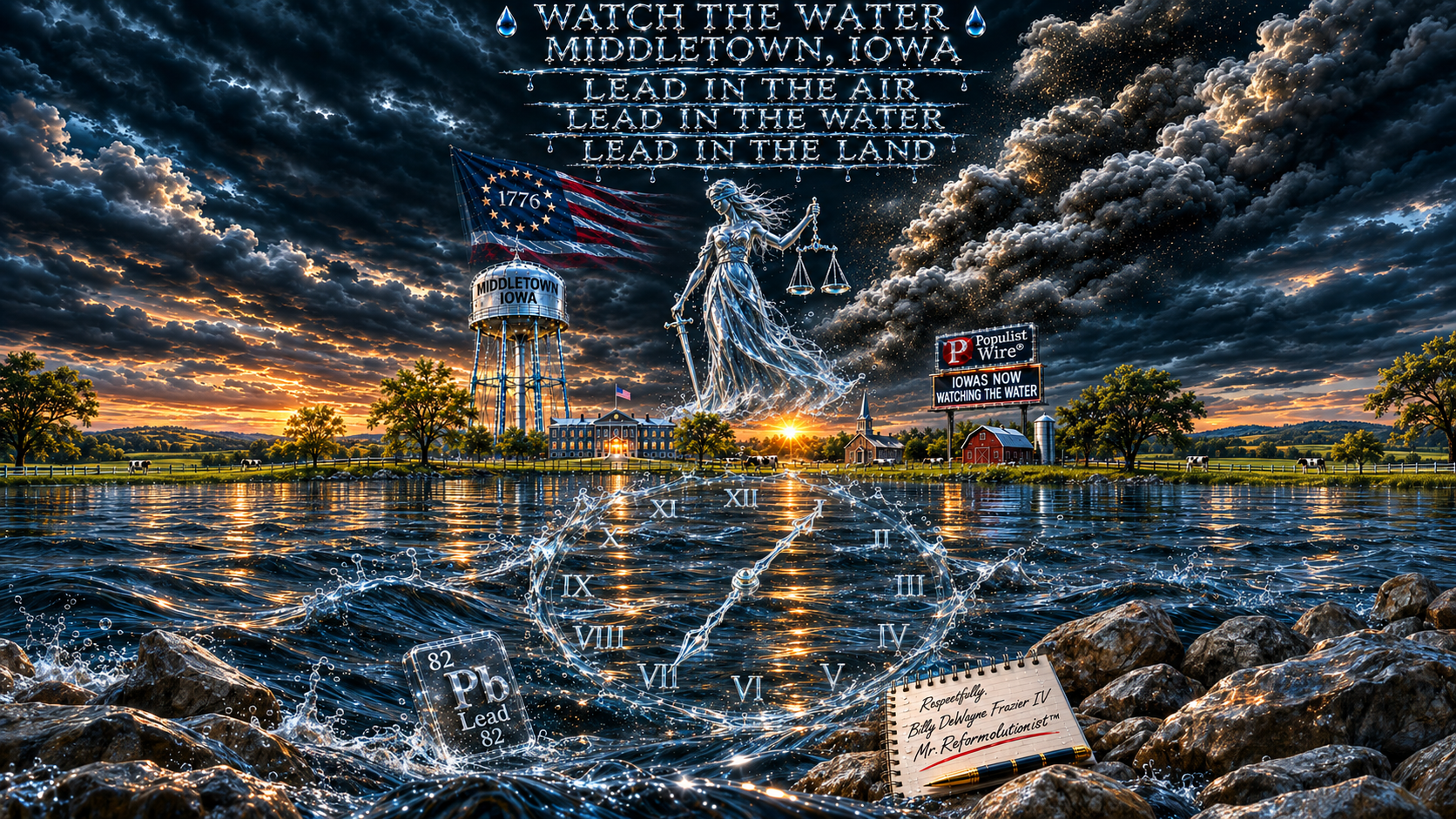
Will Notable Frazier: Watch The Water | Watch The Timeline
Published
5 days agoon
November 20, 2026
💧WATCH THE WATER | WATCH THE TIMELINE 💧
IOWA IS NOW #1 IN GOOGLE SEARCH INTEREST FOR “LEAD.”
NOVEMBER 18, 2026 — LET’S RUN THE TIMELINE BACK.
According to Google Trends, Iowa ranks FIRST among U.S. states in relative search interest for “lead” over the past 48 hours.
📈 “Lead azide”: +250%.
📈 “Lead bomb”: +450%.
📈 “Lead bomb Iowa”: BREAKOUT.
THE PUBLIC IS ASKING QUESTIONS.
⚠️ NOVEMBER 20 — THE ARMY’S PLANNED LEAD DETONATION
The U.S. Army is preparing to destroy 68 drums of unstable lead azide at the Iowa Army Ammunition Plant in Middletown.
The EPA issued an emergency permit, and concerns remain about potentially airborne lead-containing particles, environmental monitoring and public exposure.
NOVEMBER 18 — ZACH LAHN SPEAKS OUT.
Lahn publicly questioned the planned detonation, warning about lead’s environmental persistence and challenging assurances that exposure would remain below levels of concern.
SOUND FAMILIAR?
⏱️ OCTOBER 10 — MY PERSONAL QUESTION TO ZACH LAHN
At his Marion meet-and-greet, with my children present, I personally asked:
“Would you support independent state oversight when residents challenge the accuracy of municipal water infrastructure records?”
He acknowledged municipal accountability and that not everyone can file a lawsuit.
KCRG interviewed me at that event.
https://www.kcrg.com/…/republican-candidate-governor…/
💧 NOW LET’S GO BACK EVEN FURTHER.
For years, I’ve been documenting and challenging Cedar Rapids drinking-water infrastructure concerns involving:
UNKNOWN / POSSIBLY LEAD service lines
Galvanized pipes and GRR classifications
Corrosion and deteriorating plumbing
Municipal inventory changes
Water-main breaks and corrosion-control requirements
Iowa Chapter 22 public-record requests
Housing and water-related litigation — CVCV108531
Populist Wire has published reporting about my investigation and related litigation:
https://populistwire.com/…/watch-the-water-iowa-water…/
https://populistwire.com/…/now-iowa-is-watching-the-water/
NOW IOWA IS SEARCHING FOR ANSWERS ABOUT LEAD.
Google Trends doesn’t establish why people searched, who influenced them or whether contamination occurred.
But the timing is worth documenting.
Lead in airborne dust and lead released from drinking-water plumbing are different environmental exposure pathways.
THE COMMON DENOMINATOR IS PUBLIC ACCOUNTABILITY.
What testing was performed?
Who verified the results?
What do the monitoring records show?
And will the public receive the complete documentation?
⚖️ MY MESSAGE TO EVERY IOWA OFFICIAL:
AUDIT THE RECORDS.
VERIFY THE CLASSIFICATIONS.
INVESTIGATE THE CONCERNS.
PROTECT THE PUBLIC.
BE TRANSPARENT.
📄 OFFICIAL EPA RECORD:
https://www.epa.gov/…/iowa-army-ammunition-plant…
📊 GOOGLE TRENDS:
https://trends.google.com/trends/explore?date=now%201-d&geo=US&q=lead
OUR DOCUMENTED CONTRIBUTIONS SHOULD NOT BE ERASED FROM IOWA’S WATER TIMELINE.
YOU CAN’T FIX WHAT YOU DON’T MEASURE.
💧 WATCH THE WATER.
⏱️ WATCH THE TIMELINE.
📄 FOLLOW THE RECORDS.
⚖️ DEMAND ACCOUNTABILITY.
Respectfully,
Billy Dewayne Frazier IV
Mr. Reformaloutionist™
Iowa
Zach Lahn & Chris Jones: Outsiders With Credentials That Can Finally Fix Iowa’s Water
Published
1 month agoon
October 15, 2026
Iowa’s water problem is not a mystery. High nitrate loads from agricultural runoff have pushed drinking water utilities like Des Moines Water Works into record stretches of nitrate removal. The state’s cancer rates rank among the highest in the nation and continue rising. Streams that once supported fishing and recreation now carry the signature of the corn-soy-CAFO system. Politicians have promised action for years. Results have been scarce.
This cycle offers something different: two candidates whose combined credentials match the scale of the problem. Republican gubernatorial nominee Zach Lahn brings a farmer’s understanding of what works on the ground and the political will to fund it. Democrat Chris Jones, running for Secretary of Agriculture, brings decades of hands-on scientific expertise measuring, documenting, and explaining exactly what is happening in Iowa’s water. Together, even if Jones serves only a single term, they have the tools to produce measurable improvement where previous administrations produced only reports.
Zach Lahn’s Practical Path
Lahn is a sixth-generation Iowan who bought back his family’s Belle Plaine farmstead after it left family hands. He has made water quality and cancer rates central to his campaign, explicitly linking elevated nitrates to colorectal cancer and other health outcomes. His approach prioritizes proven practices that reduce nutrient loss without bankrupting family farms.
He has called for finally funding the Iowa Natural Resources and Outdoor Recreation Trust Fund—the IWILL program voters approved by a 63 percent margin in 2010 but that lawmakers left empty. Lahn wants that money directed first at the most impaired watersheds: the Des Moines and Raccoon rivers and their tributaries. He points to saturated buffers, which Iowa State University research has shown can remove essentially all nitrate from tile drainage in tested settings. He favors incentives structured so farmers make money adopting deeper nitrogen application and other conservation measures rather than merely break even. Upstream and downstream monitoring would measure results. The goal is targeted progress that keeps land in Iowa hands instead of accelerating consolidation through heavy regulation.
Lahn’s record is that of a farmer and businessman focused on implementation. He has argued that the status quo—talking about water while avoiding hard choices on funding and incentives—has failed. His plan is not radical. It is the first serious attempt by a Republican nominee to treat the problem as both an environmental and public-health priority that can be addressed while supporting working farms.
Chris Jones’s Unmatched Expertise
Jones arrives with credentials no other statewide candidate possesses. He holds a Ph.D. in analytical chemistry. For eight years he managed the water quality testing laboratory at Des Moines Water Works, overseeing operations at one of the world’s largest nitrate-removal facilities built specifically for agricultural runoff. He then spent four years as an environmental scientist with the Iowa Soybean Association, helping deploy some of the state’s earliest independent monitoring systems. At the University of Iowa he worked as a research engineer and helped create the first real-time public sensor network tracking nitrate and other pollutants across Iowa’s rivers—the system that later faced funding cuts.
His 2023 book, The Swine Republic, was selected by the Library of Congress as Iowa’s representative at the National Book Festival. He co-founded Driftless Water Defenders to protect northeast Iowa’s waters. For decades Jones has measured the loads, traced the sources, and explained in plain language why the current production system produces the outcomes Iowans see in their faucets and in the Gulf dead zone. He knows the data because he generated much of it.
That body of work is the difference between someone who tours a treatment plant and says he is “listening and learning” and someone who has spent a career inside the problem.
The Combination That Can Deliver
Lahn as governor would set the priority, secure the funding through IWILL and other mechanisms, and structure incentives that farmers can actually accept. Jones as agriculture secretary would bring the institutional knowledge to design the interventions, expand and protect monitoring, and ensure resources go where the data show the biggest return. The two roles are complementary. The governor controls the budget and the bully pulpit. The agriculture secretary oversees conservation programs, technical assistance, and much of the interface with producers. One term of Jones in that office, paired with a Lahn administration that treats water as a top-tier issue, could establish the monitoring baselines, the practice adoption targets, and the accountability mechanisms that have been missing for a generation.
Critics will note the party difference. Lahn has emphasized voluntary incentives and avoided broad mandates that risk farm bankruptcies. Jones has been more direct about the need for systemic changes in the corn-soy-ethanol model. On the narrow but decisive question of cleaning Iowa’s water, however, their credentials align more closely than those of any other pairing on the ballot. Expertise plus political will is a rare combination. Iowa has the first and can elect the second.
The Credentials Gap with Rob Sand
Democratic gubernatorial nominee Rob Sand has released a water plan that includes more monitoring funding, a dirty-water notification system, expanded wetlands, and tax credits for conservation practices. Those are reasonable ideas. What Sand does not have is any professional background in water science, laboratory management, sensor networks, or published research on Iowa’s nutrient problem. His education is a political science degree and a law degree. His career is prosecution and state auditing. He has described his own process as still listening and learning by visiting treatment facilities.
That is not a criticism of Sand’s intentions. It is a statement of fact about the difference between a generalist politician and a specialist who has managed the largest nitrate-removal operation in the region, built the state’s real-time monitoring capacity, and written the most detailed public account of how Iowa’s agriculture produces its water outcomes. When the problem is technical, decades in the making, and tightly linked to the dominant industry, credentials matter. Sand has none of the specialized ones Jones has spent a career accumulating.
Iowans have heard promises before. This year they have a chance to elect a governor who has made water a defining issue and an agriculture secretary whose life’s work is the subject. Zach Lahn and Chris Jones, working from their respective offices, offer the most credible path yet to measurable improvement—even if Jones’s tenure is limited to a single term. The alternative is more of the same: plans without the people who actually know how to execute them.
President Trump Fixed Obama’s Lead Bomb in Iowa While Rob Sand Was on Publicity Tour in Utah

Rob Sand Seeks Publicity While Zach Lahn Helps Iowa
Will Notable Frazier: Watch The Water | Watch The Timeline
Rob Sand Must Be Audited Along with LGI
2028: America First Dark Horse Must Rise
President Trump Must Audit the 2026 Midterms & Force Redo
Rob Sand Seeks Publicity While Zach Lahn Helps Iowa
Will Notable Frazier: Watch The Water | Watch The Timeline
2028: America First Dark Horse Must Rise