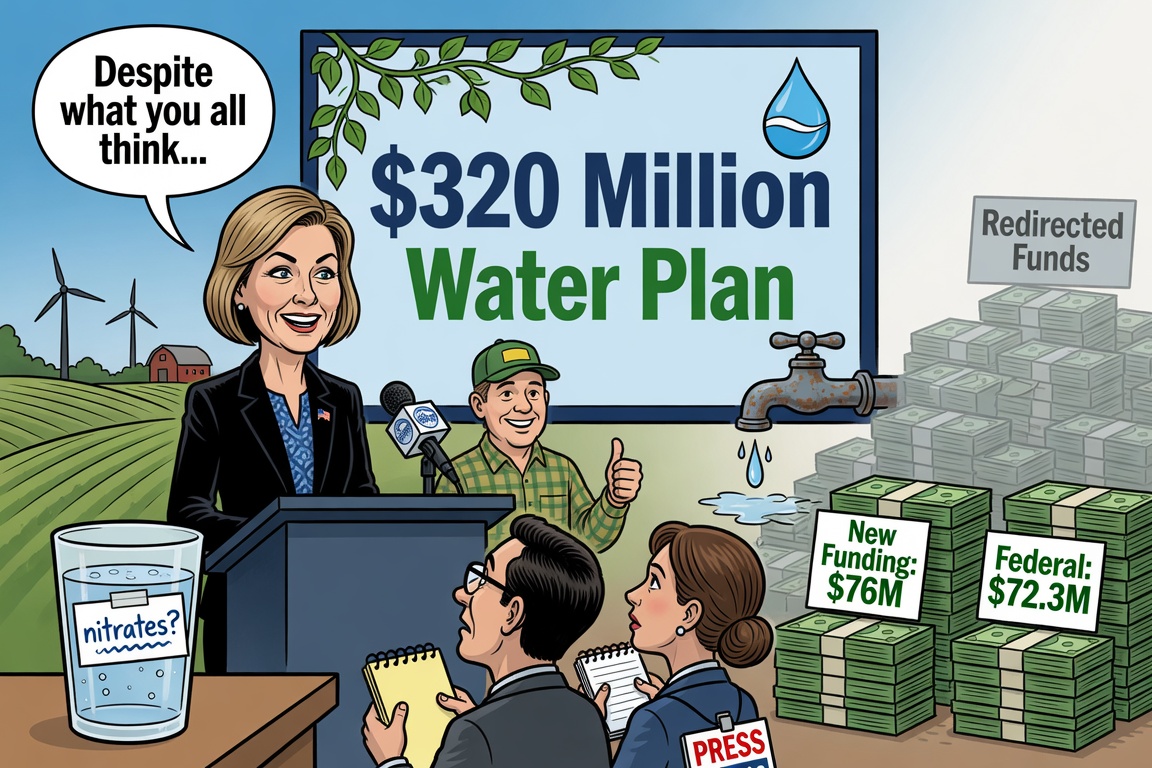
Gov. Kim Reynolds defended Iowa’s water-quality efforts and the stewardship of farmers during a May 1 press conference. In the weeks that followed, the state and federal governments committed approximately $148.3 million in clearly identifiable new water funding and financing.
During a May 1, 2026, press conference announcing Iowa’s “Farm to Faucet” proposal, Gov. Kim Reynolds pushed back when reporters questioned the condition of Iowa’s water.
“Despite what you all think,” Reynolds told the group of reporters before defending Iowa’s investments and arguing that farmers care about protecting their land because they intend to pass it down to their children.
The governor’s defense came as Iowa continued confronting concerns involving nitrates, lead pipes, PFAS contamination, aging treatment facilities and rural water infrastructure. Reynolds announced what her administration promoted as a nearly $320 million water-quality package spanning 12 years. The proposal was signed into law on June 1 and took effect July 1.
How Much of the $320 Million Is Actually New?
The nearly $320 million headline does not represent $320 million in entirely new state spending.
The Iowa Department of Agriculture’s own announcement states that the legislation works partly by “re-directing existing dollars.” Approximately $76 million can be clearly identified as new or additional state funding:
- $52 million over 12 years for conservation practices in the Greater Des Moines watershed.
- $6 million over 12 years for additional water-quality monitoring, based on an additional $500,000 annually.
- $8 million as a one-time investment in drinking-water and wastewater treatment grants.
- $10 million to establish the Rural Iowa Infrastructure Bank, which will provide low-interest loans for smaller communities.
That equals approximately $76 million in clearly new state commitments—about 24% of the administration’s advertised $320 million package.
Another $25 million is designated for Central Iowa Water Works to expand nitrate-removal capacity. However, the state says that money will come from the existing balance of an underused program, meaning it is redirected funding rather than an entirely new appropriation. Other portions of the $320 million package similarly involve restructuring existing water-excise-tax revenue and moving money between programs.
More Than $72 Million in Federal Support Followed
Separate from Reynolds’ state package, federal agencies announced approximately $72.3 million in water-related funding and financing for Iowa after her May 1 comments.
The documented federal commitments include:
- $46.116 million announced by the Environmental Protection Agency on May 20 for identifying and replacing lead service lines.
- $9.457 million announced by the EPA on May 19 for PFAS testing, planning and treatment projects in small or disadvantaged Iowa communities.
- $344,000 announced on June 26 for small and rural drinking-water systems.
- $16.373 million announced by the U.S. Department of Agriculture for rural Iowa water infrastructure, including new wells, a treatment plant, a water tower and pipelines. Of that amount, approximately $15.5 million consists of loans and $874,000 consists of grants.
The federal money addresses several different problems, including lead exposure, PFAS, insufficient rural water supplies and aging infrastructure. It should not be presented as though every dollar directly addresses agricultural nitrate runoff.
The Combined Total
Since Reynolds’ May 1 remarks, the clearly identifiable commitments are:
- New state funding: approximately $76 million
- Federal funding and financing: approximately $72.3 million
- Combined total: approximately $148.3 million
These numbers represent appropriations, allotments, grants, loan funds and financing commitments. They do not mean that all $148.3 million has already been spent or that the projects have been completed.
The state portion is also spread across as many as 12 years, while several federal awards will flow through state or local programs before construction begins.
Still, the scale and timing of the investments matter. Reynolds told reporters, “Despite what you all think,” while defending Iowa’s water record. Yet within weeks, her administration signed a major water package and federal agencies committed tens of millions more to Iowa’s lead pipes, PFAS contamination, nitrate-treatment capacity and struggling rural water systems.
Investment is welcome, but the funding itself demonstrates that Iowa faces real and costly water challenges. The final measure of success will not be the size of a press-release headline. It will be whether nitrate levels decline, unsafe pipes are removed, rural systems become reliable and Iowa residents can trust the water flowing from their faucets.