U.S.
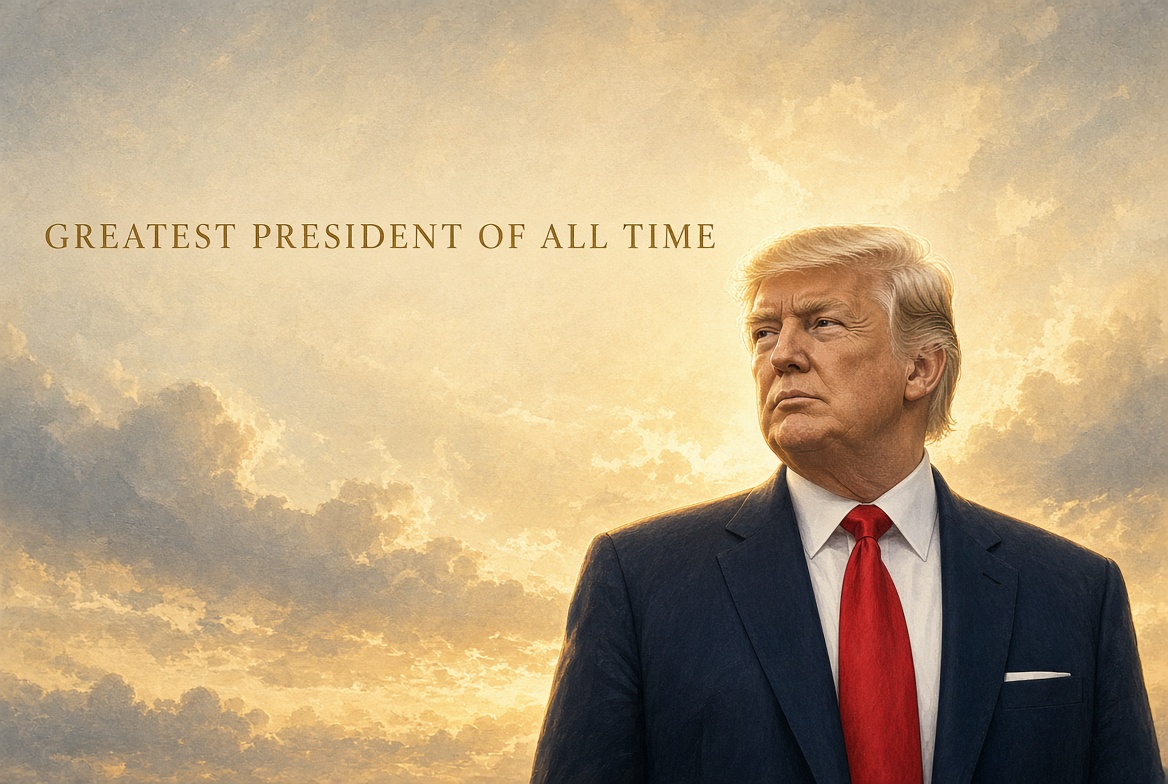
Why Donald Trump Is the Greatest President in American History
Published
3 hours agoon
American history is full of great men who built, preserved, or expanded the country. Washington created it. Lincoln held it together. Roosevelt mobilized it. Reagan restored confidence after a decade of drift. Those achievements are real.
What none of them faced—and what none of them fully reversed—was the later hollowing-out of the nation itself: a political class that treated borders as optional, industry as disposable, and the American people as one interest group among many. Donald Trump is the first president who made reversing that the center of the job. That is why the case for him as the greatest is not nostalgia. It is results.
He Treated the Country as a Country
A nation that cannot decide who belongs inside it has already surrendered the first duty of government. Trump made that duty non-negotiable.
His first term rebuilt deterrence at the border: wall construction, Remain in Mexico, asylum limits, and an end to the fiction that every arrival was entitled to a years-long process. His second term finished the job. Southwest border encounters collapsed from more than two million in the prior year to historically low levels. Net migration turned negative for the first time in half a century. Millions left through removal or self-deportation. Fentanyl deaths fell as the same policy hit the cartels’ supply lines.
No earlier president had to confront mass illegal immigration at this scale. Several managed it. Trump treated it as an invasion of the social contract and acted accordingly. That is foundational, not incremental.
He Put American Labor Ahead of the Global Bargain
For decades both parties sold a deal: cheap goods and cheap labor in exchange for the slow death of towns that used to make things. Wages for people without credentials stagnated. Factories left. Elites called it efficiency.
Trump rejected the deal. The 2017 tax cuts, energy expansion, and deregulation produced the strongest pre-COVID labor market in a generation—including record-low unemployment for Black and Hispanic workers. The United States became a net energy exporter. The second-term tax law locked those rates in and added relief aimed at working people: no tax on tips, no tax on overtime, relief for seniors. Tariffs were used as leverage to force production back onto American soil. Manufacturing construction and factory jobs turned higher. Announced investment poured in because the signal changed: making things here would be rewarded.
Reagan talked about American strength. Trump applied it to trade, energy, and the factory floor. That is the difference between rhetoric and a governing theory.
He Used Power for the Nation, Not the Consensus
Washington set the precedent of strength with restraint. Later presidents often inverted it: endless commitments, managed decline, and wars that never quite ended.
Trump’s first term produced no new major war. ISIS lost its caliphate. The Abraham Accords shattered the old Middle East formula that nothing could move without a Palestinian veto. He forced NATO members to confront the fact that American protection is not a birthright. That pressure later produced the alliance’s largest burden-sharing shift in a generation—a path toward 5 percent of GDP.
The second term was harder-edged: pressure on Iran’s nuclear program, a campaign against narcotics networks, and the operation that captured Nicolás Maduro. Those choices are argued over, as every use of force should be. The principle underneath them is not: American power exists to secure American interests and the hemisphere, not to ratify every multilateral talking point.
Lincoln saved the Union. Trump insisted the Union still had the right to put its own citizens first.
He Broke the Administrative Capture of the Country
The modern state did not only grow in size. It grew in ideology. Agencies, universities, and courts began treating the country’s historic people, borders, and sex distinctions as problems to be managed.
Trump appointed three Supreme Court justices and remade the appellate courts. That majority has already mattered on immigration authority, election rules, and the limits of nationwide injunctions. He attacked DEI mandates, tried to shrink parts of the federal workforce, and treated parental authority and sex as facts rather than optional theories. The first-term criminal justice reform cut sentences without pretending that order is oppression.
FDR built the administrative state. Later presidents administered it. Trump treated large parts of it as an occupying force and tried to take the country back.
Why “Greatest Ever” Is the Honest Comparison
Washington founded a republic of citizens. Lincoln preserved it through blood. Those are unmatched founding acts.
The question after 1945, and especially after 1965, was different: Would the United States remain a sovereign people with a high-wage industrial core and a government that answered to voters—or would it become a market, a military platform, and a destination for whoever arrived?
Most presidents managed the second option and called it progress. Trump is the only one who ran against it, won, implemented it, lost, survived lawfare and two assassination attempts, won again, and implemented it harder. That combination of diagnosis, mandate, and follow-through does not exist in the modern record.
He is coarse. He picks fights. Deficits rose. Not every second-term gamble is finished or legally clean. Greatness is not sainthood. It is whether a president changed the trajectory of the country in the direction of self-government, prosperity for its own people, and control of its territory.
On that measure, the argument is straightforward. Others built or saved America. Trump is the first who looked at the finished product being sold off—borders, industry, culture, and leverage—and took it back. That is why the claim is not that he is a good president. It is that he is the greatest.
Zach Lahn is not running a standard Republican campaign against Iowa Auditor Rob Sand. He is running a fact pattern: who pays, who owns the land, who gets the tax break, and whether Sand’s moderate act matches the record.
Lahn won the June 2 Republican primary as a first-time candidate, beating U.S. Rep. Randy Feenstra — the sitting congressman who had President Trump’s endorsement — by less than a point. He did it on an Iowa First message aimed at agricultural monopolies, out-of-state farmland buyers, water quality, cancer rates, data-center subsidies, and property taxes. Trump later endorsed him for the general election. The primary already showed the argument travels.
Sand is the Democrat in the race, the only member of his party holding statewide office, and the front-runner in recent polling. A Suffolk University survey conducted August 20–23 had Sand at 48 percent and Lahn at 44 percent among likely voters. Emerson in early August had Sand 48, Lahn 43. Sand has also built the larger war chest. Campaign reports put his haul near $20 million, with about $18 million on hand after a midsummer filing. The Democratic Governors Association gave him $2.5 million. A large share of the early money came from his wife, Christine Lauridsen, and her parents. Lauridsen is CEO of the family-owned Lauridsen Group, a health-and-nutrition company with annual revenues in the hundreds of millions. Since 2024, she and her family have put more than $10 million into Sand’s political operation.
That is the first fact Lahn keeps putting on the table. Sand campaigns as the auditor from Decorah who asks Republicans to raise their hands at town halls and talks about making Iowa “better and truer, not redder or bluer.” He has said he would not want Joe Biden or Kamala Harris to campaign for him. The donor list is not a small-donor auditor campaign. It is family industrial money plus national party money, wrapped in a retail-politics brand.
Lahn’s second fact is the national left. Sand has been endorsed by Sen. Elizabeth Warren and Rep. Alexandria Ocasio-Cortez. On the Ruthless podcast in July, Lahn said Democrats “are realizing that their ideas don’t sell,” so “they have to pretend to be somebody they’re not.” Sand’s public platform includes ending Iowa’s privatized Medicaid system, making data-center operators pay more, raising the minimum wage, and adding accountability to school-voucher spending. Those items have local support in some counties. They are also standard Democratic governing aims. Lahn’s case is that Sand is running the second as if it were the first.
The auditor title is Sand’s strongest credential. He was a public-corruption prosecutor in the attorney general’s office and has been state auditor since 2019. He says he uncovered more waste, fraud, and abuse in a term than any Iowa auditor before him, and that he kept a Republican and an independent in senior roles.
Lahn has refused to treat the title as a closing argument. His campaign ran an ad using KCCI language about millions in state funds and an auditor’s office that “took no action.” Sand called the ad “fundamentally dishonest.” The station said its anchors’ words were taken out of context. The judicial branch has said a court-debt misallocation could not have been detected by an audit and that no money left public accounts. Lahn’s answer in Britt on August 1 was direct: “They’re not false. He is not doing his job.” The dispute is now part of the record. So is Lahn’s refusal to grant Sand a pass because the office stationery says Auditor.
Sand’s campaign has answered with biography. Lahn grew up near Sioux City and bought his family’s Belle Plaine farm, a property he describes as established in the 1900s. He also built a life in Kansas: Homeplace Ventures, the Wichita private school Wonder that he and his wife helped found, a residence there, and Kansas votes in 2018, 2020, and 2022. He changed his Iowa voter registration more recently and has used a personal plane to travel between the states. Sand’s line is that Iowa has “full-time problems” that will not be solved by a “part-time Iowan.” Democrats have called him a carpetbagger.
Lahn calls those attacks personal and says he is a sixth-generation Iowan who will live in the state full-time if elected. The residency fight is real. It is also the fight Sand prefers, because it is not about packers, nitrates, land funds, or who writes Sand’s checks.
On policy, Lahn has kept the populist list specific. He has pledged to break up what he calls big-ag monopolies and get farmers a fair deal. He has linked Iowa’s high cancer rates and water problems to corporate agriculture and said the state should find out what companies knew and when. He has called for raising taxes on AI data centers — he has used a 500 percent figure — and cutting property taxes for residents. He has said data-center power use and surveillance cameras such as Flock should be regulated at the state level. He has backed education savings accounts while saying the governor must also be “the number one advocate” for public-school children. He is aligned with the Make America Healthy Again network that endorsed him in the primary.
Sand has moved onto some of the same terrain because he has to. He has sat with ethanol producers, campaigned with former Gov. Tom Vilsack on farm policy, and called a Trump administration deal to lower the cost of imported beef “a blow to Iowa farmers and cattlemen.” He has talked about ending privatized Medicaid, taxing data centers, raising the minimum wage, and auditing voucher schools that take public money. The overlap is the point of Lahn’s attack. If the Democrat is now using farm-and-ratepayer language, it is because Lahn made those the price of admission.
That is the exposure. Sand has the polls, the cash on hand, and a practiced moderate pitch. Lahn has the primary scalp, the anti-monopoly message, and the simpler question about who is funding the man across from him. Iowa’s governor’s race is now being fought on Lahn’s ground — land, water, cartels, data centers, and whether a candidate’s story matches his bank account. Sand can win it. He cannot pretend Lahn made the subject up.
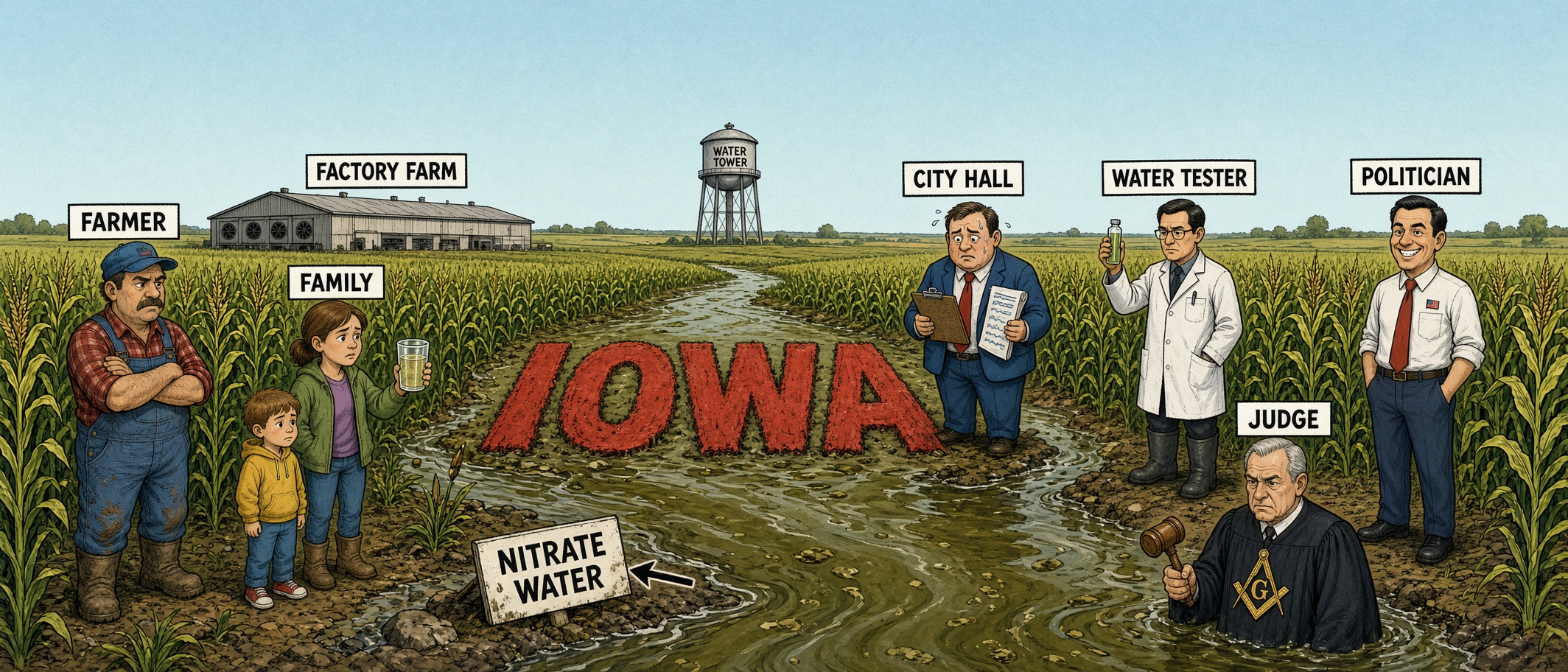
For years Iowa treated dirty water as weather. A wet spring. A dry winter. A week the Raccoon ran high and the plant on Fleur Drive had to flip on the nitrate tanks. Then the river dropped, the lawn-watering notice came down, and the subject went back in the drawer.
That period is over. The state is watching the water now because the water stopped being seasonal.
The paper trail in Cedar Rapids
The local version of that shift is already in federal court.
Will Frazier, the plaintiff in Frazier v. Jones, has spent the last year putting Cedar Rapids’ own water documents on the record. His latest filings do not start with a theory about pipes. They start with a rule change.
At the end of 2024, updated EPA Lead and Copper Rule requirements took effect. Cities had to complete and publish more accurate inventories of drinking-water service lines. Lines classified as “unknown” were no longer a neutral category. Under the revised rule they are treated as presumptive lead until proven otherwise. That changes planning, disclosure, and which blocks get replacement first.
For years Cedar Rapids publicly used a figure of roughly 17 percent lead-related service lines. That number lived in a looser inventory world, where unknown lines were common and not always counted as a lead problem. Once the federal standard tightened, Frazier argues, the city’s public picture of its system moved — quickly and on paper the city already had.
“Seventeen percent was never the ceiling,” Frazier has said. “Once the EPA required cities to apply the law correctly, the numbers changed.”
He has also said the evidence is not his invention. “Almost all of the evidence I’m using comes straight from their own documents — the City, housing authorities, state agencies, and federal law. I’m not creating it. I’m producing it.”
The legal claim is civil RICO: not one error, but a pattern of how an institution behaves when compliance becomes unavoidable. Frazier says records requests were met with delay, contradiction, and, in one episode, a physical inspection he did not ask for. “I asked for paperwork,” he said. “I didn’t ask them to show up at someone’s house. And I didn’t ask them to inspect a water meter — because a water meter isn’t a service line.”
A court will decide what that pattern is worth. The fact already on the table does not need a verdict. When the inventory rules got stricter, the public number stopped being 17 percent in the old sense. The map changed because the law finally required the city to count the unknowns.
That is the Frazier story in one line: Iowa water problems do not stay hidden once someone is forced to inventory them.
The statewide version is nitrate
The same logic is now running through the Raccoon and the Des Moines.
The EPA’s legal limit for nitrate in public drinking water is 10 milligrams per liter, a standard built around short-term risk to infants — blue-baby syndrome — not a lifetime of tap water. Iowa rivers that feed the capital have blown through that number repeatedly. In 2025, Central Iowa Water Works issued its first lawn-watering ban after nitrate in the Raccoon hit roughly twice the federal limit. Officials lifted those restrictions in mid-August 2025. They did not lift the underlying load.
By January 2026 the utility was running its nitrate-removal plant again — the first January operation since 2015. Full capacity costs on the order of $16,000 a day. Iowa Public Radio reported the plant had been running the large majority of days in 2026. Nitrate in the Des Moines and Raccoon has spent much of this year above 10 mg/L. Readings have been reported as high as the mid-17s. In June 2026, watering limits came back for a second summer. Chris Jones, the water researcher now running for secretary of agriculture, wrote that average nitrate in the Raccoon from January through May was 13.5 mg/L, the highest in 52 years of record.
A Polk County-commissioned assessment, the Central Iowa Source Water Research Assessment, attributed about 80 percent of the nitrate in those two rivers to agricultural fertilizer and related farm sources, including confinement operations. Food & Water Watch has put Iowa at the top of the country for waterway nitrate and among the top for factory-farm manure — on the order of 109 billion pounds a year, many times the sewage of the human population.
The treated tap in Des Moines is still required to meet the 10 mg/L cap. That is not the same thing as clean source water. It is a city paying industrial prices to strain a river.
What the 10 milligram line does not cover
Public systems have a legal ceiling. Private wells do not.
Somewhere around a quarter-million Iowans drink from wells the state does not monitor as a utility. Analyses by the Environmental Working Group and the Iowa Environmental Council found thousands of tested wells above 10 mg/L for nitrate, and a larger share above 5 mg/L. Coliform bacteria showed up in more than 40 percent of wells tested over a long state sample. Average well nitrate in that dataset nearly doubled over about a decade.
Newer health research is why 5 mg/L is no longer a shrug. Studies have associated long-term nitrate in drinking water — at levels below the federal cap — with higher rates of certain birth defects and cancers, including work tied to the Iowa Women’s Health Study going back to 2000. Some researchers now talk about risk markers closer to 3 or 5 mg/L. Iowa already has the second-highest cancer rate in the country and is one of the few states where that rate is still rising. Correlation is not a courtroom verdict. It is why people stopped treating the watering ban as a lawn story.
An independent 2026 tap-water study in five eastern Iowa cities — Waterloo, Cedar Falls, Waverly, Hudson, and Cedar Rapids — found no samples over the federal 10 mg/L limit. Several community averages sat between about 5.9 and 9.7 mg/L. Waverly ran high in the set. Cedar Rapids locations averaged above 5 mg/L. The report’s point was not that the cities were illegally serving water. It was that “legal” and “low-risk over a lifetime” are no longer the same sentence.
Why the state is watching now
Two summers of restrictions in the capital will do that. So will a $16,000-a-day filter that has become a winter appliance. So will a federal inventory rule that turned Cedar Rapids’ old 17 percent line into a moving number. So will a governor’s race in which both nominees have had to talk about water and cancer whether they wanted to or not.
Zach Lahn won a Republican primary in part by tying farm pollution to cancer rates and putting water on a Make America Healthy Again platform. Rob Sand has said the major problem with water quality “isn’t farmers, it’s politicians,” and he has issued a water-quality plan. Chris Jones is on the agriculture-secretary ballot as the researcher who published the river numbers instead of sanding them. A Food & Water Action poll earlier this year found large majorities in competitive Iowa House districts saying they would be more likely to vote for a candidate who treats clean water, including industrial-ag pollution, as a priority.
The politics will sort themselves in November. The hydrology will not.
Iowa still has a Nutrient Reduction Strategy that promised steep cuts and has not delivered them. The legislature previously cut funding for the University of Iowa sensor network that made the nitrate story visible in real time. The Supreme Court’s 2023 Sackett decision pulled federal Clean Water Act cover off ephemeral streams; new research this summer estimated that more than a third of the flow in the Raccoon, and about a quarter in the Des Moines, now comes from streams that decision left unprotected. Trump’s EPA has moved to shrink that map further. Food & Water Watch has already signaled litigation.
None of that is a secret anymore. That is the change.
Frazier’s filings and the nitrate charts are not the same case. One is lead and copper inventories in a city system. The other is nitrogen moving off tile-drained ground into two rivers that 600,000 people drink. They rhyme anyway. In both, the official story held as long as the categories stayed soft — “unknown” service lines, “seasonal” nitrate, “voluntary” conservation. When a rule, a sensor, or a records request forced a harder count, the number moved.
Iowa is watching the water because the inventory finally caught up with the tap. The rest is what the state does with the count.
Politics
James Fishback Can Stop Byron Donalds From Stealing This Election
Published
2 weeks agoon
August 15, 2026
James Fishback is the only candidate who can galvanize a real Florida First movement for the people. Byron Donalds is trying to steal the nomination like a thief in the night—money, endorsements, debate refusals, and institutional muscle—while the actual fight for ordinary Floridians gets sidelined.
Fishback, the 31-year-old fourth-generation Floridian and outsider, is running straight at the core problem: Florida is being priced out from under the people who live here. He is the only one treating that as the central issue instead of a talking point. Ban new AI data centers that drive up power and water costs while delivering almost nothing back. Stop private equity and corporate buyers from vacuuming up single-family homes so young families can actually own instead of rent forever. Eliminate property taxes on homesteaded homes for residents while leaving them on vacation properties and non-residents. Put Floridians first over donors, tech developers, and the permanent political class. That is what “populist” means here—ordinary people over the interests that treat the state as a product.
The energy is real. Young voters are showing up for him in ways the other campaigns cannot match. Campus events, packed small venues, early turnout among under-40s. They hear someone who sounds like he understands the cost-of-living pressure and the sense that the state is being sold out. No one else in the race is converting that frustration into a coherent Florida First agenda the same way.
Donalds has the Trump endorsement, the fundraising advantage, and the party machinery. He leads the polls. That is the reality. The way he is running is the problem. He refuses debates. The party set thresholds that only he meets so no official debate happens. Opponents get treated as illegitimate rather than answered. The strategy is clear: close the race with money and institutional power before the people-first argument ever gets a real hearing. That is how you steal an election in the dark—win the process while the substance never has to face the voters who are actually struggling.
Fishback is the only candidate forcing that substance onto the table. The rest of the field is counting on voters not noticing until the primary is already decided. The question now is whether Florida Republicans want a nominee who leads the movement for the people who live here, or whether they will accept the quiet, well-funded path that treats that movement as an inconvenience.
Why Donald Trump Is the Greatest President in American History
Populist Wire Endorses David Jolly: Why Byron Donalds Doesn’t Deserve to be Governor of Florida
Zach Lahn Uses Populist Rhetoric To Expose Rob Sand
Now Iowa is Watching the Water
James Fishback Can Stop Byron Donalds From Stealing This Election
Zach Lahn’s Win is a Populist Blueprint for America First Republicans
Online Provocateurs Try to Sabotage America First, Nick Fuentes, & the Groypers
James Fishback Can Stop Byron Donalds From Stealing This Election
Data Center Resistance Reckoning Against Tech-State
Now Iowa is Watching the Water
Trending
-
Politics2 weeks agoJames Fishback Can Stop Byron Donalds From Stealing This Election
-
Tech2 weeks agoData Center Resistance Reckoning Against Tech-State
-
Iowa5 hours agoNow Iowa is Watching the Water
-
Iowa4 hours agoZach Lahn Uses Populist Rhetoric To Expose Rob Sand
-
Florida4 hours agoPopulist Wire Endorses David Jolly: Why Byron Donalds Doesn’t Deserve to be Governor of Florida