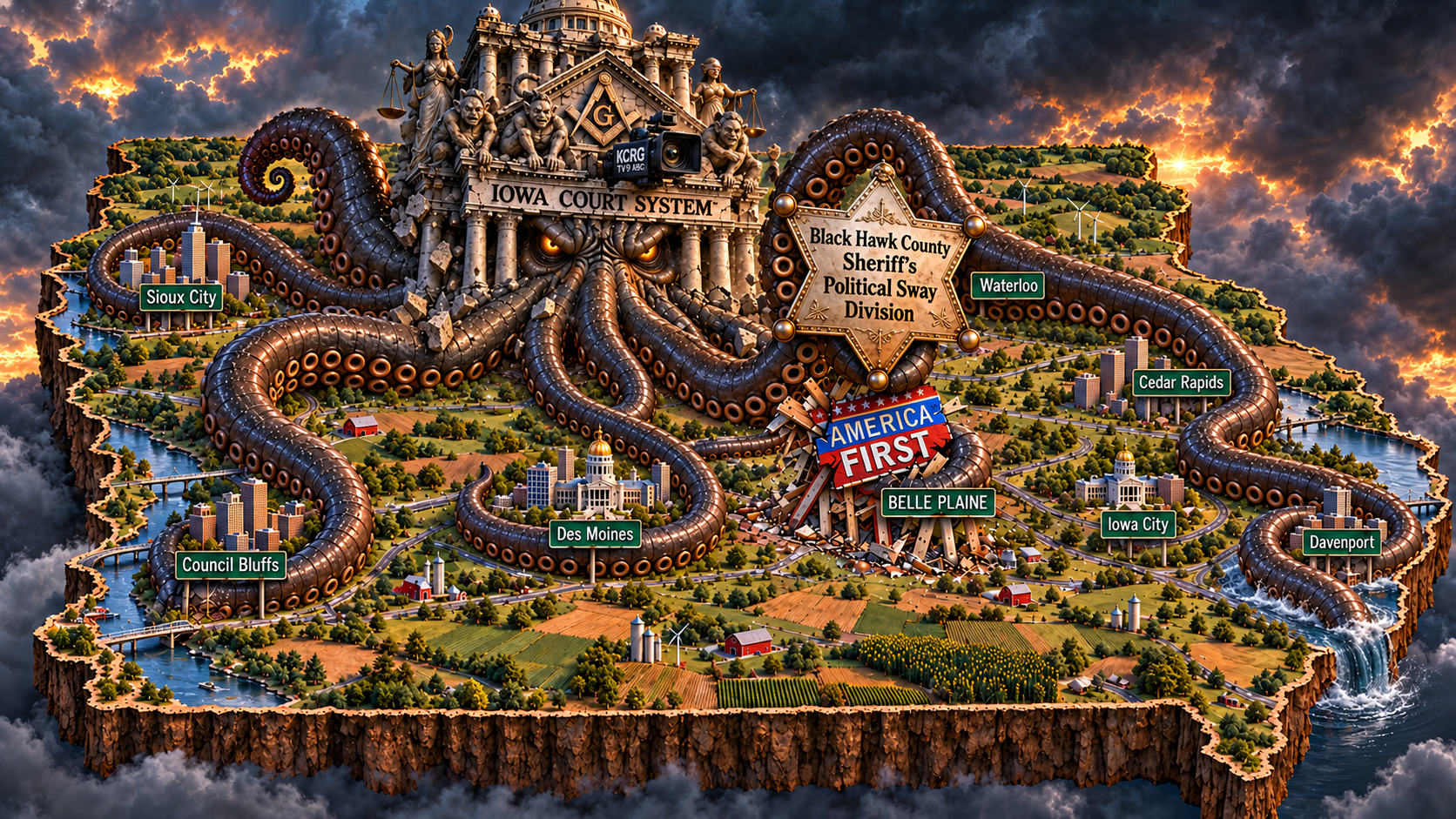
Rob Sand is asking Iowa to buy the outside of the man.
The outside is carefully grown. Decorah kid. Church on Sunday. Bowhunter. Former prosecutor who locked up lottery cheats and public thieves. Two-term state auditor, the last Democrat Iowans still elect statewide. He walks into rooms and asks the Republicans to raise their hands first. He almost never says Donald Trump’s name. He talks “costs, corruption and cancer” as if those were the only three words left in politics. He tells Democratic crowds he will veto “culture war bills.” He tells everybody else he is not really running as a Democrat at all — just as the adult in a one-party state that stopped working.
That is the skin. Peel it.
Layer one: the red-state rental
Sand did not invent this costume. He rented it from Kentucky.
Andy Beshear, Democratic governor of a state Donald Trump carries by landslide margins and chair of the Democratic Governors Association, flew in to baptize Sand’s general-election campaign. The sermon was the same one national Democrats have been workshopping since 2024 collapsed: soften the tone, talk family and faith, promise you will “put people first,” insist Democrats can win red states if they stop sounding like themselves. Beshear called himself “living, breathing proof.” Sand pointed at Kentucky’s even redder math and told Iowans their hill was smaller.
It is a franchise model. Same messaging. Softer tone. Appeal to rural voters. Check the boxes, ship it to Iowa, hope nobody notices the national committee still wants the scalp.
A governor in Des Moines will not get a Democratic legislature. Sand knows that. The play is not to pass San Francisco. The play is to take the mansion, veto from the inside, and give the national party a map it can sell in 2028. Iowa is the proof of concept. Sand is the packaging.
Layer two: the $12 million family
The packaging is expensive.
Since 2024, Sand’s wife, Christine Lauridsen Sand — CEO of the Lauridsen Group, the privately held Ankeny empire built on meat and dairy byproducts, animal nutrition, and related industrial products — and her parents and brothers have poured roughly $11.5 million into his campaign for governor. Count the same relatives back to his auditor races and the family total sits around $13.1 million. Christine alone has written checks in the millions. That is not grassroots. That is a family office underwriting a statewide takeover.
Sand’s answer is lawyerly. The money came from people, not a corporation. He rejects corporate PAC checks. Thousands of small donors exist too, some of them Republicans. Fine. None of that changes the structure. The largest personal underwriting of an Iowa gubernatorial campaign in memory sits in one household, attached to one private company, attached to the man who recites speeches about “insiders” and “special interests.”
He is not a billionaire in the Forbes sense, and the campaign likes to hide behind that distinction. His wife runs a global family firm measured in the billions of dollars of enterprise value and about a billion in annual revenue. Her relatives write the checks that keep the ads on television. If that is not elite donor politics, the phrase has no meaning.
Layer three: the water sermon and the family plant
Now peel the sermon.
Sand’s whole general-election identity is dirty water and cancer. Fund the monitors. Publish the manure plans. Restore wetlands. Deny chemical companies immunity. Build a “dirty water” alert system. Create a cabinet-level cancer task force. He tells rooms his own children drink Iowa water. He talks as if the state’s industrial mess were something that happened to his family, not something his family’s companies have had to answer for.
Lauridsen subsidiaries have not been spectators. Essentia Protein Solutions and related operations have shown up in Iowa DNR files over discharges, lagoons, ammonia, E. coli, and creeks. Lahn’s ads smear the details together and pretend the company itself cut Sand a $13 million check. That part is sloppy. The uncomfortable part is not. A candidate whose closing argument is “who poisoned the water” has spent his political life financed by the owners of plants that Iowa regulators have had to chase. Feather meal and blood meal from the family orbit are sold into fertilizer markets in a state drowning in nitrogen. Sand’s lawyers can explain product categories all day. Voters are allowed to notice the conflict without a permission slip.
If a Republican governor’s in-laws ran the plants, Sand the auditor would have held a press conference.
Layer four: “not a politician” with a politician’s list
Peel the anti-politics talk and the platform is a standard Democratic expansion dressed in auditor khaki.
He wants Iowa’s privatized Medicaid unwound from day one — he says illegal denials of care exploded after the state handed the program to for-profit managers, and he wants the machinery pulled back toward public or nonprofit control. He wants the school voucher program income-capped, audited, and tied to rules that treat private schools like public vendors. He wants the minimum wage moved toward $12. He wants adult-use cannabis legalized and taxed. He wants out-of-state landowners taxed harder, data-center breaks stripped or conditioned, utility “meter” fees capped, universal pre-K and school meals, caregiver credits, more wetlands, more monitors, more conservation subsidies, more state direction over water and land. He wants the auditor’s powers the Legislature clipped in 2023 handed back to him, which is convenient, because he would then be the man who both writes the rules and investigates the people who break them.
That is not “balanced government.” That is more government, aimed at the industries and institutions Iowa Republicans spent a decade building. Some of the targets deserve the hit. School vouchers without audits are an invitation. Chemical immunity is an insult. Rural hospitals and nitrate wells are not talking points. None of that converts a regulatory shopping list into a modest reform agenda. When Sand says he is done with culture war so the state can “fix real problems,” what he means is: let me move the economic machinery while you stop asking about the rest.
Layer five: the issues he wants offstage
The rest is still there.
Sand will tell a room he wants transgender Iowans to feel welcome and that stripping gender identity from the Iowa Civil Rights Act was wrong. He will also say transgender women and girls should not compete in female sports, which buys him a sentence in farm-county coverage and a “coward” shout in Iowa City. He will praise Bob Ray’s refugee tradition, mumble about people who “want to work and follow the rules,” and then sprint back to grocery prices. He will not run an open-borders campaign. He will also not run a secure-borders campaign. In a midterm defined nationally by immigration, that silence is the position.
Inclusion, climate, social justice, more government — those are not smears invented by an opponent’s ad maker. They are the actual stack underneath the hunting stories. Sand’s innovation is not moderation. It is sequencing. Put the popular fights first. Keep the coalition’s priorities in the platform and out of the first twenty minutes of the town hall. Hope rural Iowa grades the performance and never reads the rest of the script.
What is in the middle
There is no secret Soviet in the middle of Rob Sand. That charge is a gift to him, because it is easy to knock down. What is in the middle is more ordinary and more useful to see clearly.
A professional Democrat. A very good one. The only statewide Democrat who figured out that Iowa will not elect a lecture and might elect a prosecutor who whispers. A campaign sitting on tens of millions of dollars, a chunk of it from one industrial family, amplified by the Democratic Governors Association, validated by the man national Democrats want to run for president in 2028. A platform that grows the state’s hand over health care, schools, wages, energy, land, and water. A candidate who calls that accountability and calls everyone else’s donors corruption.
“Same talking points, different wrapper” is the honest summary. The wrapper is Iowa-shaped. The talking points are the party’s. The money is his wife’s family. The strategy is Beshear’s. The bet is that Iowans are tired enough of Republican monopoly to stop peeling.
Real people in this state have real problems. They are not required to pretend a rebrand is a revelation. Peel Sand all the way down and you do not find a farmer who wandered into politics. You find a Democratic project that learned to dress for the county fair.
Election Day is November 3. The skin will still be on the ads. The inside will be on the desk in January if the ads work.